
We read your photo as:
Explain the oxidation of a primary alcohol to a carboxylic acid, using ethanol as an example.
Chemistry
ScanSolve AI Answer
Answer
Step-by-step solution
2 stepsHere is an example of the oxidation of a primary alcohol to an aldehyde and then to a carboxylic acid:
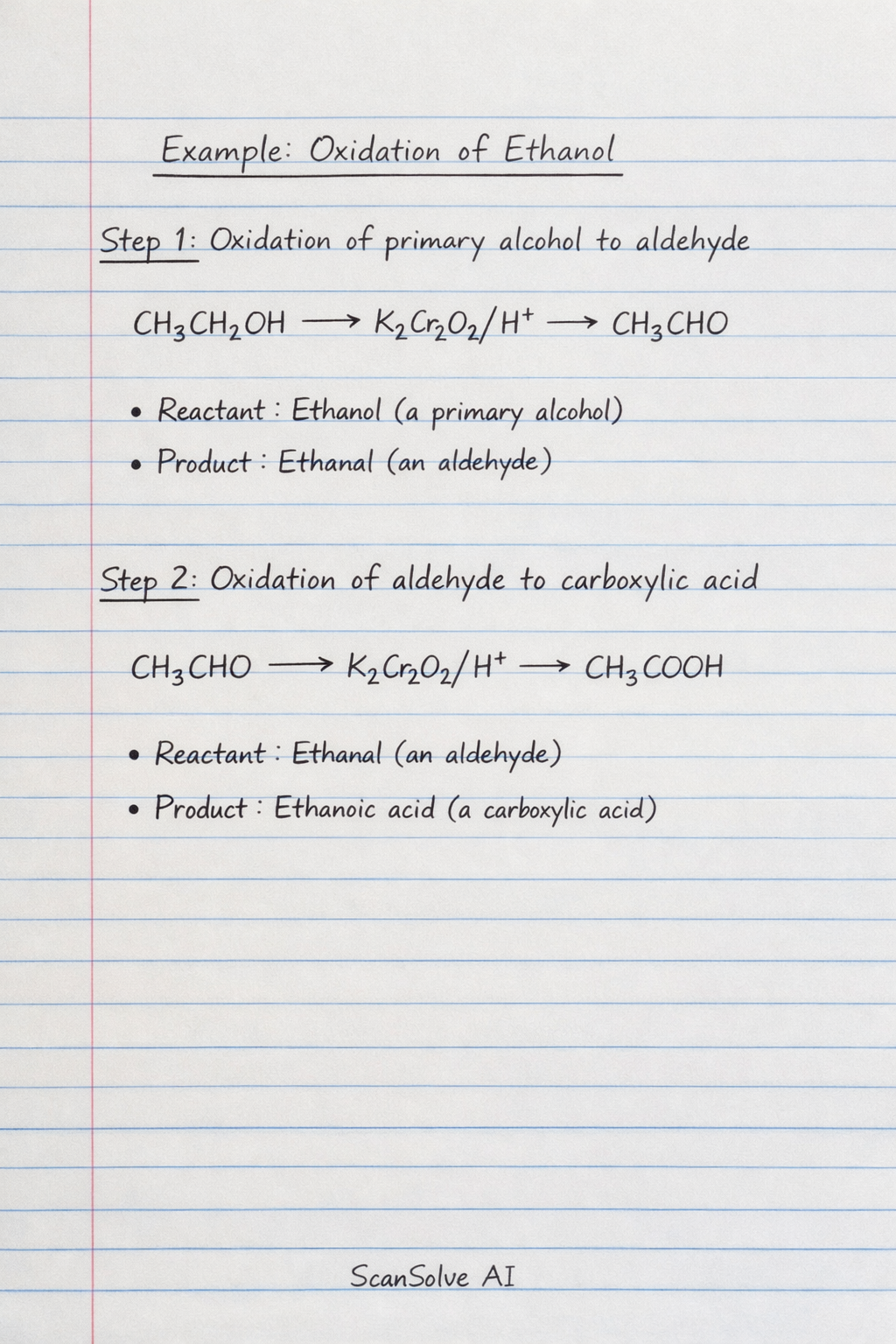
Example: Oxidation of Ethanol
When ethanol (a primary alcohol) is oxidized using a strong oxidizing agent like acidified potassium dichromate () or potassium permanganate (), it first forms ethanal (an aldehyde), which is then further oxidized to ethanoic acid (a carboxylic acid).
Oxidation of primary alcohol to aldehyde
- Reactant: Ethanol (a primary alcohol)
- Product: Ethanal (an aldehyde)
Oxidation of aldehyde to carboxylic acid
- Reactant: Ethanal (an aldehyde)
- Product: Ethanoic acid (a carboxylic acid)
Combining these, the overall reaction for the complete oxidation of ethanol to ethanoic acid is:
Was this helpful?
Try one yourself
A new problem that tests the same skill.
Still stuck on this one?
Ask a follow-up, and the answer starts from this question.
Got a different question?Ask your own question
More Chemistry Questions
QOxidation reaction of primary alcohol to aldehyde and also carboxylic acid. Send a graphical…QTo convert a primary alcohol to a carboxylic acid, a strong oxidizing agent is required. The given…QWhat organic compound class is produced when a primary alcohol undergoes a controlled, partial…QHow can prepared a named aldehyde and ketone use oxidation of alcoholQHow can you prepare a named aldehyde/ and named ketone use oxidation of alcohol
Browse by topic:Organic Chemistry
Handwritten Step-by-Step Solution
Get this as a handwritten image on WhatsApp — like a tutor wrote it for you.
Try on WhatsApp