
We read your photo as:
Oxidation: C2O4²- -> 2CO₂ + 2e^- (Charge: -2 on left, 2(0) + 2(-1) = -2 on right. Balanced.)
ScanSolve AI Answer
Step-by-step solution
3 stepsHere are the answers to your questions:
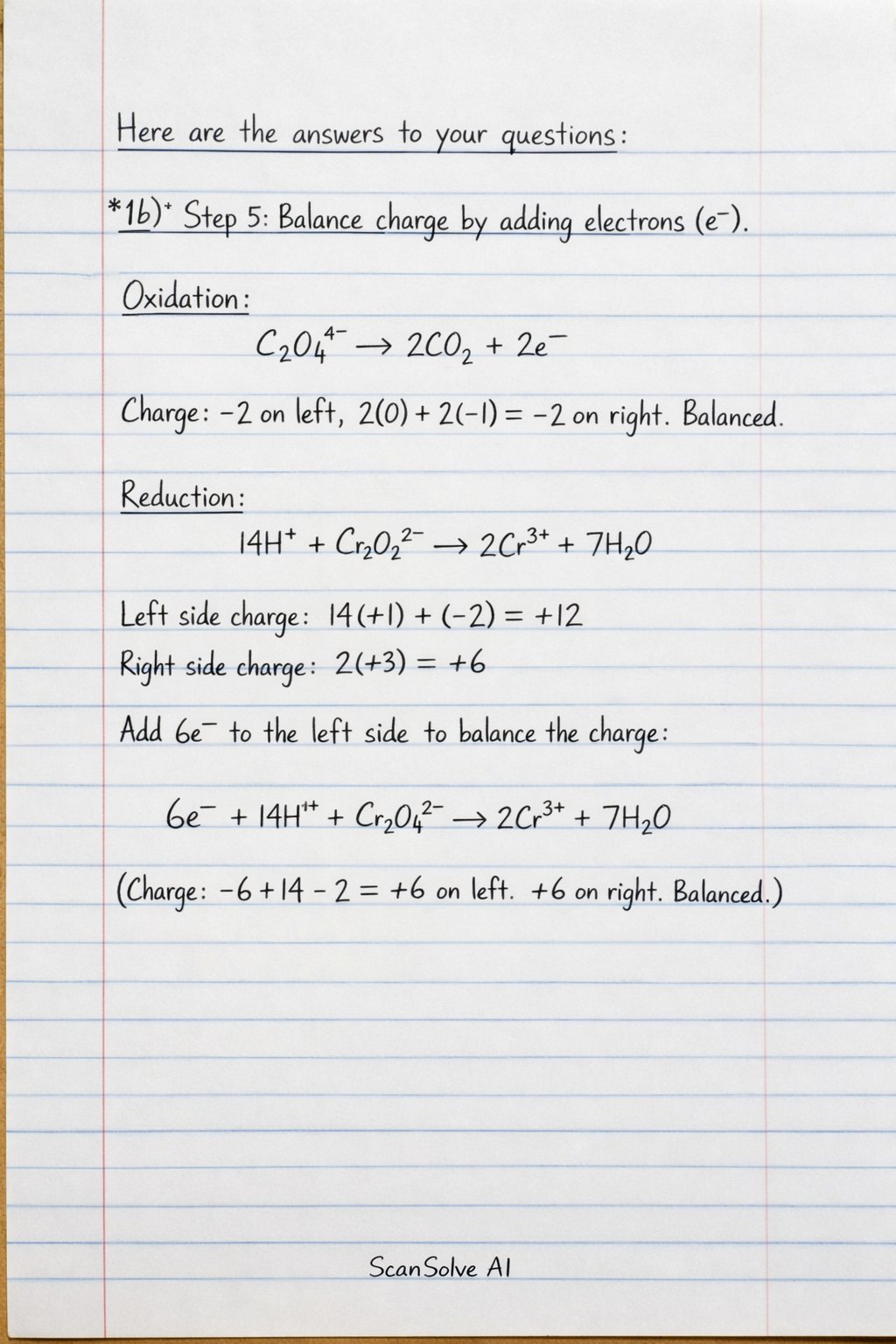
1b)
Balance charge by adding electrons ().
Oxidation: (Charge: on left, on right. Balanced.)
Reduction:
Left side charge:
Right side charge:
Add to the left side to balance the charge:
(Charge: on left. on right. Balanced.)Multiply half-reactions by appropriate factors to balance electrons.
To balance the in the oxidation half-reaction with the in the reduction half-reaction, multiply the oxidation half-reaction by 3.
Oxidation:
Reduction:Add the balanced half-reactions and cancel electrons.
The overall balanced equation is:
1bi)
- Reforming: A catalytic process in petroleum refining that converts straight-chain alkanes into branched-chain alkanes, cycloalkanes, and aromatic hydrocarbons. This process typically occurs at high temperatures and pressures with a catalyst.
- Significance: Reforming increases the octane number of gasoline, which improves its anti-knocking properties and combustion efficiency in engines. It also produces valuable aromatic compounds used as feedstocks in the petrochemical industry.
1bii) Two examples of anti-knocking agents:
- Ethanol
- Toluene
1biii)
- Amylose: A linear polysaccharide made of -D-glucose units linked by glycosidic bonds. It forms a helical structure and is less soluble in water.
- Amylopectin: A branched polysaccharide made of -D-glucose units linked by glycosidic bonds in the main chain and glycosidic bonds at the branch points. It is highly branched and more soluble in water.
2ai)
Periodic property: A chemical or physical property of elements that shows a repeating trend or pattern when the elements are arranged in order of increasing atomic number.2aii) Four periodic properties:
- Atomic radius
- Ionization energy
- Electron affinity
- Electronegativity
2aiii)
Representative elements (or main group elements): Elements found in the s-block and p-block of the periodic table. Their valence electrons are in the s and p orbitals.2bi) Four components of glass:
- Silicon dioxide ()
- Sodium carbonate ()
- Calcium carbonate ()
- Magnesium oxide ()
2bii)
Glass is not considered a true solid because it lacks the long-range ordered crystalline structure of true solids. Instead, it is an amorphous solid or supercooled liquid, where its atoms are arranged randomly but are frozen in place, giving it rigidity. It softens gradually over a temperature range rather than having a distinct melting point.2biii) Two uses of glass:
- Windows and architectural glazing
- Containers (e.g., bottles, jars)
3a)
- Thermoplastic polymers: Polymers that can be repeatedly softened by heating and hardened by cooling. Their polymer chains are held by weak intermolecular forces, allowing them to be reshaped.
- Example: Polyethylene
- Thermosetting polymers: Polymers that undergo irreversible chemical changes upon heating, forming a rigid, cross-linked network structure. Once cured, they cannot be softened or reshaped.
- Example: Bakelite
3b)
Synthetic polymer: A polymer that is man-made, typically synthesized from smaller monomer units through chemical reactions in a laboratory or industrial setting.
Example: Nylon
Still stuck on this one?
Ask a follow-up, and the answer starts from this question.
More Chemistry Questions
Handwritten Step-by-Step Solution
Get this as a handwritten image on WhatsApp — like a tutor wrote it for you.
Try on WhatsApp