
We read your photo as:
Calculate the percentage of water of hydration in a hydrated salt B, assuming it is sodium carbonate decahydrate, given relevant information likely provided earlier in the exam.
ScanSolve AI Answer
Answer
Step-by-step solution
5 stepsTo solve these questions, I need some information that was likely provided in earlier parts of the exam paper, specifically the formula of the hydrated salt B and the concentration of acid A. Since these are not in the current image, I will make reasonable assumptions based on typical WASSCE Chemistry practicals to demonstrate the calculation method.
Assumptions:
- For part (ii), I will assume that the hydrated salt B is sodium carbonate decahydrate (), as its anhydrous form () has a molar mass of .
- For part (iii), I will use the average titre value of acid A as (from our previous hypothetical calculation). I will also assume that acid A is a monoprotic acid (e.g., HCl) and its concentration is , which is a common concentration in such experiments.
Part ii· 3 steps
percentage of water of hydration in B;
Determine the molar mass of water of hydration.
The molar mass of water () is .
For , the molar mass of water of hydration is .Determine the molar mass of the hydrated salt B.
The molar mass of anhydrous salt B () is given as .
The molar mass of the hydrated salt B () is the sum of the molar mass of the anhydrous salt and the molar mass of the water of hydration.Calculate the percentage of water of hydration.
Part iii· 2 steps
number of moles of hydrogen ions in the average titre value.
Convert the average titre volume to .
The average titre value of acid A is .
Calculate the number of moles of acid A.
Using the assumed concentration of acid A as $0.100 \text{ mol
Try one yourself
A new problem that tests the same skill.
Still stuck on this one?
Ask a follow-up, and the answer starts from this question.
More Chemistry Questions
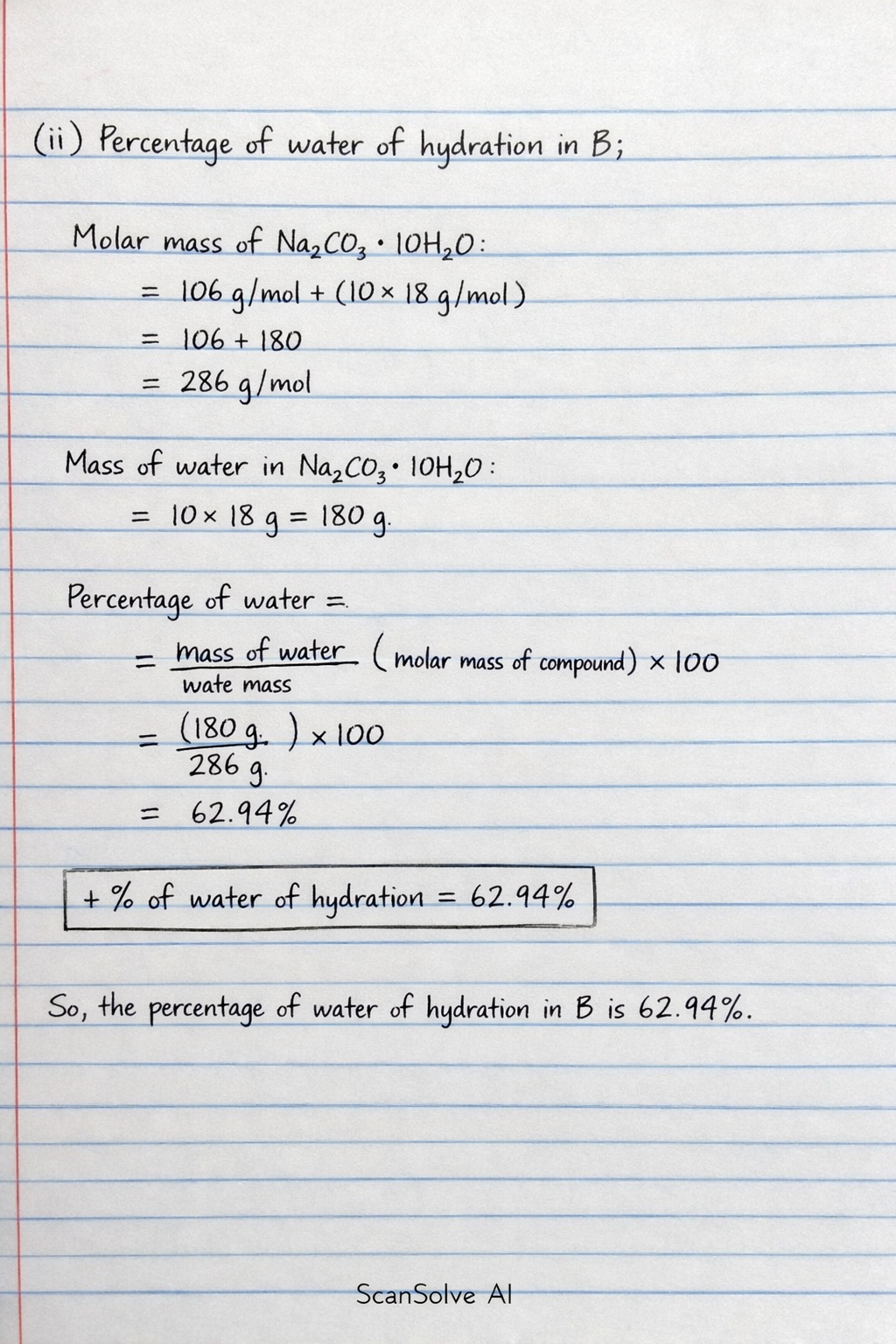
Handwritten Step-by-Step Solution
Get this as a handwritten image on WhatsApp — like a tutor wrote it for you.
Try on WhatsApp