
We read your photo as:
Present the structure of vitamin C, explain accuracy with reference to a weighing balance, and define calibration.
ScanSolve AI Answer
Here are the answers to the questions from the exam paper:
Question 3
-
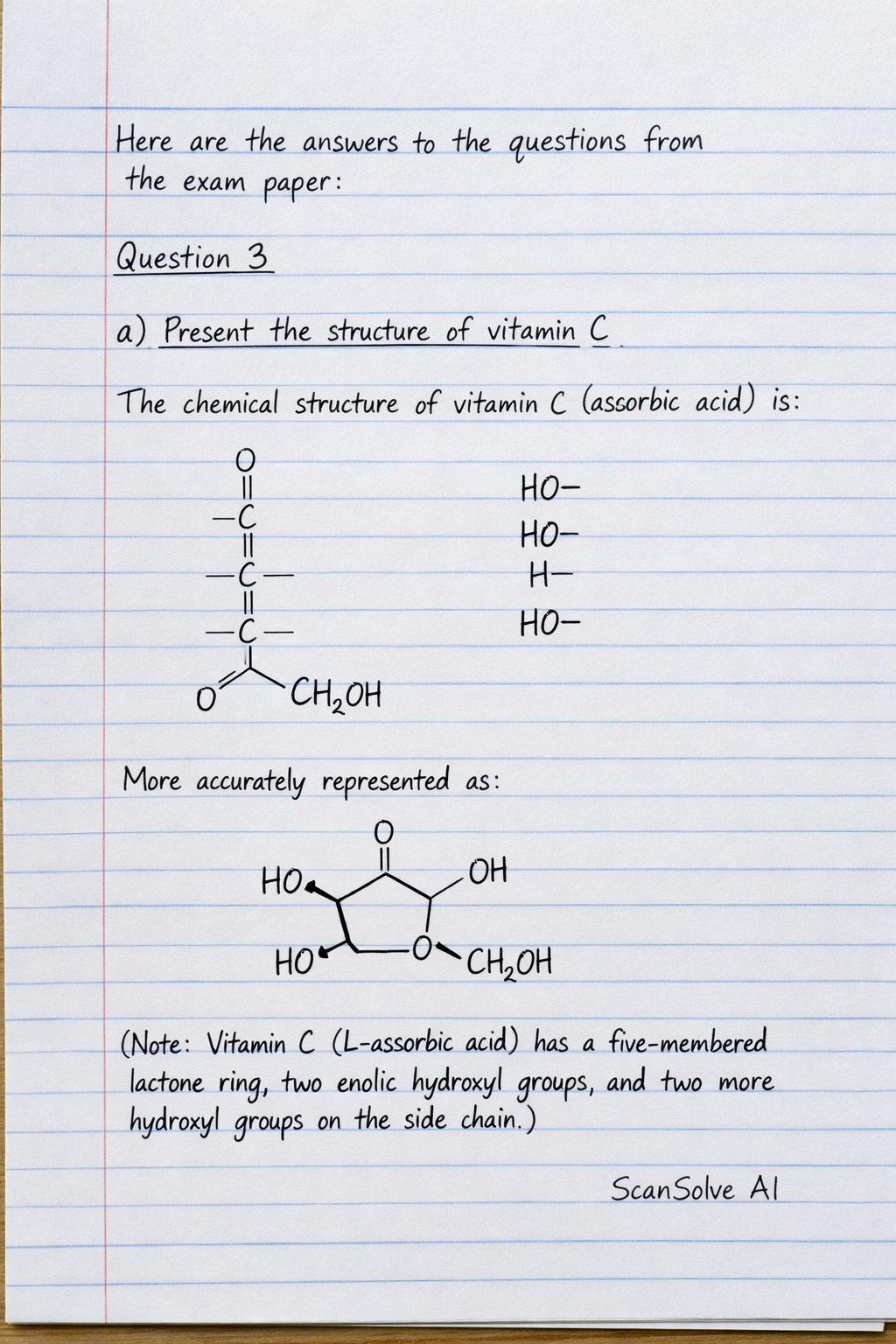
a) Present the structure of vitamin C The chemical structure of vitamin C (ascorbic acid) is:
More accurately represented as:
\begin{center}
\includegraphics[width=0.3\textwidth]{ascorbic_acid_structure.png}
\end{center}
(Note: As an AI, I cannot directly draw complex chemical structures. The image above represents the structure of L-ascorbic acid, which is vitamin C. Key features include a five-membered lactone ring, two enolic hydroxyl groups, and two more hydroxyl groups on the side chain.)
-
b) Explain the term accuracy with reference to weighing balance Accuracy, in the context of a weighing balance, refers to how close a measured weight is to the true or actual weight of an object. A highly accurate balance provides readings that are very close to the accepted standard value.
-
c) Define calibration Calibration is the process of comparing the readings of a measuring instrument (like a weighing balance) against a known standard to ensure its accuracy. It involves adjusting the instrument to minimize any deviation from the true values.
-
d) The heaviest load that can be measured on the instrument is called? The heaviest load that can be measured on an instrument is called its capacity or maximum load.
Question 4
-
a) Differentiate between precision and readability?
- Precision refers to the reproducibility of measurements, meaning how close repeated measurements are to each other, regardless of their closeness to the true value.
- Readability refers to the smallest increment of weight that a balance can display. It indicates the resolution of the balance, for example, 0.0001 g.
-
b) The act of removing a known weight of an object (usually the weighing container) to zero a scale. This means that the final reading will be of the material to be weighed and will not reflect the weight of the container. Most balances allow taring to 100% of capacity. This process is called? This process is called taring or tare compensation.
-
c) Why is it necessary not to handle objects to be weighed with bare hands. It is necessary not to handle objects to be weighed with bare hands because oils, moisture, and dirt from the skin can transfer to the object, adding extra weight and leading to inaccurate measurements. Additionally, body heat can affect the air currents around the balance pan, causing fluctuations in readings.
-
d) There are four types of burette designs. Name any two. Two types of burette designs are:
- Mohr burette (or pinchcock burette)
- Stopcock burette (or glass stopcock burette, or Teflon stopcock burette)
Still stuck on this one?
Ask a follow-up, and the answer starts from this question.
More Chemistry Questions
Handwritten Step-by-Step Solution
Get this as a handwritten image on WhatsApp — like a tutor wrote it for you.
Try on WhatsApp