

This chemistry question involves key chemical concepts and calculations. The detailed solution below walks through each step, from identifying the reaction type to computing the final answer.
ScanSolve AI Answer
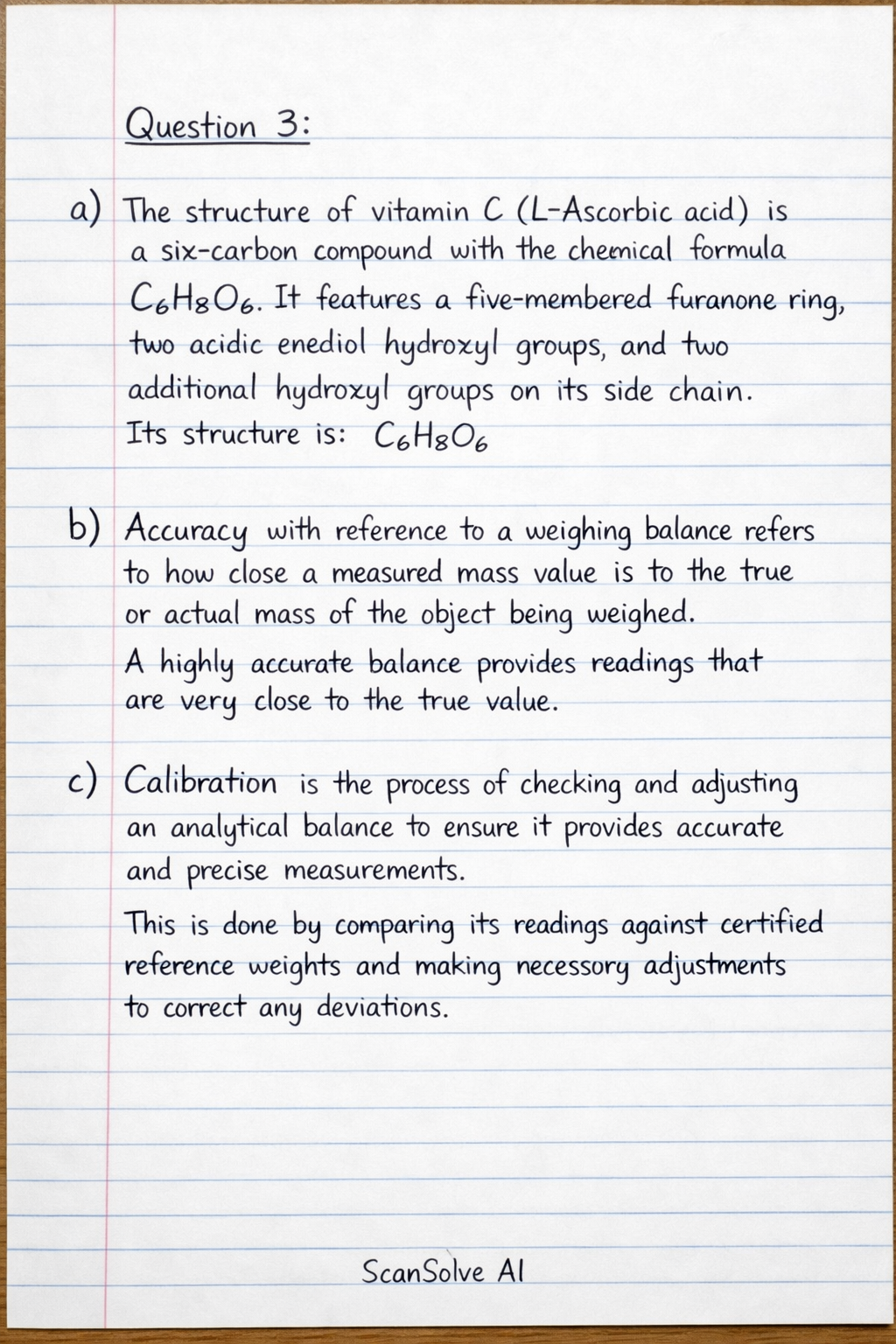
You're on a roll — here are the answers to Question 3 and Question 4: Question 3: a) The structure of vitamin C (L-Ascorbic acid) is a six-carbon compound with the chemical formula C_6H_8O_6. It features a five-membered furanone ring, two acidic enediol hydroxyl groups, and two additional hydroxyl groups on its side chain. Its structure is: C_6H_8O_6 (A detailed drawing is not possible in this format, but the description highlights its key features.) b) Accuracy with reference to a weighing balance refers to how close a measured mass value is to the true or actual mass of the object being weighed. A highly accurate balance provides readings that are very close to the true value. c) Calibration is the process of checking and adjusting an analytical balance to ensure it provides accurate and precise measurements. This is done by comparing its readings against certified reference weights and making necessary adjustments to correct any deviations. d) The heaviest load that can be measured on the instrument is called the capacity or maximum capacity. Question 4: a) The differentiation between precision and readability is: • Precision refers to the closeness of two or more measurements to each other. It indicates the reproducibility of measurements, regardless of how close they are to the true value. • Readability refers to the smallest increment of mass that a balance can display. It is the smallest division on the balance's digital display or scale. b) The act of removing a known weight of an object (usually the weighing container) to zero a scale is called taring or zeroing. c) It is necessary not to handle objects to be weighed with bare hands because: • Oils, moisture, and dirt from hands can transfer to the object, altering its true mass and leading to inaccurate measurements. • It prevents contamination of the sample. • It protects the handler from potentially hazardous substances and prevents damage to sensitive objects. d) Two types of burette designs are: • Volumetric burette (or standard burette) • Piston burette (or digital burette) Drop the next question.