

This chemistry question involves key chemical concepts and calculations. The detailed solution below walks through each step, from identifying the reaction type to computing the final answer.
ScanSolve AI Answer
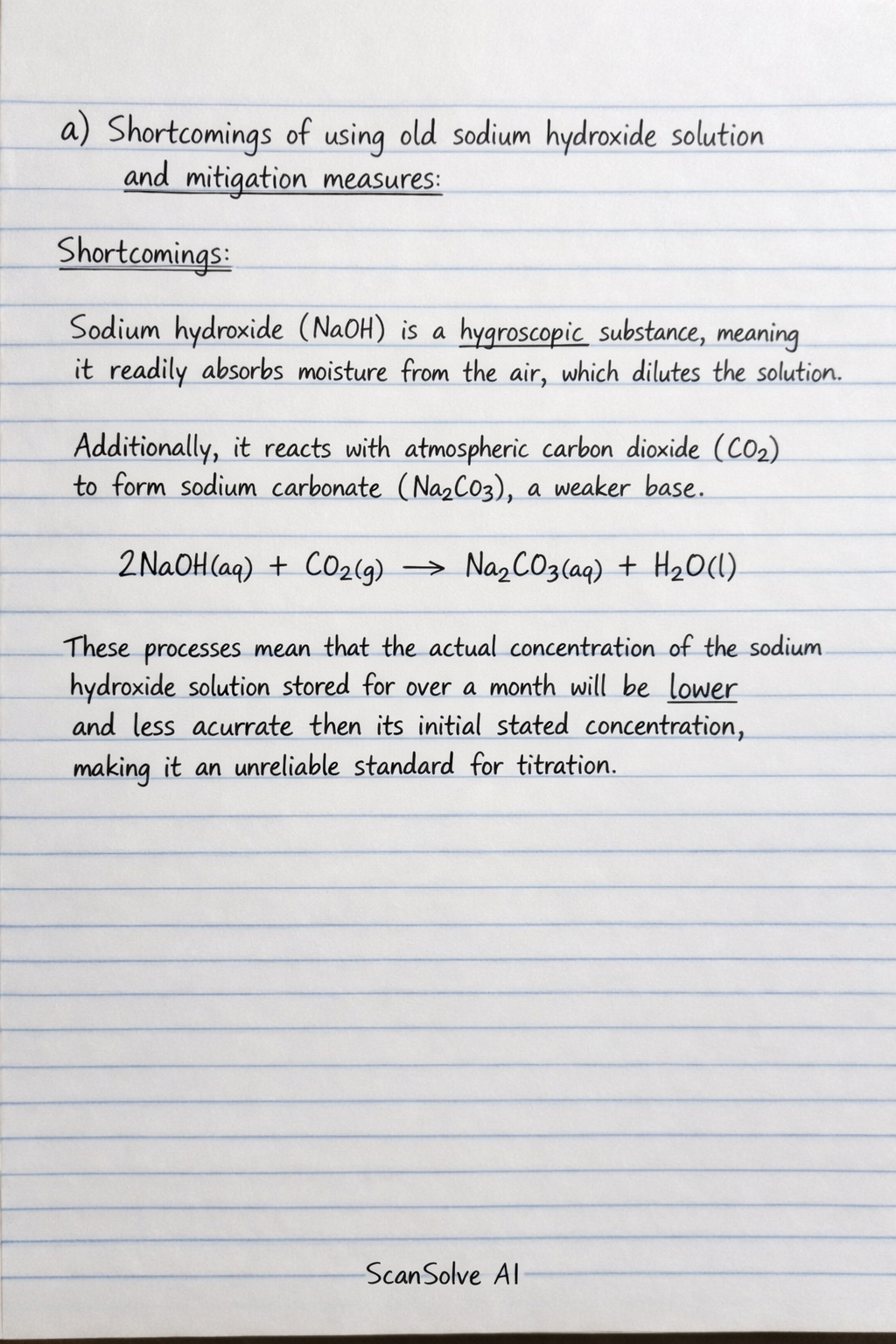
a) Shortcomings of using old sodium hydroxide solution and mitigation measures Shortcomings: Sodium hydroxide (NaOH) is a hygroscopic substance, meaning it readily absorbs moisture from the air, which dilutes the solution. Additionally, it reacts with atmospheric carbon dioxide (CO_2) to form sodium carbonate (Na_2CO_3), a weaker base. 2NaOH(aq) + CO_2(g) → Na_2CO_3(aq) + H_2O(l) These processes mean that the actual concentration of the sodium hydroxide solution stored for over a month will be lower and less accurate than its initial stated concentration, making it an unreliable standard for titration. Mitigation measures: • Standardize the NaOH solution: Before using it to titrate the vinegar, the sodium hydroxide solution should first be standardized against a primary standard (e.g., potassium hydrogen phthalate or oxalic acid) to determine its exact current concentration. • Proper storage: Store sodium hydroxide solutions in tightly sealed, airtight containers to minimize exposure to atmospheric moisture and carbon dioxide. b) Assessment of the accuracy of the labels on the vinegar cans To assess the accuracy, we will calculate the actual concentration of the ethanoic acid (vinegar) using the titration data and compare it to the labeled concentration. The balanced chemical equation for the reaction between ethanoic acid (CH_3COOH) and sodium hydroxide (NaOH) is: CH_3COOH(aq) + NaOH(aq) → CH_3COONa(aq) + H_2O(l) The stoichiometry is 1:1. Given data: Volume of NaOH solution (V_b) = 25.0 cm^3 = 0.0250 L Concentration of NaOH solution (C_b) = 0.025 M Volume of vinegar solution (V_a) = 18.60 cm^3 = 0.01860 L Labeled concentration of vinegar = 0.05 M Step 1: Calculate the moles of NaOH used. Moles of NaOH = C_b × V_b Moles of NaOH = 0.025 M × 0.0250 L = 0.000625 mol Step 2: Determine the moles of ethanoic acid reacted. Since the reaction is 1:1, the moles of ethanoic acid are equal to the moles of NaOH. Moles of CH_3COOH = 0.000625 mol Step 3: Calculate the actual concentration of the ethanoic acid (vinegar). Concentration of CH_3COOH (C_a) = Moles of CH_3COOHV_a C_a = 0.000625 mol0.01860 L = 0.03360215... M Rounding to two significant figures (limited by the concentration of NaOH): C_a ≈ 0.034 M Step 4: Assess the accuracy of the label. The calculated concentration of the vinegar is 0.034 M. The labeled concentration is 0.05 M. To assess accuracy, we can calculate the percentage difference: Percentage Difference = |Calculated Concentration - Labeled Concentration|Labeled Concentration × 100\% Percentage Difference = |0.034 M - 0.05 M|0.05 M × 100\% Percentage Difference = 0.016 M0.05 M × 100\% = 0.32 × 100\% = 32\% The calculated concentration (0.034 M) is significantly lower than the labeled concentration (0.05 M), with a difference of 32\%. Therefore, the labels on the vinegar cans are inaccurate. Send me the next one 📸