
We read your photo as:
Which process is used to manufacture alkenes, and what is the term for species formed and consumed during a reaction pathway but not in the overall equation?
ScanSolve AI Answer
Answer
Step-by-step solution
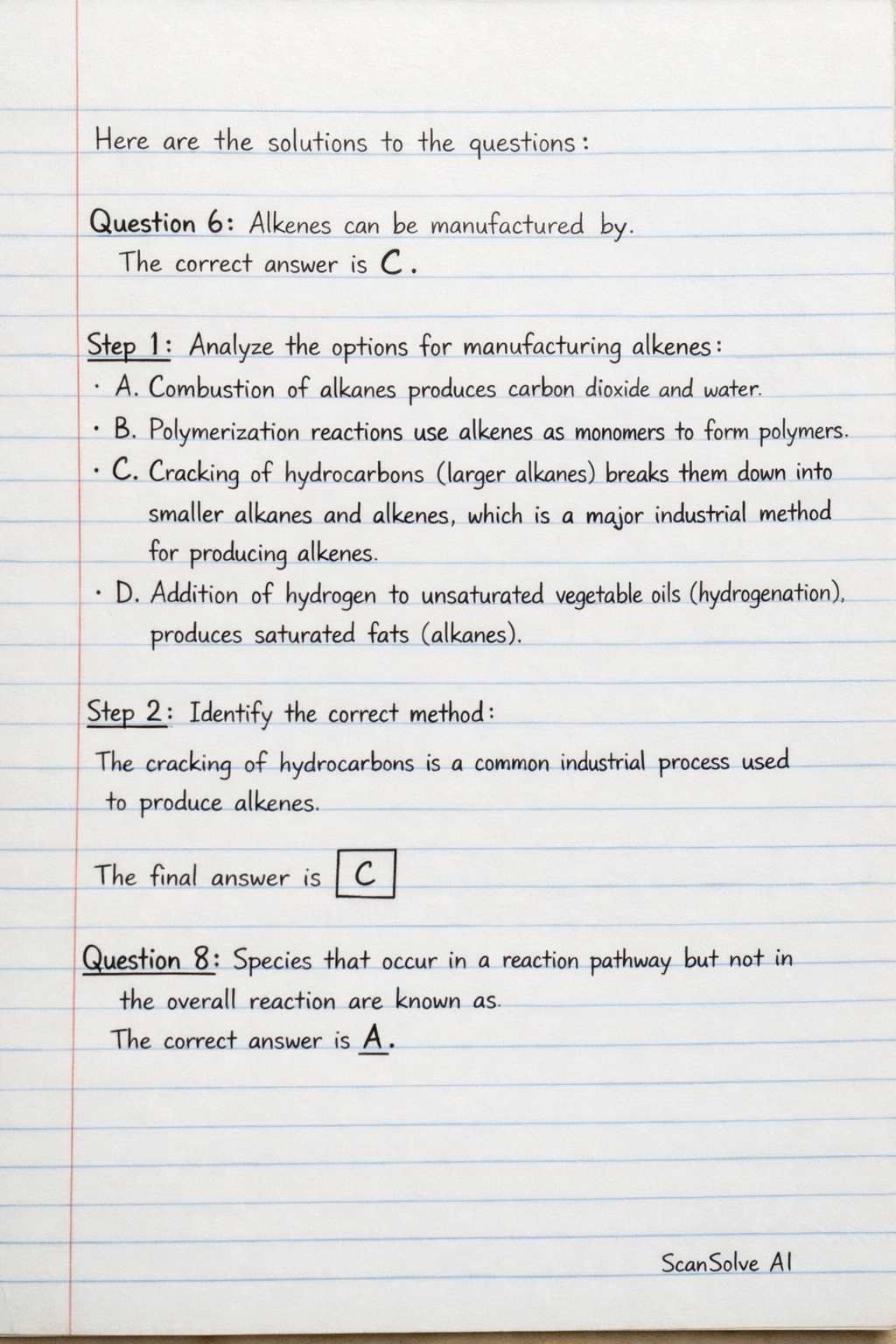
11 stepsHere are the solutions to the questions:
Part 6· 2 steps
Alkenes can be manufactured by
The correct answer is C.
Analyze the options for manufacturing alkenes.
- A. Combustion of alkanes produces carbon dioxide and water.
- B. Polymerization reactions use alkenes as monomers to form polymers.
- C. Cracking of hydrocarbons (larger alkanes) breaks them down into smaller alkanes and alkenes, which is a major industrial method for producing alkenes.
- D. Addition of hydrogen to unsaturated vegetable oils (hydrogenation) produces saturated fats (alkanes).
Identify the correct method.
The cracking of hydrocarbons is a common industrial process used to produce alkenes.
The final answer is
Part 8· 2 steps
Species that occur in a reaction pathway but not in the overall reaction are known as
The correct answer is A.
Understand the definition of reaction species.
- Intermediates are chemical species that are formed in one step of a reaction mechanism and consumed in a subsequent step. They do not appear in the overall balanced chemical equation.
- Reactants are the starting materials that are consumed in the overall reaction.
- Inhibitors slow down reactions but are not necessarily formed and consumed within the pathway.
- Products are the substances formed at the end of the overall reaction.
Match the definition to the options.
The description perfectly fits the definition of an intermediate.
The final answer is
Part 9· 1 step
Which of the following statements is correct?
The correct answer is D.
Evaluate each statement.
- A. Pentane (CH) has 3 structural isomers: n-pentane, isopentane (2-methylbutane), and neopentane (2,2-dimethylpropane). So, the statement "Pentane has five isomers" is incorrect.
- B. Butane (CH) has a higher molecular weight than propane (CH). For alkanes, boiling points generally increase with increasing molecular weight due to stronger London dispersion forces. Therefore, butane has a higher boiling point than propane. This statement is incorrect.
- C. Alkanes undergo substitution reactions with halogens (like chlorine) in the presence of UV light, not addition reactions. Addition reactions are characteristic of unsaturated compounds like alkenes and alkynes. This statement is incorrect.
- D. The general formula for an alkane is CH. For an alkane with 49 carbon atoms (n=49), the number of hydrogen atoms is . This statement is correct.
The final answer is
Part 10· 3 steps
The best indicator to use for the titration of ethanoic acid with sodium hydroxide is
The correct answer is B.
Identify the nature of the acid and base.
- Ethanoic acid (CHCOOH) is a weak acid.
- Sodium hydroxide (NaOH) is a strong base.
Determine the pH at the equivalence point.
The titration of a weak acid with a strong base results in an equivalence point that is in the basic region (pH > 7).
Select an indicator suitable for the equivalence point pH.
- Phenolphthalein changes color in the pH range of approximately 8.2-10.0, which is suitable for a basic equivalence point.
- Methyl orange (pH 3.1-4.4), screened methyl orange (pH ~3.2-4.2), and methyl red (pH 4.4-6.2) change color in the acidic range, making them unsuitable for this titration.
The final answer is
Part 11· 3 steps
The reduction half equation of the following reaction is
The correct answer is C.
Determine the oxidation states of the elements involved.
In the reaction:
- Zinc (Zn) goes from an oxidation state of 0 in to +2 in (). This is oxidation (loss of electrons).
- Copper (Cu) goes from an oxidation state of +2 in () to 0 in . This is reduction (gain of electrons).
Write the reduction half-equation.
Reduction involves the gain of electrons. The copper ion gains electrons to become neutral copper metal . To balance the charge, two electrons are needed.
Compare with the given options.
Option C matches the derived reduction half-equation.
- Option A is a dissolution equation.
- Option B shows only one electron gained, which is incorrect for to .
- Option D is the oxidation half-equation for zinc.
The final answer is
Try one yourself
A new problem that tests the same skill.
Still stuck on this one?
Ask a follow-up, and the answer starts from this question.
More Chemistry Questions
Handwritten Step-by-Step Solution
Get this as a handwritten image on WhatsApp — like a tutor wrote it for you.
Try on WhatsApp