

This chemistry question involves key chemical concepts and calculations. The detailed solution below walks through each step, from identifying the reaction type to computing the final answer.
ScanSolve AI Answer
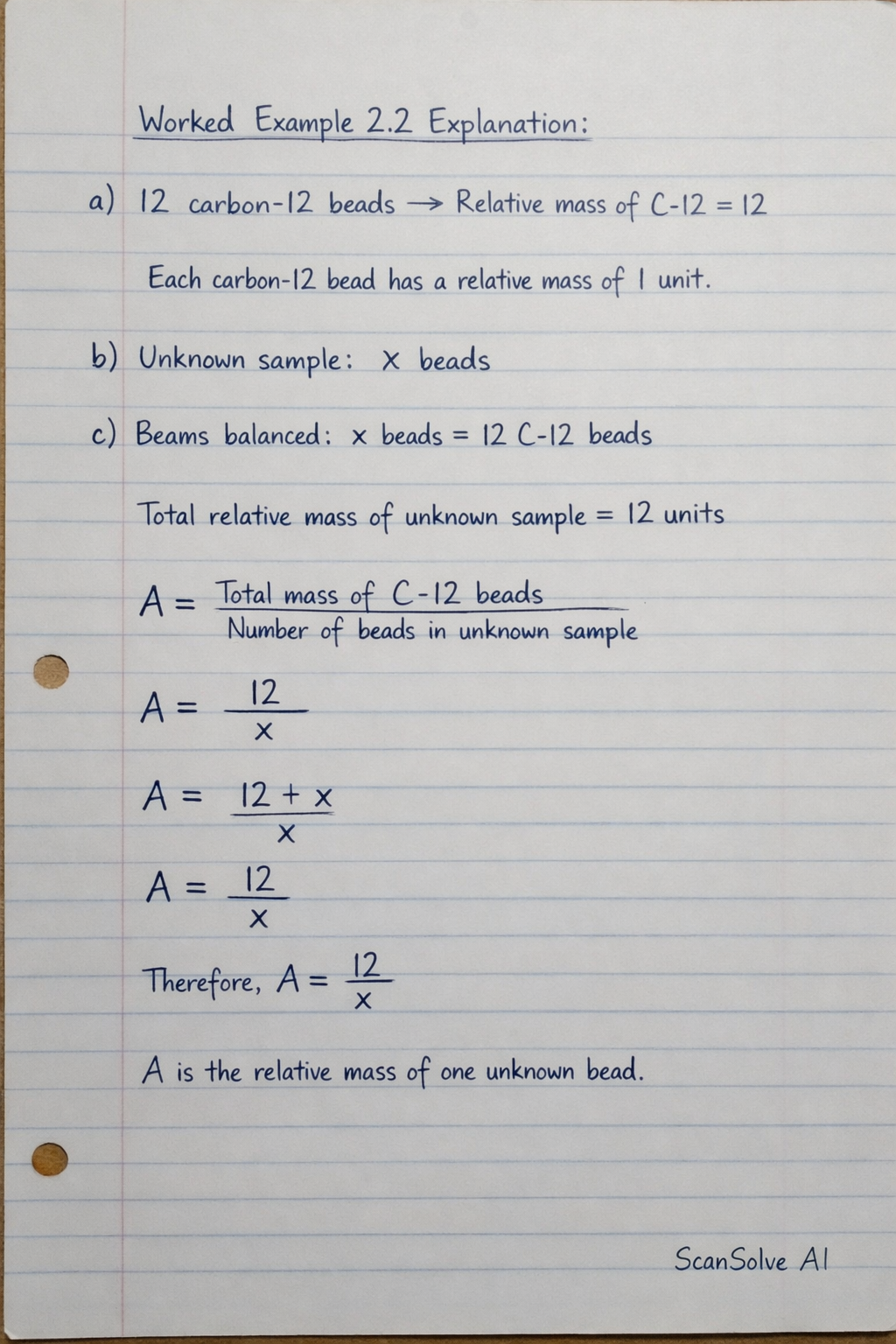
Here's an explanation of the concepts and calculations from the image. The "Worked Example 2.2" illustrates how to determine the relative mass of an unknown substance using a beam balance, comparing it to a carbon-12 sample. Worked Example 2.2 Explanation: The example uses an analogy with beads. a)* A carbon-12 sample is represented by 12 beads. By definition, carbon-12 has a relative atomic mass of 12. This implies that each carbon-12 bead in this analogy has a relative mass of 1 unit. b)* An unknown sample is represented by x beads. c)* To find the relative mass of the unknown sample, the example assumes that x beads of the unknown sample have the same total mass as the 12 carbon-12 beads when balanced. Therefore, the total relative mass of the x unknown beads is 12 units. The formula A = (12)/(Number of beads in unknown sample) = (12)/(x) = y calculates the relative mass per bead of the unknown sample. So, y represents the relative mass of one bead of the unknown substance. Activity 2.2: Understanding relative molecular mass Relative molecular mass (M_r) is the sum of the relative atomic masses (A_r) of all the atoms in a molecule. We will use the approximate relative atomic masses: Hydrogen (H) ≈ 1.0, Carbon (C) ≈ 12.0, and Oxygen (O) ≈ 16.0. 1) For Water (H_2O): Step 1: Identify the atoms and their quantities. The molecule H_2O contains 2 hydrogen atoms and 1 oxygen atom. Step 2: List the relative atomic masses. A_r(H) = 1.0 A_r(O) = 16.0 Step 3: Calculate the relative molecular mass. M_r(H_2O) = (2 × A_r(H)) + (1 × A_r(O)) M_r(H_2O) = (2 × 1.0) + (1 × 16.0) M_r(H_2O) = 2.0 + 16.0 M_r(H_2O) = 18.0 The relative molecular mass of water is 18.0. 2) For Carbon Dioxide (CO_2): Step 1: Identify the atoms and their quantities. The molecule CO_2 contains 1 carbon atom and 2 oxygen atoms. Step 2: List the relative atomic masses. A_r(C) = 12.0 A_r(O) = 16.0 Step 3: Calculate the relative molecular mass. M_r(CO_2) = (1 × A_r(C)) + (2 × A_r(O)) M_r(CO_2) = (1 × 12.0) + (2 × 16.0) M_r(CO_2) = 12.0 + 32.0 M_r(CO_2) = 44.0 The relative molecular mass of carbon dioxide is 44.0. 3) For Methane (CH_4): Step 1: Identify the atoms and their quantities. The molecule CH_4 contains 1 carbon atom and 4 hydrogen atoms. Step 2: List the relative atomic masses. A_r(C) = 12.0 A_r(H) = 1.0 Step 3: Calculate the relative molecular mass. M_r(CH_4) = (1 × A_r(C)) + (4 × A_r(H)) M_r(CH_4) = (1 × 12.0) + (4 × 1.0) M_r(CH_4) = 12.0 + 4.0 M_r(CH_4) = 16.0 The relative molecular mass of methane is 16.0.