
This chemistry question involves key chemical concepts and calculations. The detailed solution below walks through each step, from identifying the reaction type to computing the final answer.
ScanSolve AI Answer
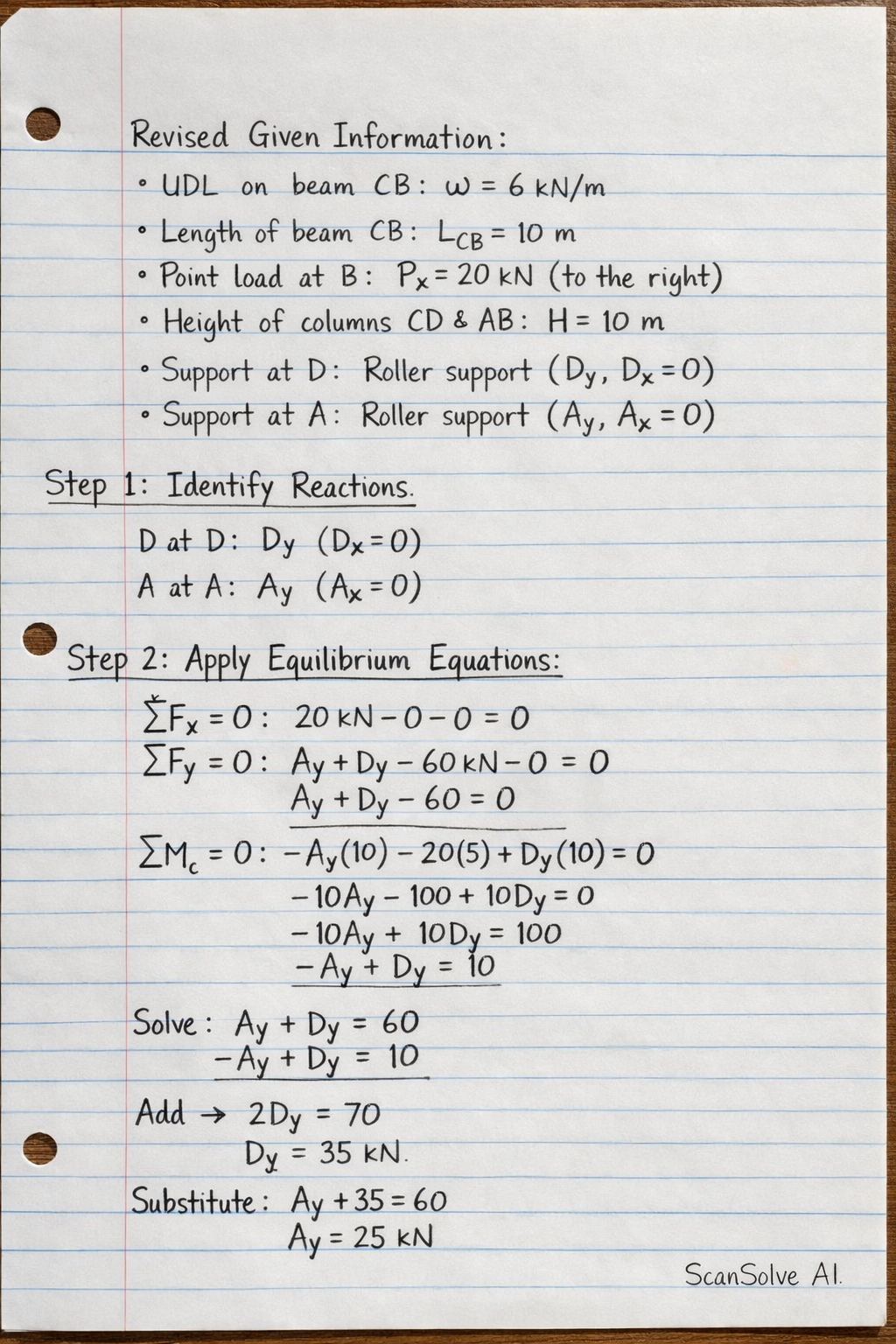
You are correct to point out that if D is a roller support, then its horizontal reaction D_x is zero. Let's re-evaluate the support reactions with this corrected information. Revised Given Information: Uniformly distributed load (UDL) on beam CB: w = 6 KN/m Length of beam CB: L_CB = 10 m Horizontal point load at B: P_x = 20 KN (acting to the right) Height of columns CD and AB: H = 10 m Support at D: Roller support (resists vertical force D_y, but D_x = 0) Support at A: Roller support (resists vertical force A_y, but A_x = 0) Step 1: Identify Reactions At roller support D: Vertical reaction D_y. (Horizontal reaction D_x = 0). At roller support A: Vertical reaction A_y. (Horizontal reaction A_x = 0). Step 2: Apply Equilibrium Equations 1. Sum of horizontal forces ( F_x = 0): Assume forces to the right are positive. The only horizontal force applied to the frame is the 20 KN load at B. Since both supports A and D are roller supports, they cannot provide any horizontal reaction. F_x = 20 KN = 0 This equation is a contradiction (20 KN ≠ 0). Conclusion: If both supports A and D are roller supports, the structure cannot resist the 20 KN horizontal load applied at B. This means the frame is unstable under this loading condition and cannot be in static equilibrium. Therefore, it is not possible to calculate the support reactions A_y and D_y under the assumption of static equilibrium with these support conditions and the given horizontal load. To proceed with a stable structure, one of the following would typically be required: Support D is a pin support* (as it appears in the original image), which can provide a horizontal reaction D_x. The horizontal load of 20 KN is not present or is resisted by another mechanism not shown. Please clarify the support conditions or if there's an alternative interpretation for the horizontal load.