
We read your photo as:
Which statements about alkanes are correct? 1. Alkanes are polar and soluble in water. 2. Boiling points increase with molecular weight. 3. Branched alkanes have lower boiling points than straight-cha
ScanSolve AI Answer
Answer
Step-by-step solution
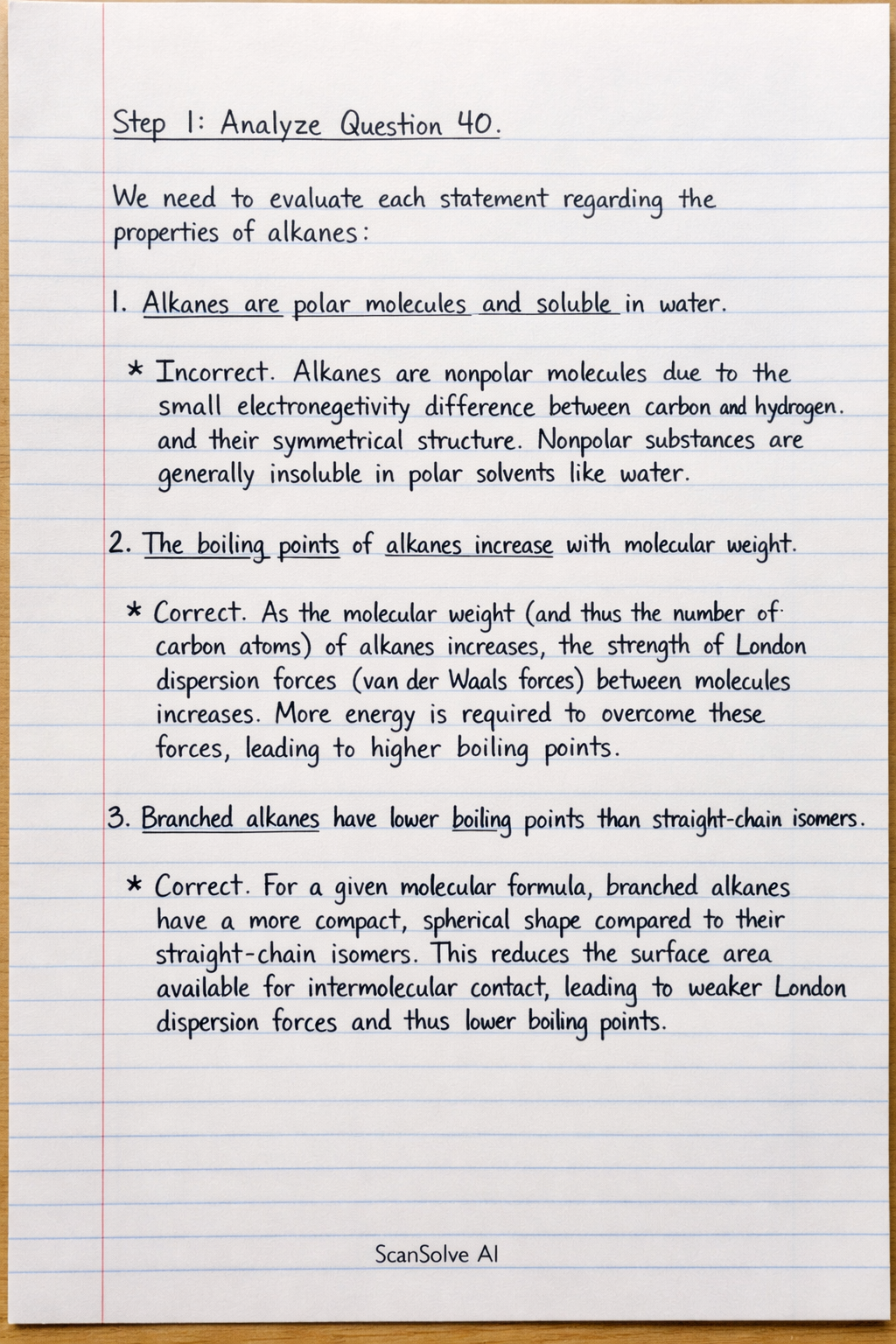
4 stepsAnalyze Question 40.
We need to evaluate each statement regarding the properties of alkanes:
- Alkanes are polar molecules and soluble in water.
- Incorrect. Alkanes are nonpolar molecules due to the small electronegativity difference between carbon and hydrogen and their symmetrical structure. Nonpolar substances are generally insoluble in polar solvents like water.
- The boiling points of alkanes increase with molecular weight.
- Correct. As the molecular weight (and thus the number of carbon atoms) of alkanes increases, the strength of London dispersion forces (van der Waals forces) between molecules increases. More energy is required to overcome these forces, leading to higher boiling points.
- Branched alkanes have lower boiling points than straight-chain isomers.
- Correct. For a given molecular formula, branched alkanes have a more compact, spherical shape compared to their straight-chain isomers. This reduces the surface area available for intermolecular contact, leading to weaker London dispersion forces and thus lower boiling points.
Statements 2 and 3 are correct. Assuming the options follow a standard format where C represents statements 2 and 3, the correct option is C.
- Alkanes are polar molecules and soluble in water.
Analyze Question 41.
We need to select the correct statement(s) below in relation to the structure of atoms:
- Protons and neutrons are found in the nucleus.
- Correct. The nucleus of an atom contains protons (positively charged) and neutrons (no charge).
- Electrons have a negative charge and negligible mass.
- Correct. Electrons are negatively charged and have a mass much smaller than protons and neutrons (approximately of a proton's mass), often considered negligible in atomic mass calculations.
- The atomic number equals the number of neutrons.
- Incorrect. The atomic number (Z) equals the number of protons in an atom. The mass number (A) equals the sum of protons and neutrons. The number of neutrons can vary for isotopes of the same element.
Statements 1 and 2 are correct. Assuming the options follow a standard format where B represents statements 1 and 2, the correct option is B.
- Protons and neutrons are found in the nucleus.
Analyze Question 42.
We need to determine what X-ray diffraction can be used for:
- Crystal structure
- Correct. X-ray diffraction (XRD) is a primary technique for determining the overall crystal structure of materials.
- Lattice parameters
- Correct. XRD patterns allow for the precise calculation of lattice parameters (the dimensions and angles of the unit cell).
- Positions of atoms within the unit cell
- Correct. By analyzing the intensities of the diffracted X-rays, the electron density distribution within the unit cell can be mapped, which reveals the positions of atoms.
Statements 1, 2, and 3 are all correct. Assuming the options follow a standard format where A represents statements 1, 2, and 3, the correct option is A.
- Crystal structure
Analyze Question 43.
We need to evaluate each statement about s-block elements (Group 1 and Group 2 metals):
- They form basic oxides.
- Correct. s-block metals are highly electropositive and react with oxygen to form oxides that are typically basic (e.g., , ). These oxides react with water to form hydroxides (bases).
- They have low ionization energy.
- Correct. s-block elements have their valence electrons in the outermost s-orbital, which are relatively easy to remove due to their large atomic radii and effective shielding. This results in low ionization energies.
- They are poor conductors of electricity.
- Incorrect. s-block elements are metals. Metals are generally excellent conductors of electricity due to the presence of delocalized valence electrons.
Statements 1 and 2 are correct. Assuming the options follow a standard format where B represents statements 1 and 2, the correct option is B.
- They form basic oxides.
Try one yourself
A new problem that tests the same skill.
Still stuck on this one?
Ask a follow-up, and the answer starts from this question.
More Chemistry Questions
Handwritten Step-by-Step Solution
Get this as a handwritten image on WhatsApp — like a tutor wrote it for you.
Try on WhatsApp