
We read your photo as:
What are the definitions of chemistry, its branches, saturated/unsaturated solutions, and geothermal heat pumps, and the state of matter in the sun?
ScanSolve AI Answer
Here are the answers to the questions:
SHORT QUESTIONS
Q1: What is Chemistry?
Chemistry is the branch of science that deals with the properties, composition, and structure of substances. Alternatively, it is the study of earth (solids), air (gases), sea (liquids), and sky (plasma) and their interactions.
Q2: Name different branches of chemistry.
The different branches of chemistry are:
- i) Physical chemistry
- ii) Inorganic chemistry
- iii) Organic chemistry
- iv) Environmental chemistry
- v) Analytical chemistry
- vi) Biochemistry
- vii) Nuclear chemistry
- viii) Polymer chemistry
Q3: What are unsaturated and saturated solutions?
- i) An unsaturated solution is a solution that can dissolve more solute at a particular (given) temperature. For example, a 2.0M solution of NaCl at room temperature is unsaturated.
- ii) A saturated solution is a solution that cannot dissolve more solute at a particular temperature. For example, a 5.3M solution of NaCl at room temperature is saturated.
Q4: What is geothermal heat pump?
A geothermal heat pump is a pump that transfers underground water into a building. During winter, it heats the building, and in summer, it cools the building.
Q5: In which state does matter exist in the sun?
Matter exists in the sun as plasma. Due to high temperatures, atoms are ionized. The plasma in the sun consists of hydrogen, helium, electrons, ions, and photons.
Q6: In what way is plasma created in a fluorescent tube?
When electricity is passed through a gas in a fluorescent tube, plasma is produced due to the ionization of gas atoms. Plasma consists of ions, electrons, and photons.
Q7: Which form of matter do most of the material things in this world belong to?
Most material things in the world belong to the solid form of matter.
Q8: Define element. Give examples.
An element is a pure substance that contains the same kind of atoms. Examples include sodium and carbon.
Q9: What are Compounds? Give example.
A compound is a pure substance formed by the chemical combination of two or more elements in a fixed ratio. Examples include water and ammonia.
Q10: What are mixtures? Give examples.
A mixture is an impure substance formed by mixing two or more elements or compounds in any ratio. Examples include air, rock, and milk.
Q11: What are types of mixtures.
There are two types of mixtures:
- i) Homogeneous mixture: A mixture whose composition is uniform throughout. Examples include air and salt solution in water.
- ii) Heterogeneous mixtures: A mixture whose composition is not uniform throughout. An example is rocks.
LONG QUESTIONS
Q1: Describe different branches of chemistry.
- i) Physical Chemistry: This branch deals with the composition, structure, and changes of matter, and the physical laws governing them. It is also used to increase the rate of reaction for industrial use.
- ii) Inorganic Chemistry: This branch deals with all elements and their compounds except carbon and its compounds. It studies the synthesis, properties, and structure of metals, nonmetals, salts, acids, and bases.
- iii) Organic Chemistry: This branch deals with hydrocarbons and their derivatives. It includes the study of the synthesis, properties, composition, and structure of carbon compounds.
Still stuck on this one?
Ask a follow-up, and the answer starts from this question.
More Chemistry Questions
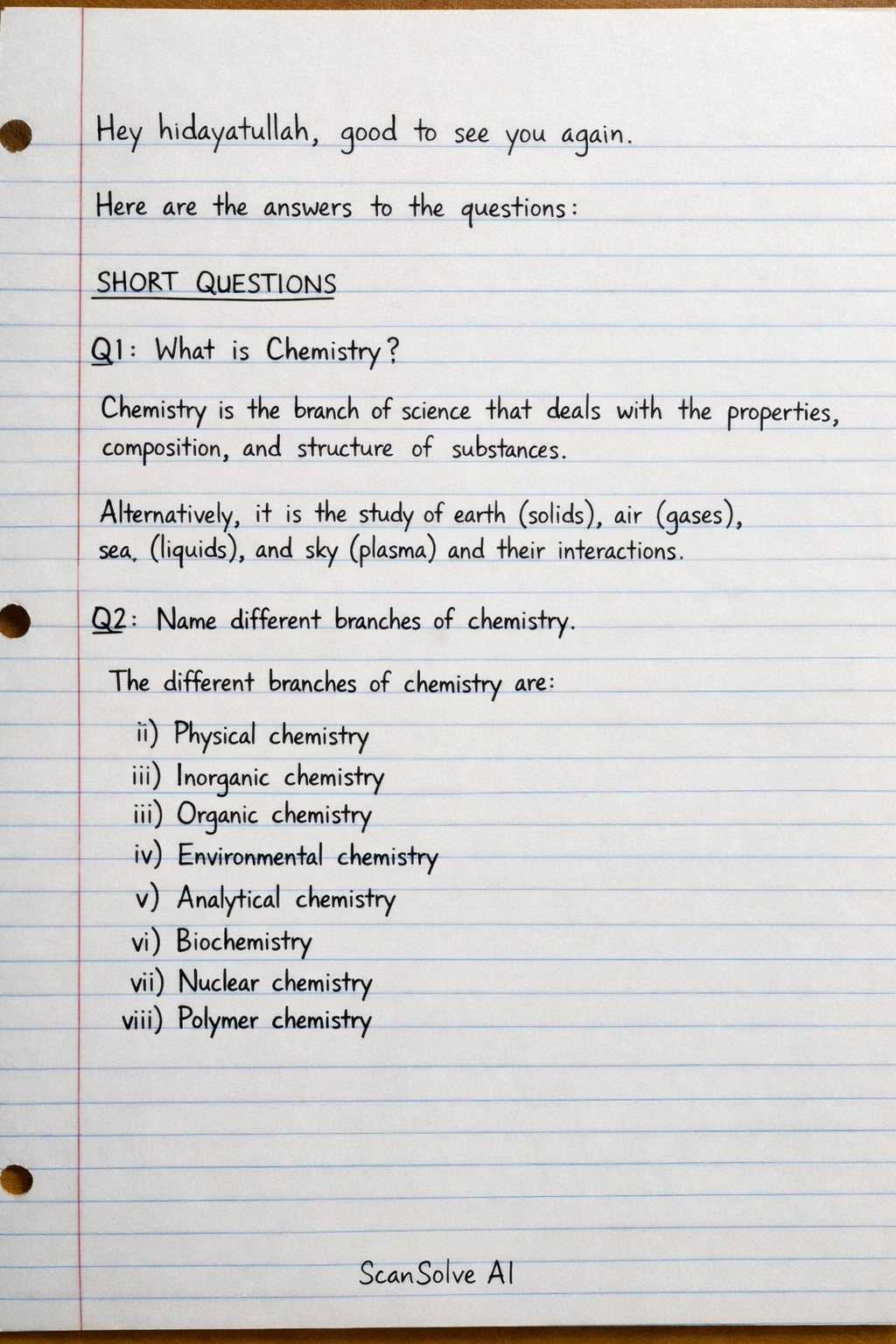
Handwritten Step-by-Step Solution
Get this as a handwritten image on WhatsApp — like a tutor wrote it for you.
Try on WhatsApp