
We read your photo as:
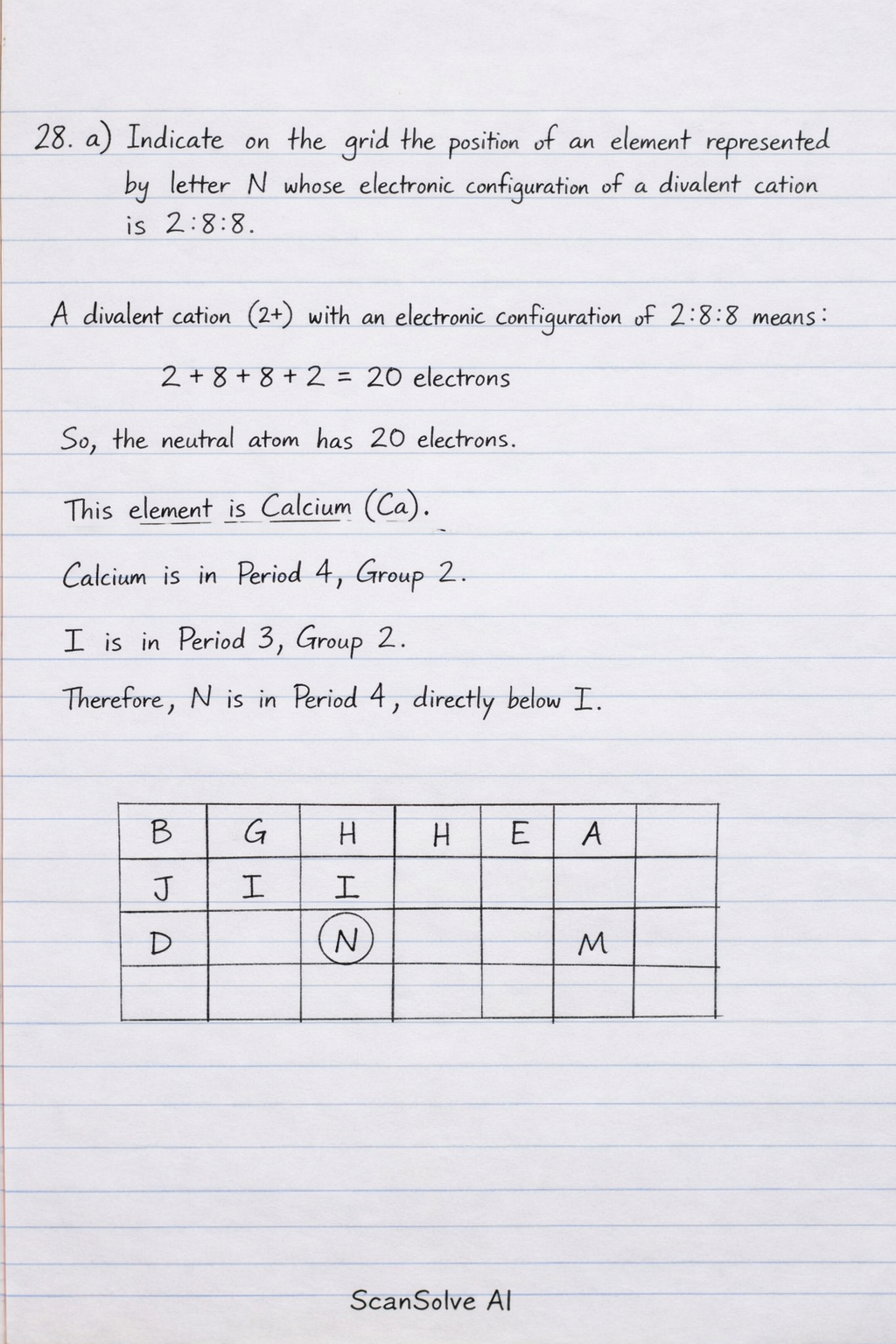
The grid below represents periodic table. Study it and answer the questions that follow. The letters do not represent the actual symbols of the elements. a) Indicate on the grid the position of an ele
ScanSolve AI Answer
Step-by-step solution
4 stepshere are the solutions to the questions:
-
The grid below represents periodic table. Study it and answer the questions that follow. The letters do not represent the actual symbols of the elements. a) Indicate on the grid the position of an element represented by letter N whose electronic configuration of a divalent cation is 2:8:8. A divalent cation (2+) with an electronic configuration of 2:8:8 means the neutral atom has electrons. This element is Calcium (Ca), which is in Period 4, Group 2. In the given grid, I is in Period 3, Group 2. Therefore, N would be in Period 4, directly below I.
b) Name the bond formed when D and H react. Explain your answer.
Bond type:
Explanation: D is in Group 1 (an alkali metal) and H is in Group 15 (a non-metal). D will readily lose its valence electron to form a positive ion, while H will gain electrons to achieve a stable octet, forming a negative ion. The large electronegativity difference between a metal and a non-metal leads to the transfer of electrons and the formation of strong electrostatic forces of attraction between the oppositely charged ions.c) Write an equation for the reaction between B and water.
B is an alkali metal in Period 2 (e.g., Lithium). Alkali metals react vigorously with water.d) How do the atomic radii of I and L compare. Explain.
Comparison: The atomic radius of I is larger than that of L.
Explanation: Both I and L are in the same period (Period 3). Across a period, the atomic radius decreases from left to right. This is because the nuclear charge increases, pulling the valence electrons closer to the nucleus, while the number of electron shells remains the same. I is in Group 2, and L is in Group 14, so I is to the left of L.e) In terms of structure and bonding explain why the oxide of G has lower melting point than oxide of L.
G is in Group 13, Period 2 (Boron). Its oxide is . L is in Group 14, Period 3 (Silicon). Its oxide is .
Explanation: The oxide of G () is a covalent network solid but with a less extensive or weaker network compared to . The oxide of L () is a giant covalent network structure. In , strong covalent bonds extend throughout the entire structure, requiring a very large amount of energy to break these bonds during melting, resulting in a very high melting point. has a lower melting point because its covalent network is not as strong or extensive, or it can exist in a vitreous form with weaker overall forces. -
Study the information given below and answer the questions that follow. a) Why is the formula of aluminium chloride given as and not ? Explanation: Aluminium chloride exists as a dimer, , in the vapor phase and in non-polar solvents, and also in the solid state at lower temperatures. This is because aluminium, having only six valence electrons in , achieves a stable octet by forming coordinate bonds with chlorine atoms from another molecule, thus forming the more stable dimeric structure.
b) Give two chlorides that are liquid at room temperature. Give a reason for the answer.
Chlorides: and (PCl3 has an inconsistent MP/BP in the table, so SiCl4 and SCl2 are clearer examples).
Reason: These chlorides are simple molecular substances with weak intermolecular forces (van der Waals forces) between their molecules. Only a small amount of energy is required to overcome these weak forces, resulting in low melting and boiling points, making them liquids at room temperature.c) Give a reason why has a lower melting point than although both Al and Mg are metals.
Explanation: is an ionic compound with a giant ionic lattice structure. Strong electrostatic forces of attraction exist between the and ions, requiring a large amount of energy to overcome, leading to a high melting point (). In contrast, is a covalent compound (despite Al being a metal) existing as discrete molecules with weak intermolecular forces. Less energy is needed to overcome these weak forces, resulting in a much lower melting point (sublimes at ).d) Which of the chlorides would remain in liquid state for the highest temperature range explains why?
Chloride:
Explanation: The liquid temperature range is the difference between the boiling point and the melting point.- :
- :
- : Sublimes at , so its liquid range is negligible at atmospheric pressure.
- :
- : has the largest liquid temperature range. This is because it is an ionic compound with strong electrostatic forces of attraction between its ions. A significant amount of energy is required to break these forces for both melting and boiling, leading to a wide temperature range over which it exists as a liquid.
-
The following is a flowchart that shows the industrial preparation of nitric (V) acid. (Since I cannot draw a flowchart, I will describe the steps sequentially.) Industrial Preparation of Nitric (V) Acid (Ostwald Process)
Catalytic Oxidation of Ammonia
Ammonia ($\text{NH}_3$) and air (source of $\text{O}_2$) are mixed and passed over a heated **platinum-rhodium catalyst** at about $800-900^\circ\text{C}$ and $4-10$ atmospheres pressure. This produces nitric oxide ($\text{NO}$) and water. $$ 4\text{NH}_3\text{(g)} + 5\text{O}_2\text{(g)} \xrightarrow{\text{Pt/Rh catalyst}} 4\text{NO(g)} + 6\text{H}_2\text{O(g)} $$Oxidation of Nitric Oxide
The hot nitric oxide is cooled and then reacted with excess air (oxygen) in an oxidation chamber. This converts nitric oxide to nitrogen dioxide ($\text{NO}_2$). $$ 2\text{NO(g)} + \text{O}_2\text{(g)} \rightarrow 2\text{NO}_2\text{(g)} $$Absorption of Nitrogen Dioxide in Water
The nitrogen dioxide is then passed into an absorption tower where it reacts with water, usually sprayed from the top. This forms nitric (V) acid ($\text{HNO}_3$) and regenerates nitric oxide ($\text{NO}$). $$ 3\text{NO}_2\text{(g)} + \text{H}_2\text{O(l)} \rightarrow 2\text{HNO}_3\text{(aq)} + \text{NO(g)} $$Recycling of Nitric Oxide
The nitric oxide ($\text{NO}$) produced in the absorption tower is recycled back to the oxidation chamber (Step 2) to be re-oxidized to nitrogen dioxide, making the process more efficient.
Still stuck on this one?
Ask a follow-up, and the answer starts from this question.
More Chemistry Questions
Handwritten Step-by-Step Solution
Get this as a handwritten image on WhatsApp — like a tutor wrote it for you.
Try on WhatsApp