The IUPAC name of compound shown below is

Chemistry
The IUPAC name of compound shown below is

ScanSolve AI Answer

Answer

C

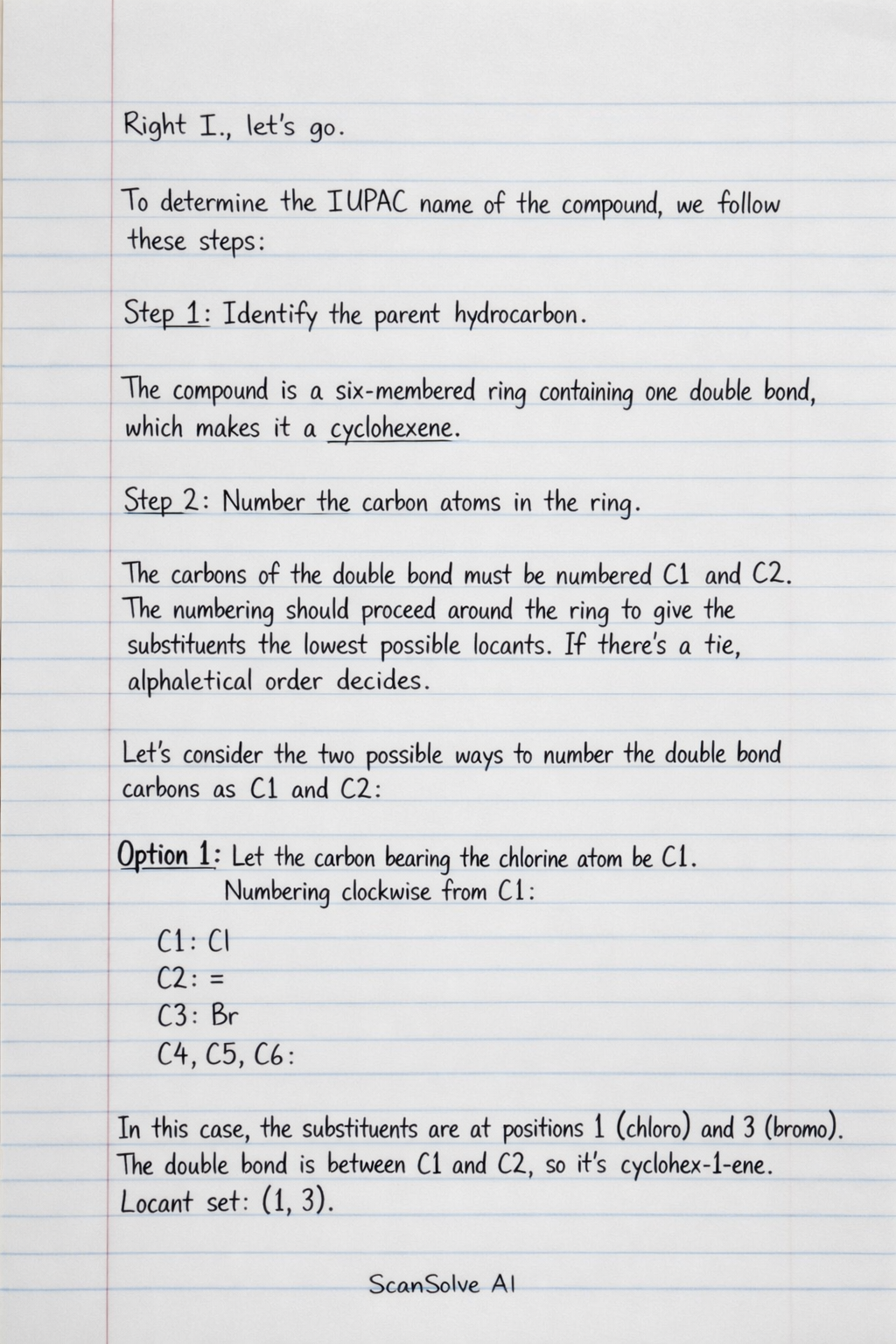
To determine the IUPAC name of the compound, we follow these steps:

Step 1: Identify the parent hydrocarbon. The compound is a six-membered ring containing one double bond, which makes it a cyclohexene.

Step 2: Number the carbon atoms in the ring. The carbons of the double bond must be numbered C1 and C2. The numbering should proceed around the ring in a direction that gives the substituents the lowest possible locant numbers. If there's a tie, alphabetical order of substituents determines which carbon gets the lower number.

Let's consider the two possible ways to number the double bond carbons as C1 and C2:

  • Option 1: Let the carbon bearing the chlorine atom be C1. The double bond is between C1 and C2. Numbering clockwise from C1:

    • C1: has Cl
    • C2: part of double bond
    • C3: has Br
    • C4, C5, C6 In this case, the substituents are at positions 1 (chloro) and 3 (bromo). The double bond is between C1 and C2, so it's cyclohex-1-ene. The locant set for substituents is (1, 3).
  • Option 2: Let the carbon not bearing the chlorine atom (but still part of the double bond) be C1. The double bond is between C1 and C2. Numbering clockwise from C1:

    • C1: part of double bond
    • C2: has Cl
    • C3: has Br
    • C4, C5, C6 In this case, the substituents are at positions 2 (chloro) and 3 (bromo). The double bond is between C1 and C2, so it's cyclohex-1-ene. The locant set for substituents is (2, 3).

Step 3: Compare the locant sets. Comparing (1, 3) from Option 1 and (2, 3) from Option 2, the set (1, 3) is lower at the first point of difference (1 < 2). Therefore, Option 1 is the correct numbering. The chlorine is at C1, and the bromine is at C3.

Step 4: Assemble the name. The substituents are bromo (at position 3) and chloro (at position 1). According to alphabetical order, "bromo" comes before "chloro". The parent ring is cyclohexene. The position of the double bond (1-ene) is often omitted for cyclohexene as it's implied to be between C1 and C2.

Thus, the IUPAC name is 3-bromo-1-chlorocyclohexene.

Comparing this with the given options: (A) 2-bromo-6- chlorocyclohex-1-ene (B) 6-bromo-2-chlorocyclohexene (C) 3-bromo-1-chlorocyclohexene (D) 1-bromo-3-chlorocyclohexene

The correct option is (C).

The final answer is C\boxed{C} Send me the next one 📸

Was this helpful?

Need help with your own homework?

Get instant step-by-step solutions to any question. Free to start.

Ask Your Question
Handwritten step-by-step solution preview

Handwritten Step-by-Step Solution

Get this as a handwritten image on WhatsApp — like a tutor wrote it for you.

Try on WhatsApp

Still have questions?

Quick Answer

To determine the IUPAC name of the compound, we follow these steps: Step 1: Identify the parent hydrocarbon.

The IUPAC name of compound shown below is
Chemistry

This chemistry question involves key chemical concepts and calculations. The detailed solution below walks through each step, from identifying the reaction type to computing the final answer.

ScanSolve AI Answer
To determine the IUPAC name of the compound, we follow these steps: Step 1: Identify the parent hydrocarbon. The compound is a six-membered ring containing one double bond, which makes it a cyclohexene. Step 2: Number the carbon atoms in the ring. The carbons of the double bond must be numbered C1 and C2. The numbering should proceed around the ring in a direction that gives the substituents the lowest possible locant numbers. If there's a tie, alphabetical order of substituents determines which carbon gets the lower number. Let's consider the two possible ways to number the double bond carbons as C1 and C2: Option 1: Let the carbon bearing the chlorine atom be C1. The double bond is between C1 and C2. Numbering clockwise from C1: C1: has Cl C2: part of double bond C3: has Br C4, C5, C6 In this case, the substituents are at positions 1 (chloro) and 3 (bromo). The double bond is between C1 and C2, so it's cyclohex-1-ene. The locant set for substituents is (1, 3). Option 2: Let the carbon not* bearing the chlorine atom (but still part of the double bond) be C1. The double bond is between C1 and C2. Numbering clockwise from C1: C1: part of double bond C2: has Cl C3: has Br C4, C5, C6 In this case, the substituents are at positions 2 (chloro) and 3 (bromo). The double bond is between C1 and C2, so it's cyclohex-1-ene. The locant set for substituents is (2, 3). Step 3: Compare the locant sets. Comparing (1, 3) from Option 1 and (2, 3) from Option 2, the set (1, 3) is lower at the first point of difference (1 < 2). Therefore, Option 1 is the correct numbering. The chlorine is at C1, and the bromine is at C3. Step 4: Assemble the name. The substituents are bromo (at position 3) and chloro (at position 1). According to alphabetical order, "bromo" comes before "chloro". The parent ring is cyclohexene. The position of the double bond (1-ene) is often omitted for cyclohexene as it's implied to be between C1 and C2. Thus, the IUPAC name is 3-bromo-1-chlorocyclohexene. Comparing this with the given options: (A) 2-bromo-6- chlorocyclohex-1-ene (B) 6-bromo-2-chlorocyclohexene (C) 3-bromo-1-chlorocyclohexene (D) 1-bromo-3-chlorocyclohexene The correct option is (C). The final answer is C Send me the next one 📸