The table below shows the atomic numbers of elements T, U, V and W. Study it and answer the questions that follow. The letters are not the actual symbols of the elements. (a) What type of bond would be formed between:- (i) elements U and W

Chemistry
The table below shows the atomic numbers of elements T, U, V and W. Study it and answer the questions that follow. The letters are not the actual symbols of the elements. (a) What type of bond would be formed between:- (i) elements U and W

ScanSolve AI Answer

Answer

A

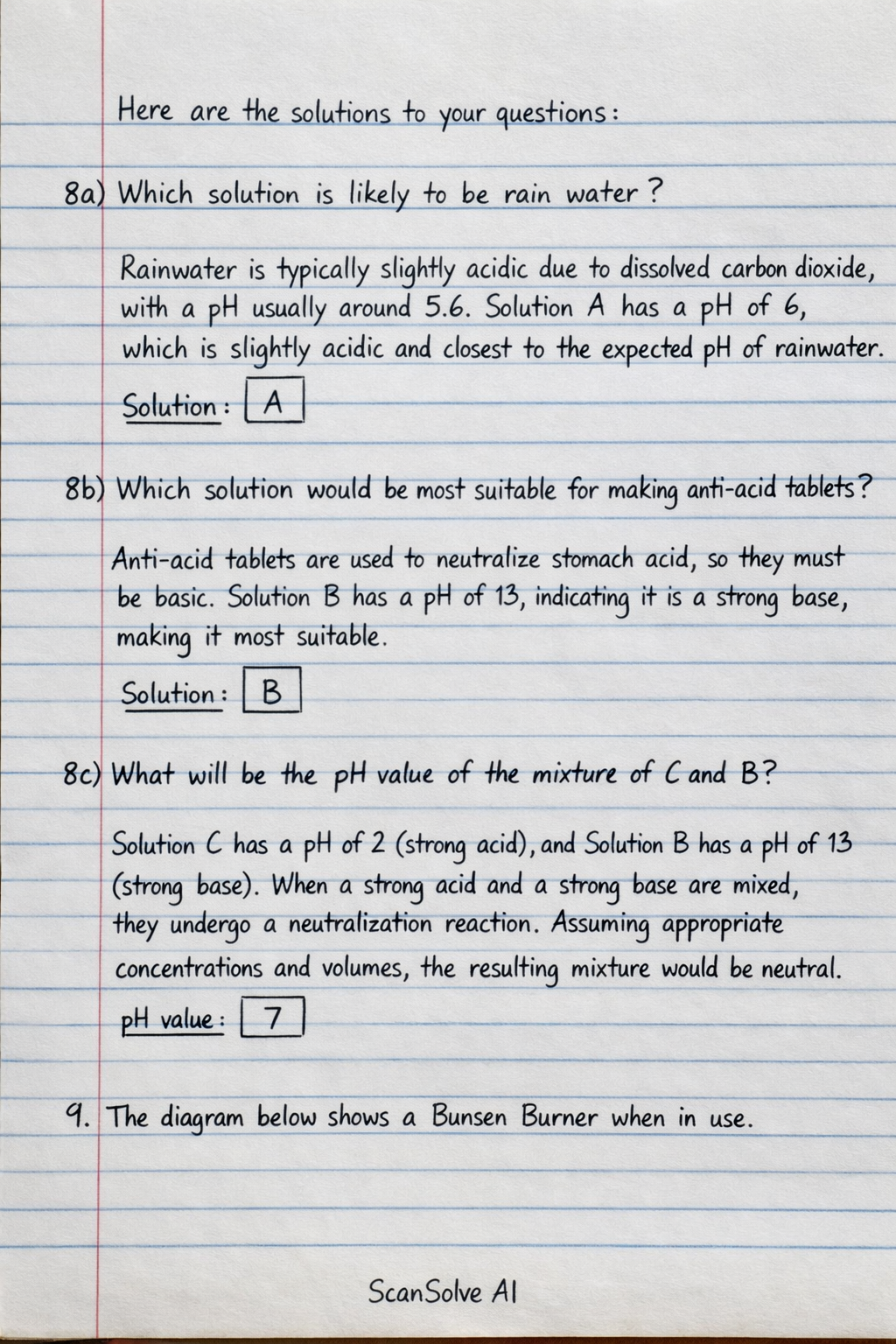
Here are the solutions to your questions:

8. The table shows the pH values of solutions A to E

  • 8a) Which solution is likely to be rain water? Rainwater is typically slightly acidic due to dissolved carbon dioxide, with a pH usually around 5.6. Solution A has a pH of 6, which is slightly acidic and closest to the expected pH of rainwater. Solution: A\boxed{A}

  • 8b) Which solution would be most suitable for making anti-acid tablets? Anti-acid tablets are used to neutralize stomach acid, so they must be basic. Solution B has a pH of 13, indicating it is a strong base, making it most suitable. Solution: B\boxed{B}

  • 8c) What will be the pH value of the mixture of C and B? Solution C has a pH of 2 (strong acid), and Solution B has a pH of 13 (strong base). When a strong acid and a strong base are mixed, they undergo a neutralization reaction. Assuming appropriate concentrations and volumes, the resulting mixture would be neutral. pH value: 7\boxed{7}

9. The diagram below shows a Bunsen Burner when in use.

  • Which of the labeled parts is used for heating? Give a reason. The labeled part used for heating is A. Reason: Part A represents the outer, non-luminous cone of the flame, which is the hottest part because it allows for complete combustion of the gas due to a sufficient supply of oxygen.

10. The table below shows the atomic numbers of elements T, U, V and W. Study it and answer the questions that follow. The letters are not the actual symbols of the elements.

| Element | T | U | V | W | | :------------ | :-- | :-- | :-- | :-- | | Atomic number | 13 | 16 | 17 | 20 |

  • 10a) What type of bond would be formed between:-
    • (i) elements U and W Element U has an atomic number of 16, so its electron configuration is 2, 8, 6. It is a non-metal and tends to gain 2 electrons to achieve a stable octet. Element W has an atomic number of 20, so its electron configuration is 2, 8, 8, 2. It is a metal and tends to lose 2 electrons to achieve a stable octet. When a metal (W) reacts with a non-metal (U), electrons are transferred, forming an ionic bond. Type of bond: Ionicbond\boxed{Ionic bond}

3 done, 2 left today. You're making progress.

Was this helpful?

Need help with your own homework?

Get instant step-by-step solutions to any question. Free to start.

Ask Your Question
Handwritten step-by-step solution preview

Handwritten Step-by-Step Solution

Get this as a handwritten image on WhatsApp — like a tutor wrote it for you.

Try on WhatsApp

Still have questions?

Quick Answer

8. The table shows the pH values of solutions A to E 8a) Which solution is likely to be rain water? Rainwater is typically slightly acidic due to dissolved carbon dioxide, with a pH usually around 5.6.

The table below shows the atomic numbers of elements T, U, V and W. Study it and answer the questions that follow. The letters are not the actual symbols of the elements. (a) What type of bond would be formed between:- (i) elements U and W
Chemistry

This chemistry question involves key chemical concepts and calculations. The detailed solution below walks through each step, from identifying the reaction type to computing the final answer.

ScanSolve AI Answer
Here are the solutions to your questions: 8. The table shows the pH values of solutions A to E 8a) Which solution is likely to be rain water? Rainwater is typically slightly acidic due to dissolved carbon dioxide, with a pH usually around 5.6. Solution A has a pH of 6, which is slightly acidic and closest to the expected pH of rainwater. Solution: A 8b) Which solution would be most suitable for making anti-acid tablets? Anti-acid tablets are used to neutralize stomach acid, so they must be basic. Solution B has a pH of 13, indicating it is a strong base, making it most suitable. Solution: B 8c) What will be the pH value of the mixture of C and B? Solution C has a pH of 2 (strong acid), and Solution B has a pH of 13 (strong base). When a strong acid and a strong base are mixed, they undergo a neutralization reaction. Assuming appropriate concentrations and volumes, the resulting mixture would be neutral. pH value: 7 9. The diagram below shows a Bunsen Burner when in use. Which of the labeled parts is used for heating? Give a reason. The labeled part used for heating is A. Reason: Part A represents the outer, non-luminous cone of the flame, which is the hottest part because it allows for complete combustion of the gas due to a sufficient supply of oxygen. 10. The table below shows the atomic numbers of elements T, U, V and W. Study it and answer the questions that follow. The letters are not the actual symbols of the elements. | Element | T | U | V | W | | :------------ | :-- | :-- | :-- | :-- | | Atomic number | 13 | 16 | 17 | 20 | 10a) What type of bond would be formed between:- (i) elements U and W Element U has an atomic number of 16, so its electron configuration is 2, 8, 6. It is a non-metal and tends to gain 2 electrons to achieve a stable octet. Element W has an atomic number of 20, so its electron configuration is 2, 8, 8, 2. It is a metal and tends to lose 2 electrons to achieve a stable octet. When a metal (W) reacts with a non-metal (U), electrons are transferred, forming an ionic bond. Type of bond: Ionic bond 3 done, 2 left today. You're making progress.