

This chemistry question involves key chemical concepts and calculations. The detailed solution below walks through each step, from identifying the reaction type to computing the final answer.
ScanSolve AI Answer
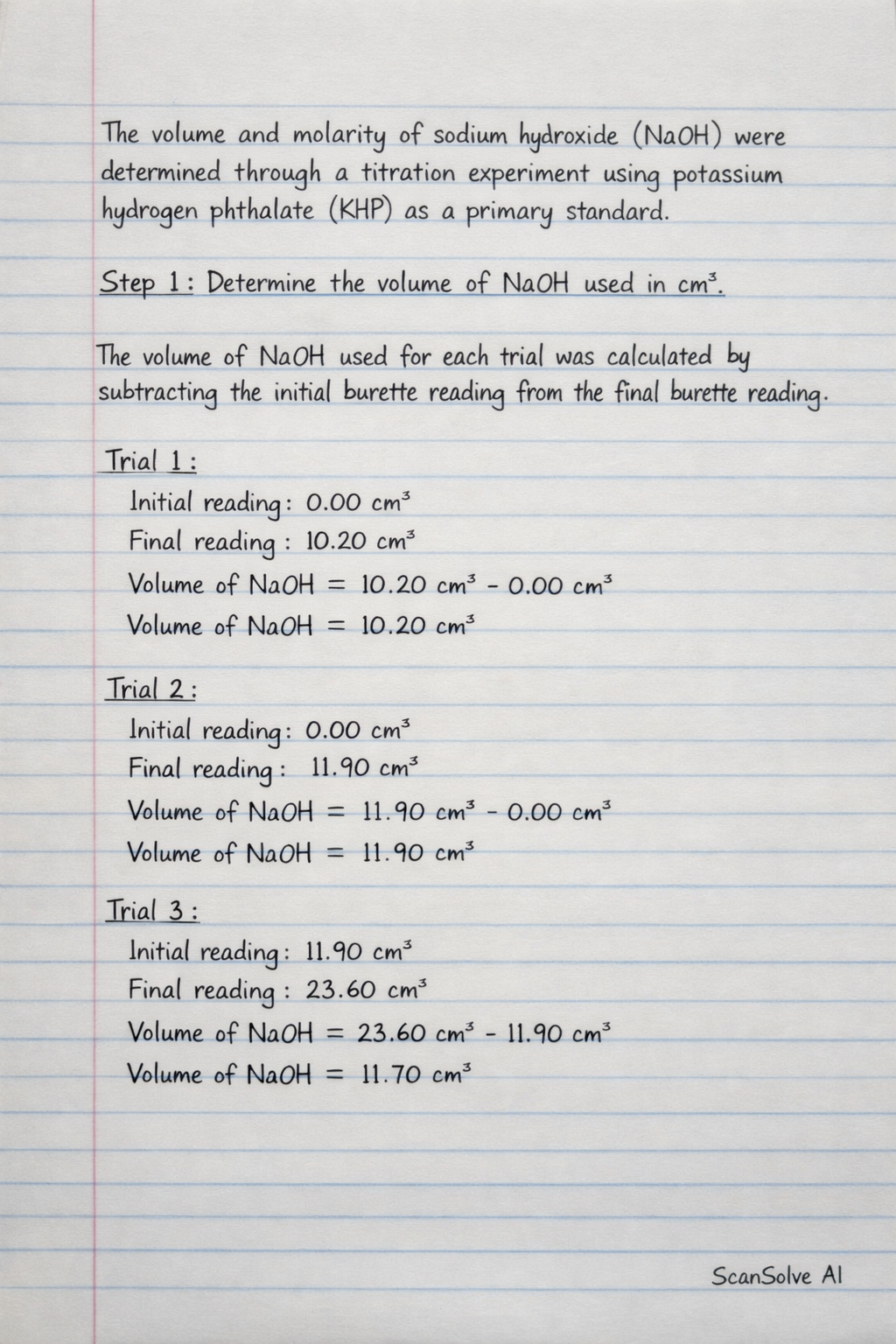
The volume and molarity of sodium hydroxide (NaOH) were determined through a titration experiment using potassium hydrogen phthalate (KHP) as a primary standard. Step 1: Determine the volume of NaOH used in cm³. The volume of NaOH used for each trial was calculated by subtracting the initial burette reading from the final burette reading. Trial 1: Volume of NaOH = 10.20 cm^3 - 0.00 cm^3 = 10.20 cm^3 Trial 2: Volume of NaOH = 11.90 cm^3 - 0.00 cm^3 = 11.90 cm^3 Trial 3: Volume of NaOH = 23.60 cm^3 - 11.90 cm^3 = 11.70 cm^3 Step 2: Convert the volume of NaOH from cm³ to Liters (L). To convert cm³ to Liters, divide by 1000 cm^3/L. Trial 1: Volume of NaOH = 10.20 cm^31000 cm^3/L = 0.0102 L Trial 2: Volume of NaOH = 11.90 cm^31000 cm^3/L = 0.0119 L Trial 3: Volume of NaOH = 11.70 cm^31000 cm^3/L = 0.0117 L Step 3: Calculate the moles of KHP used in each trial. The moles of KHP were calculated using its mass and molar mass (204.24 g/mol). Moles of KHP = Mass of KHPMolar mass of KHP Trial 1: Moles of KHP = 0.21900 g204.24 g/mol = 0.00107 mol Trial 2: Moles of KHP = 0.28900 g204.24 g/mol = 0.00141 mol Trial 3: Moles of KHP = 0.22000 g204.24 g/mol = 0.00108 mol Step 4: Determine the molarity of NaOH for each trial. Since KHP is a monoprotic acid and reacts with NaOH in a 1:1 mole ratio, the moles of NaOH at the equivalence point are equal to the moles of KHP. Molarity of NaOH = Moles of NaOHVolume of NaOH (L) Trial 1: Molarity of NaOH = 0.00107 mol0.0102 L = 0.105 M Trial 2: Molarity of NaOH = 0.00141 mol0.0119 L = 0.118 M Trial 3: Molarity of NaOH = 0.00108 mol0.0117 L = 0.092 M Step 5: Calculate the average molarity of NaOH. The average molarity was found by summing the molarities from each trial and dividing by the number of trials. Average Molarity of NaOH = 0.105 M + 0.118 M + 0.092 M3 = 0.315 M3 = 0.105 M