We read your photo as:

The weight of one molecule of CaCO₃ is 2. The gaseous hydrocarbon having formula CnH₂n+2 diffuses twice as quickly as sulphur dioxide. The molecular formula of hydrocarbon is

Chemistry

ScanSolve AI Answer

Answer

B

Step-by-step solution

5 steps

Here are the answers to the multiple-choice questions:

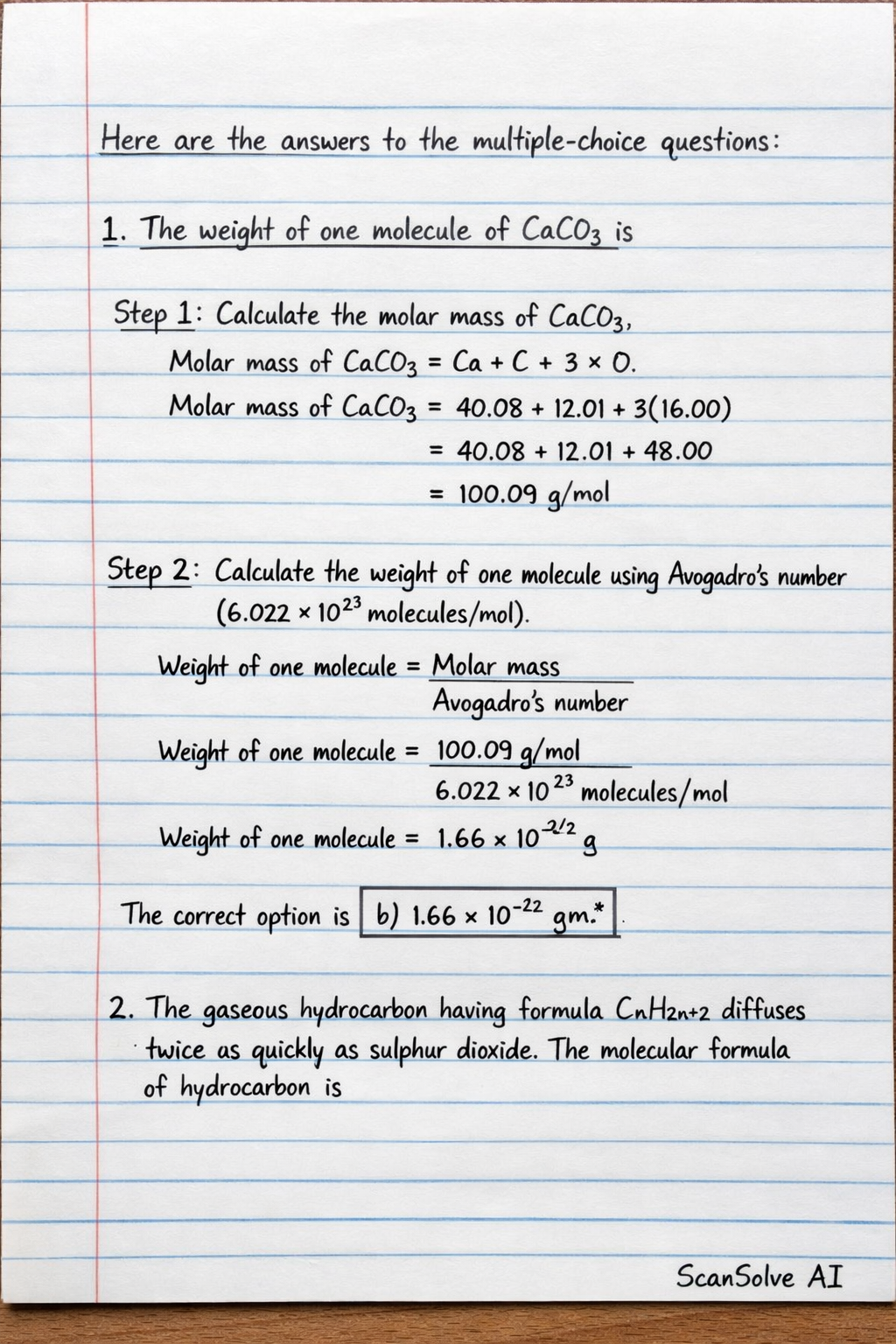
1. The weight of one molecule of CaCO₃ is

  1. Calculate the molar mass of CaCO3\text{CaCO}_3.

    Molar mass of CaCO3=Ca+C+3×O\text{CaCO}_3 = \text{Ca} + \text{C} + 3 \times \text{O}
    Molar mass of CaCO3=40.08+12.01+3(16.00)=40.08+12.01+48.00=100.09 g/mol\text{CaCO}_3 = 40.08 + 12.01 + 3(16.00) = 40.08 + 12.01 + 48.00 = 100.09 \text{ g/mol}

  2. Calculate the weight of one molecule using Avogadro's number (6.022×10²³ molecules/mol6.022 \times 10^{23} \text{ molecules/mol}).

    Weight of one molecule =Molar massAvogadro’s number= \frac{\text{Molar mass}}{\text{Avogadro's number}}
    Weight of one molecule =100.09 g/mol6.022×1023 molecules/mol= \frac{100.09 \text{ g/mol}}{6.022 \times 10^{23} \text{ molecules/mol}}
    Weight of one molecule ≈1.66×10⁻²² g\approx 1.66 \times 10^{-22} \text{ g}

    The correct option is b) 1.66×10⁻²² gm\boxed{1.66 \times 10^{-22} \text{ gm}}.

    2. The gaseous hydrocarbon having formula CnH₂n+2 diffuses twice as quickly as sulphur dioxide. The molecular formula of hydrocarbon is

  3. Apply Graham's Law of Diffusion.

    Graham's Law states that the ratio of the rates of diffusion of two gases is inversely proportional to the square root of the ratio of their molar masses:

    Rate1Rate2=Molar mass2Molar mass1\frac{\text{Rate}_1}{\text{Rate}_2} = \sqrt{\frac{\text{Molar mass}_2}{\text{Molar mass}_1}}

    Let the hydrocarbon be gas 1 and sulphur dioxide (SO2\text{SO}_2) be gas 2.
    Given: Ratehydrocarbon=2×RateSO2\text{Rate}_{\text{hydrocarbon}} = 2 \times \text{Rate}_{\text{SO}_2}, so RatehydrocarbonRateSO2=2\frac{\text{Rate}_{\text{hydrocarbon}}}{\text{Rate}_{\text{SO}_2}} = 2.
    Molar mass of SO2=32.07(S)+2×16.00(O)=64.07 g/mol\text{SO}_2 = 32.07 (\text{S}) + 2 \times 16.00 (\text{O}) = 64.07 \text{ g/mol}.

  4. Calculate the molar mass of the hydrocarbon.

    2=64.07Molar masshydrocarbon2 = \sqrt{\frac{64.07}{\text{Molar mass}_{\text{hydrocarbon}}}}

    Squaring both sides:

    4=64.07Molar masshydrocarbon4 = \frac{64.07}{\text{Molar mass}_{\text{hydrocarbon}}} Molar masshydrocarbon=64.074=16.0175 g/mol\text{Molar mass}_{\text{hydrocarbon}} = \frac{64.07}{4} = 16.0175 \text{ g/mol}
  5. Determine the molecular formula of the hydrocarbon.

    The hydrocarbon has the formula CnH2n+2\text{C}_n\text{H}_{2n+2}.
    Molar mass of CnH2n+2=n(12.01)+(2n+2)(1.01)=12.01n+2.02n+2.02=14.03n+2.02\text{C}_n\text{H}_{2n+2} = n(12.01) + (2n+2)(1.01) = 12.01n + 2.02n + 2.02 = 14.03n + 2.02.
    Set this equal to the calculated molar mass:

    14.03n+2.02=16.017514.03n + 2.02 = 16.0175 14.03n=16.0175−2.0214.03n = 16.0175 - 2.02 14.03n=13.997514.03n = 13.9975 n≈1n \approx 1

    For n=1n=1, the formula is C1H2(1)+2=CH4\text{C}_1\text{H}_{2(1)+2} = \text{CH}_4.
    The molar mass of CH4=12.01+4(1.01)=16.05 g/mol\text{CH}_4 = 12.01 + 4(1.01) = 16.05 \text{ g/mol}, which matches our calculation.

    The correct option is d) CH4\boxed{\text{CH}_4}.

    3. The structure of NaCl is

    The correct option is b) Face centered cubic lattice\boxed{\text{Face centered cubic lattice}}.

    4. Paste of lime in water is called

    The correct option is c) milk of lime\boxed{\text{milk of lime}}.

    5. Which one of the following elements is macro element?

    The correct option is a) Mg\boxed{\text{Mg}}.

    6. Which one of the following is amphoteric oxide?

    The correct option is b) ZnO\boxed{\text{ZnO}}.

    7. The formula of ammonium carbamate formed during manufacture of urea is

    The correct option is b) NH2COONH4\boxed{\text{NH}_2\text{COONH}_4}.

    8. Hydrometallurgy is applied for the reduction of

    The correct option is c) Ag2S\boxed{\text{Ag}_2\text{S}}.

    9. White phosphorous reacts with caustic alkali to give

    The correct option is **c)

Was this helpful?

Try one yourself

A new problem that tests the same skill.

Still stuck on this one?

Ask a follow-up, and the answer starts from this question.

Got a different question?Ask your own question
Handwritten step-by-step solution preview

Handwritten Step-by-Step Solution

Get this as a handwritten image on WhatsApp — like a tutor wrote it for you.

Try on WhatsApp