
We read your photo as:
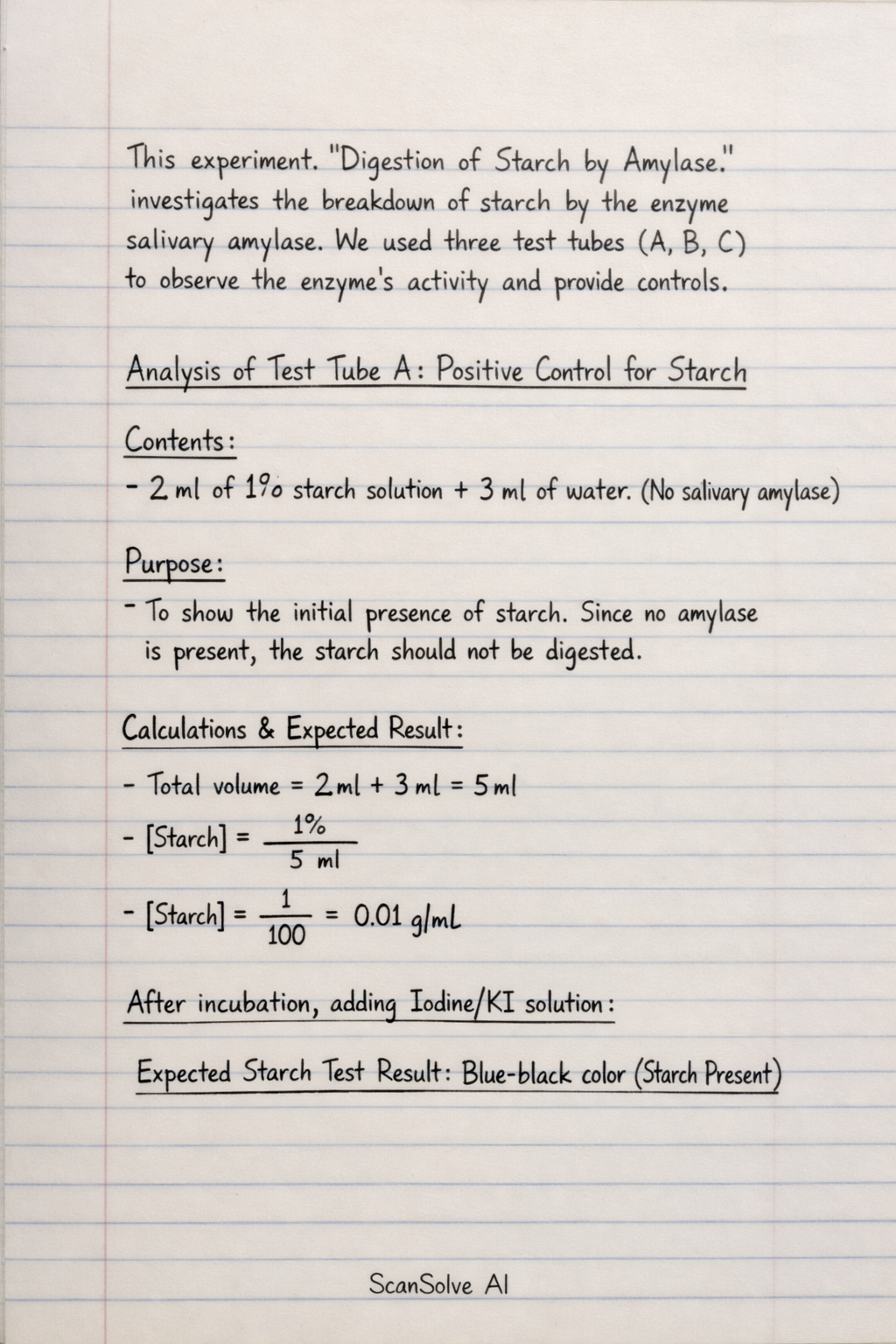
This experiment, "Digestion of Starch by Amylase," investigates the breakdown of starch by the enzyme salivary amylase. The setup uses three test tubes (A, B, C) to observe the enzyme's activity and p
Chemistry
ScanSolve AI Answer
This experiment, "Digestion of Starch by Amylase," investigates the breakdown of starch by the enzyme salivary amylase. The setup uses three test tubes (A, B, C) to observe the enzyme's activity and provide controls.
Here's an analysis of each test tube and the expected results if a starch test (using Iodine/KI solution) is performed after incubation:
-
Test tube A: Positive Control for Starch
- Contents: 2 ml of 1% starch solution + 3 ml of water. (No salivary amylase)
- Purpose: This tube serves as a control to show the initial presence of starch. Since no amylase is present, the starch should not be digested.
- Expected Starch Test Result: After incubation, adding Iodine/KI solution will result in a blue-black color, indicating the presence of starch.
-
Test tube B: Negative Control for Starch
- Contents: 2 ml of water + 3 ml of salivary amylase. (No starch solution)
- Purpose: This tube ensures that the salivary amylase solution itself does not contain starch or give a false positive result with the iodine test.
- Expected Starch Test Result: After incubation, adding Iodine/KI solution will result in a yellowish-brown color (the color of the iodine solution), indicating the absence of starch.
-
Test tube C: Experimental Tube
- Contents: 2 ml of 1% starch solution + 3 ml of salivary amylase. (No additional water)
- Purpose: This tube is where the digestion of starch by salivary amylase is expected to occur. Amylase breaks down starch into smaller sugar molecules (like maltose).
- Expected Starch Test Result: After incubation at 37°C for 10 minutes, the salivary amylase should have digested most, if not all, of the starch. Therefore, adding Iodine/KI solution will result in a yellowish-brown color, indicating the absence or significant reduction of starch. If digestion is incomplete, a reddish-brown or lighter blue color might be observed.
Was this helpful?
Still stuck on this one?
Ask a follow-up, and the answer starts from this question.
Got a different question?Ask your own question
More Chemistry Questions
QThis experiment investigates the digestion of starch by salivary amylase. The three test tubes are…QExplain the results of the starch hydrolysis experiment, focusing on products, enzyme function…QAfin de déterminer l'effet de la température sur l'activité enzymatique, une expérience a été…QDescribe the procedure and expected results for testing starch in a sample.QTest for Carbohydrates - Starch. 1. Put 1 spatula of the sample in a watch glass and few drops of…
Browse by topic:Biochemistry
Handwritten Step-by-Step Solution
Get this as a handwritten image on WhatsApp — like a tutor wrote it for you.
Try on WhatsApp