

This chemistry question involves key chemical concepts and calculations. The detailed solution below walks through each step, from identifying the reaction type to computing the final answer.
ScanSolve AI Answer
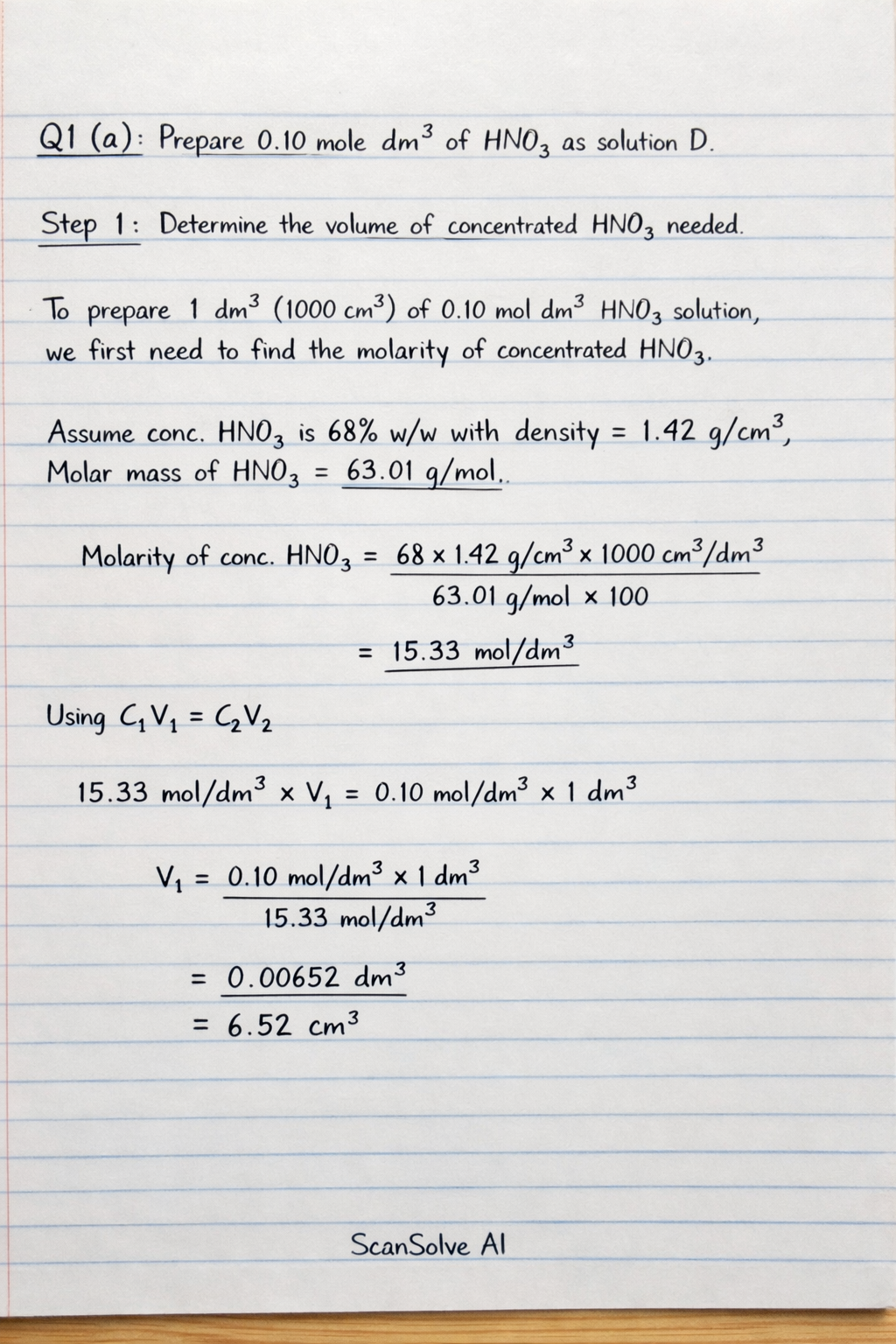
here are the solutions for the chemistry practical paper: Q1 (a): Prepare 0.10 mole dm^-3 of HNO_3 as solution D. Step 1: Determine the volume of concentrated HNO_3 needed. To prepare 1 dm^3 (1000 cm^3) of 0.10 mol dm^-3 HNO_3 solution, we first need to find the molarity of concentrated HNO_3. Assuming concentrated HNO_3 is 68\% w/w with a density of 1.42 g/cm^3 and molar mass of HNO_3 is 63.01 g/mol: Molarity of conc. HNO_3 = 68 × 1.42 g/cm^3 × 1000 cm^3/dm^363.01 g/mol × 100 = 15.33 mol/dm^3 Using the dilution formula C_1V_1 = C_2V_2: 15.33 mol/dm^3 × V_1 = 0.10 mol/dm^3 × 1 dm^3 V_1 = 0.10 mol/dm^3 × 1 dm^315.33 mol/dm^3 = 0.00652 dm^3 = 6.52 cm^3 Step 2: Outline the preparation procedure. • Carefully measure out 6.52 cm^3 of concentrated HNO_3 using a measuring cylinder or pipette. • Pour about 500 cm^3 of distilled water into a 1 dm^3 volumetric flask. • Slowly add the measured concentrated HNO_3 to the water in the volumetric flask, swirling gently. (Always add acid to water). • Add more distilled water until the solution is just below the calibration mark. • Stopper the flask and invert several times to mix. • Add distilled water dropwise until the bottom of the meniscus aligns with the 1 dm^3 calibration mark. • Stopper and invert the flask several times to ensure thorough mixing. • Label the solution as Solution D (0.10 mol dm^-3 HNO_3). This stock solution can then be dispensed in 200 cm^3 portions to each student. Q1 (b): Prepare 0.04 mole dm^-3 of Na_2CO_3 · 10H_2O as solution E. Step 1: Calculate the mass of Na_2CO_3 · 10H_2O needed. To prepare 1 dm^3 (1000 cm^3) of 0.04 mol dm^-3 Na_2CO_3 · 10H_2O solution. Molar mass of Na_2CO_3 · 10H_2O: (2 × 22.99) + 12.01 + (3 × 16.00) + (10 × (2 × 1.008 + 16.00)) = 286.15 g/mol. Mass needed = Molarity × Volume × Molar mass Mass = 0.04 mol/dm^3 × 1 dm^3 × 286.15 g/mol = 11.446 g Step 2: Outline the preparation procedure. • Weigh out 11.45 g of Na_2CO_3 · 10H_2O accurately using a digital balance. • Transfer the weighed solid into a beaker and dissolve it in about 200 cm^3 of distilled water. Stir to ensure complete dissolution. • Carefully transfer the solution into a 1 dm^3 volumetric flask using a funnel. • Rinse the beaker and funnel with small portions of distilled water and add the rinsings to the volumetric flask to ensure all solute is transferred. • Add distilled water until the solution is just below the calibration mark. • Stopper the flask and invert several times to mix. • Add distilled water dropwise until the bottom of the meniscus aligns with the 1 dm^3 calibration mark. • Stopper and invert the flask several times to ensure thorough mixing. • Label the solution as Solution E (0.04 mol dm^-3 Na_2CO_3 · 10H_2O). This stock solution can then be dispensed in 125 cm^3 portions to each student. Q1 (c): Prepare 0.08 mole dm^-3 of KOH as solution F. Step 1: Calculate the mass of KOH needed. To prepare 1 dm^3 (1000 cm^3) of 0.08 mol dm^-3 KOH solution. Molar mass of KOH: 39.10 + 16.00 + 1.008 = 56.108 g/mol. Mass needed = Molarity × Volume × Molar mass Mass = 0.08 mol/dm^3 × 1 dm^3 × 56.108 g/mol = 4.48864 g ≈ 4.49 g Step 2: Outline the preparation procedure. • Weigh out 4.49 g of KOH pellets quickly, as it is hygroscopic, using a digital balance. • Transfer the weighed solid into a beaker and dissolve it in about 200 cm^3 of distilled water. Stir to ensure complete dissolution. (Note: Dissolution of KOH is exothermic). • Allow the solution to cool to room temperature. • Carefully transfer the cooled solution into a 1 dm^3 volumetric flask using a funnel. • Rinse the beaker and funnel with small portions of distilled water and add the rinsings to the volumetric flask. • Add distilled water until the solution is just below the calibration mark. • Stopper the flask and invert several times to mix. • Add distilled water dropwise until the bottom of the meniscus aligns with the 1 dm^3 calibration mark. • Stopper and invert the flask several times to ensure thorough mixing. • Label the solution as Solution F (0.08 mol dm^-3 KOH). This stock solution can then be dispensed in 125 cm^3 portions to each student. Q1 (d): Prepare methyl orange and phenolphthalein indicators. Step 1: Prepare Methyl Orange indicator. • Dissolve 0.1 g of methyl orange powder in 100 cm^3 of distilled water. Stir until completely dissolved. Step 2: Prepare Phenolphthalein indicator. • Dissolve 1 g of phenolphthalein powder in 100 cm^3 of ethanol (or industrial methylated spirit). Stir until completely dissolved. Q2: Provide samples and reagents. • Provide 2 g of Tin(II) Chloride labeled as SAMPLE B1. • Provide 2 g of 2-Hydrobenzoic Acid (Salicylic Acid) labeled as SAMPLE B2. • Ensure that all necessary test reagents for inorganic and organic qualitative analysis are provided in the laboratory benches as instructed. What's next? 📸