
We read your photo as:
Describe how to test for water and write the balanced chemical equation for the direct synthesis of sodium chloride.
ScanSolve AI Answer
Step-by-step solution
8 stepsDescribe a test for water.
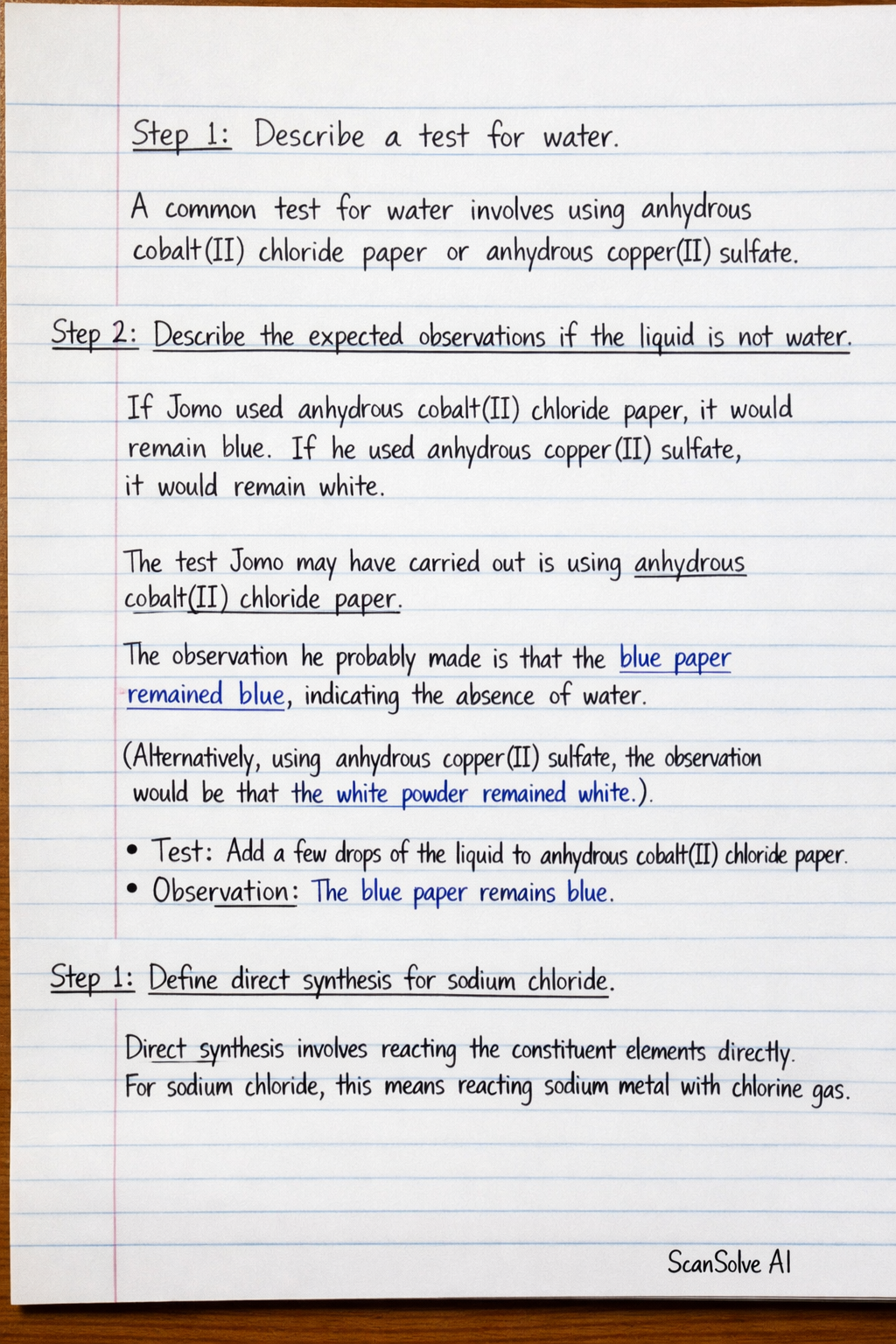
A common test for water involves using anhydrous cobalt(II) chloride paper or anhydrous copper(II) sulfate.
Describe the expected observations if the liquid is not water.
If Jomo used anhydrous cobalt(II) chloride paper, it would remain blue. If he used anhydrous copper(II) sulfate, it would remain white.
The test Jomo may have carried out is using anhydrous cobalt(II) chloride paper.
The observation he probably made is that the blue paper remained blue, indicating the absence of water.
(Alternatively, using anhydrous copper(II) sulfate, the observation would be that the white powder remained white.)- Test: Add a few drops of the liquid to anhydrous cobalt(II) chloride paper.
- Observation: The blue paper remains blue.
Define direct synthesis for sodium chloride.
Direct synthesis involves reacting the constituent elements directly. For sodium chloride, this means reacting sodium metal with chlorine gas.
Write the balanced chemical equation for the reaction.
A sample of sodium chloride can be prepared by direct synthesis by reacting sodium metal with chlorine gas.
The balanced chemical equation for this reaction is:Explain the structure and bonding of carbon (IV) oxide.
Carbon (IV) oxide () has a simple molecular structure. Within each molecule, there are strong covalent bonds between carbon and oxygen atoms. However, between the molecules, there are only weak intermolecular forces (van der Waals forces).
Explain why carbon (IV) oxide is a gas at room temperature.
Due to the weak intermolecular forces, only a small amount of energy is required to overcome them, allowing the molecules to move freely as a gas at room temperature.
Explain the structure and bonding of silicon (IV) oxide.
Silicon (IV) oxide () has a giant covalent (macromolecular) structure. Each silicon atom is covalently bonded to four oxygen atoms, and each oxygen atom is covalently bonded to two silicon atoms, forming a continuous network of strong covalent bonds throughout the entire structure.
Explain why silicon (IV) oxide is a solid at room temperature.
A large amount of energy is required to break these numerous strong covalent bonds throughout the giant structure, which is why it exists as a solid with a very high melting point at room temperature.
- Carbon (IV) oxide () has a simple molecular structure with weak intermolecular forces between molecules. Little energy is needed to overcome these forces, so it is a gas at room temperature.
- Silicon (IV) oxide () has a giant covalent structure with strong covalent bonds extending throughout the entire lattice. A large amount of energy is required to break these strong bonds, making it a solid at room temperature.
Still stuck on this one?
Ask a follow-up, and the answer starts from this question.
More Chemistry Questions
Handwritten Step-by-Step Solution
Get this as a handwritten image on WhatsApp — like a tutor wrote it for you.
Try on WhatsApp