

This chemistry question involves key chemical concepts and calculations. The detailed solution below walks through each step, from identifying the reaction type to computing the final answer.
ScanSolve AI Answer
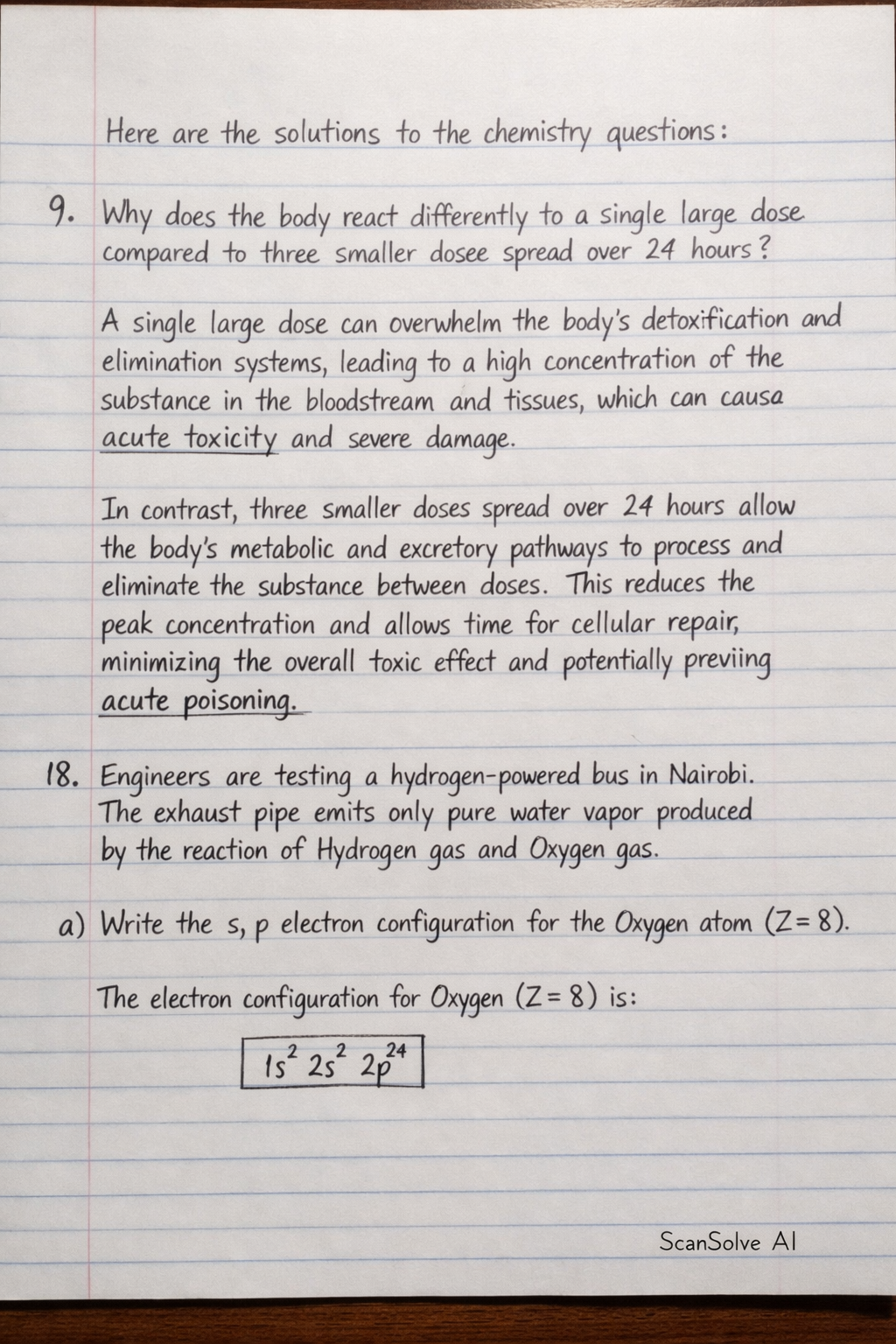
Here are the solutions to the chemistry questions: 9. Explain the toxicological risk, why does the body react differently to a single large dose compared to three smaller doses spread over 24 hours? A single large dose can overwhelm the body's detoxification and elimination systems, leading to a high concentration of the substance in the bloodstream and tissues, which can cause acute toxicity and severe damage. In contrast, three smaller doses spread over 24 hours allow the body's metabolic and excretory pathways to process and eliminate the substance between doses. This reduces the peak concentration and allows time for cellular repair, minimizing the overall toxic effect and potentially preventing acute poisoning. 18. Engineers are testing a hydrogen-powered bus in Nairobi. The exhaust pipe emits only pure water vapor produced by the reaction of Hydrogen gas and Oxygen gas. a) Write the s, p electron configuration for the Oxygen atom (Z=8). The electron configuration for Oxygen (Z=8) is: 1s^2 2s^2 2p^4 b) Write a balanced chemical equation for this combustion, including state symbols. The balanced chemical equation for the combustion of hydrogen gas with oxygen gas to produce water vapor is: 2H_2(g) + O_2(g) → 2H_2O(g) 19. A person suffering from heartburn takes Milk of Magnesia, which is Magnesium Hydroxide (Mg(OH)2). It reacts with the Hydrochloric Acid (HCl) in the stomach to produce Magnesium chloride and water. a) Draw the box orbital diagram for the magnesium (Z=12). Magnesium (Z=12) has 12 electrons. Its electron configuration is 1s^2 2s^2 2p^6 3s^2. The box orbital diagram is: c 1s \\ c 2s \\ c 2p \\ c 3s \\ b) Write the formula for the magnesium chloride salt formed when Mg(OH)2 neutralizes HCl. Magnesium forms a Mg^2+ ion and chloride forms a Cl^- ion. To balance the charges, two chloride ions are needed for one magnesium ion. The formula for magnesium chloride is: MgCl_2