
We read your photo as:
Determine which salt crystallizes at 20 °C and calculate the mass crystallized. Define hard water and state one use of it.
ScanSolve AI Answer
Step-by-step solution
4 stepshapa kuna majibu ya maswali yako:
Part a· 2 steps
I)
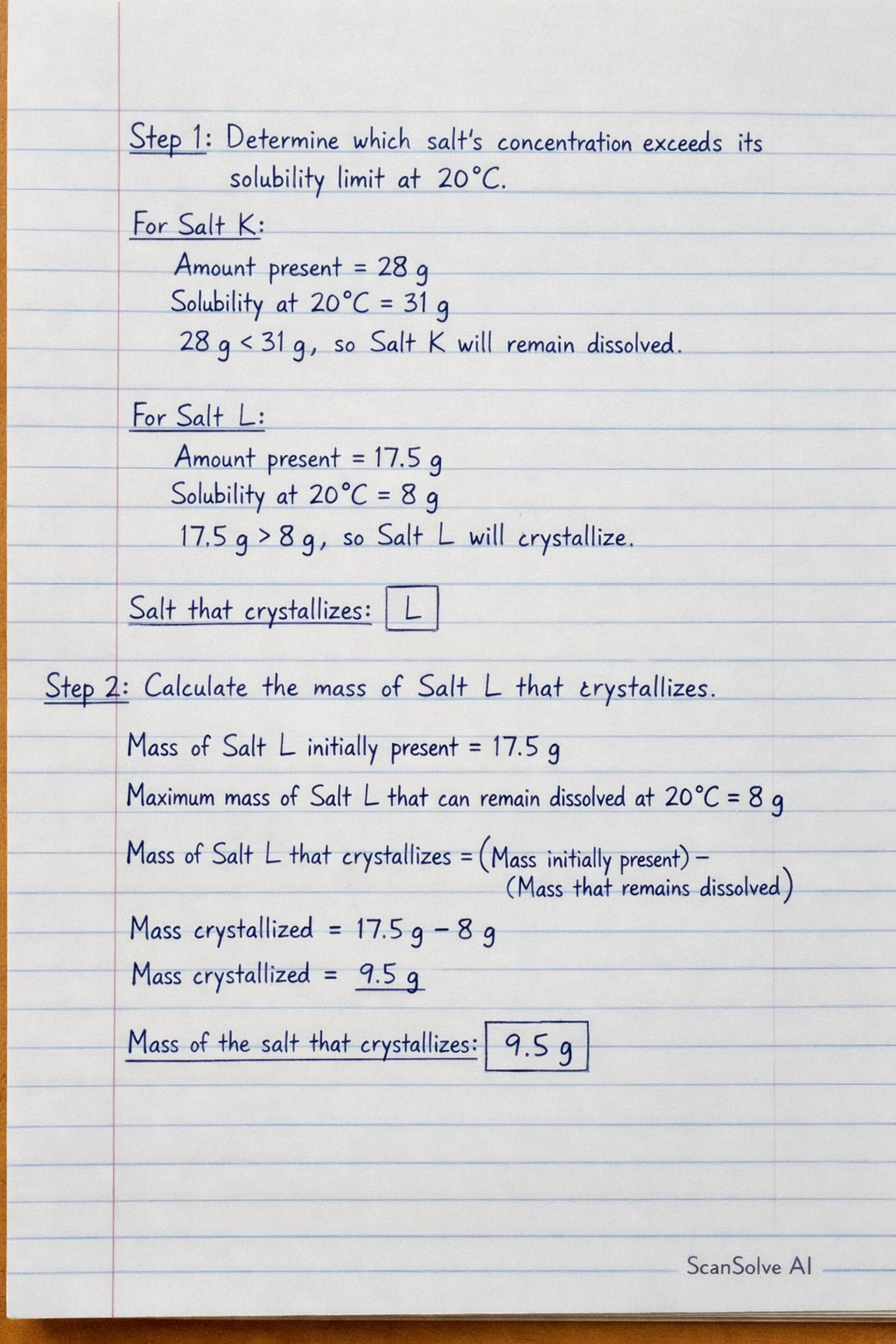
Determine which salt's concentration exceeds its solubility limit at 20 °C.
For Salt K:
Amount present = 28 g
Solubility at 20 °C = 31 g
Since , Salt K will remain dissolved.For Salt L:
Amount present = 17.5 g
Solubility at 20 °C = 8 g
Since , Salt L will crystallize.- Salt that crystallizes:
II)
Calculate the mass of Salt L that crystallizes.
Mass of Salt L initially present = 17.5 g
Maximum mass of Salt L that can remain dissolved at 20 °C = 8 g
Mass of Salt L that crystallizes = (Mass initially present) - (Mass that remains dissolved)- Mass of the salt that crystallizes:
Part b(i)· 1 step
Define hard water.
Hard water is water that contains a high concentration of dissolved mineral ions, primarily calcium () and magnesium () ions. It does not readily form lather with soap.
- What is hard water:
Part b(ii)· 1 step
State one use of hard water.
Hard water can be used in certain industrial processes or for drinking as it provides essential minerals.
- One use of hard water:
Still stuck on this one?
Ask a follow-up, and the answer starts from this question.
More Chemistry Questions
Handwritten Step-by-Step Solution
Get this as a handwritten image on WhatsApp — like a tutor wrote it for you.
Try on WhatsApp