
We read your photo as:
Mention four advantages of using a computer. List four basic parts of a computer. Give the three types of computers. Define Asset. What is a Liability? List the two types of Assets. List the two types of Liabilities. State the accounting equation. Complete the table below.
ScanSolve AI Answer
Step-by-step solution
4 stepsHere are the answers to your questions:
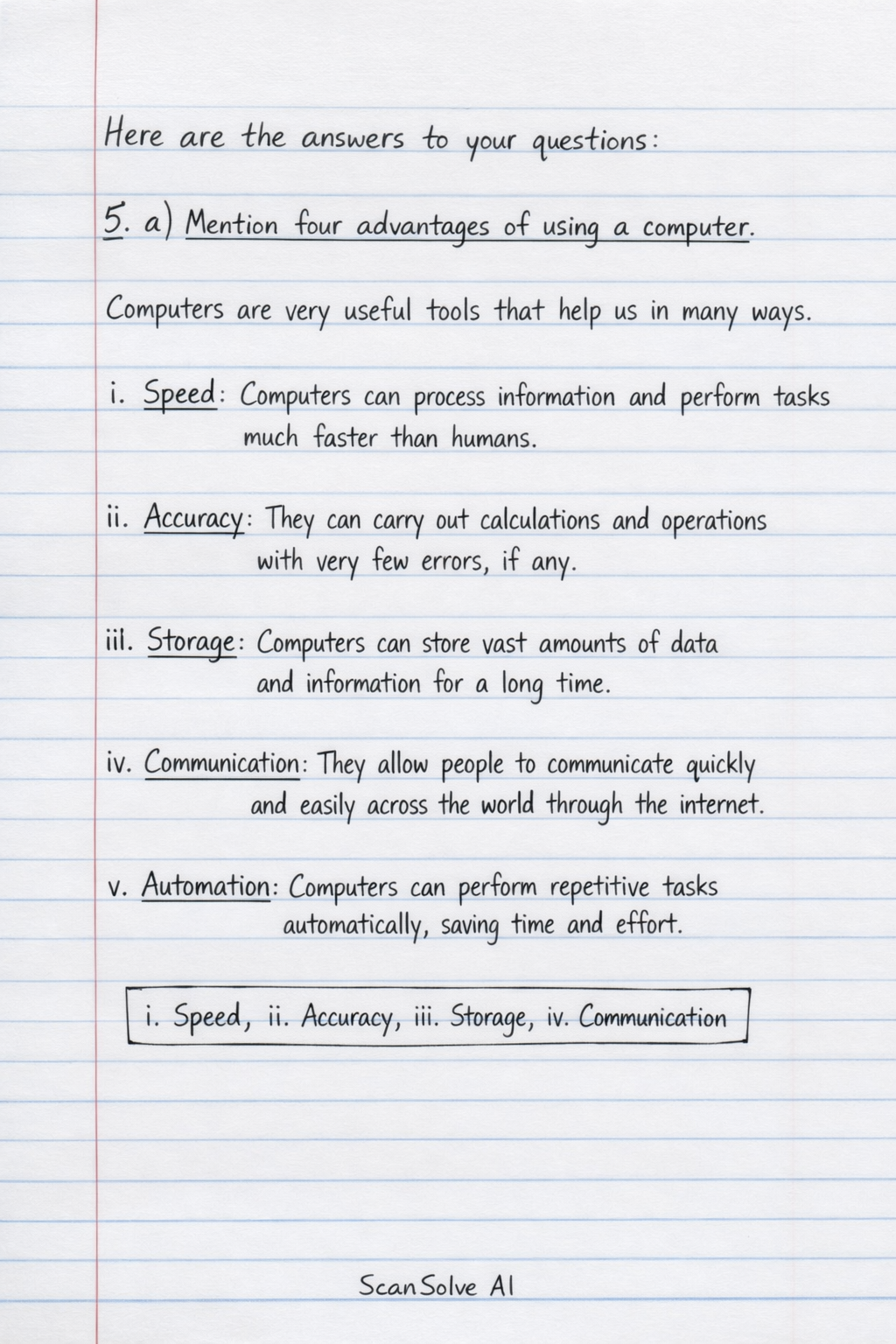
5. a) Mention four advantages of using a computer.
Computers are very useful tools that help us in many ways.
- i. Speed: Computers can process information and perform tasks much faster than humans.
- ii. Accuracy: They can carry out calculations and operations with very few errors, if any.
- iii. Storage: Computers can store vast amounts of data and information for a long time.
- iv. Communication: They allow people to communicate quickly and easily across the world through the internet.
- v. Automation: Computers can perform repetitive tasks automatically, saving time and effort. i. Speed, ii. Accuracy, iii. Storage, iv. Communication
5. b) List four basic parts of a computer.
A computer system is made up of several essential components.
- i. Monitor: This is the screen that displays information.
- ii. Keyboard: Used for typing text and commands into the computer.
- iii. Mouse: Used to control the pointer on the screen and select items.
- iv. Central Processing Unit (CPU): This is the "brain" of the computer, which carries out instructions. i. Monitor, ii. Keyboard, iii. Mouse, iv. Central Processing Unit (CPU)
5. c) Give the three types of computers.
Computers come in different sizes and have different capabilities.
- i. Digital computers: These are the most common type, processing data in discrete units (like 0s and 1s). Examples include personal computers, laptops, and smartphones.
- ii. Analogue computers: These computers represent data as continuously varying physical quantities, such as voltage or pressure. They are often used for specific scientific or engineering tasks.
- iii. Hybrid computers: These combine features of both analogue and digital computers, offering the speed of analogue computers and the accuracy of digital computers. i. Digital computers, ii. Analogue computers, iii. Hybrid computers
6. a) (i) Define Asset.
An asset is something valuable owned by a business or individual that can provide future economic benefits. It could be cash, property, equipment, or money owed to the business.
An asset is something owned by a business that has value and can provide future benefits.
6. a) (ii) What is a Liability?
A liability is an amount of money owed by a business or individual to others. It represents a financial obligation that must be paid in the future.
A liability is an amount of money owed by a business to others.
6. a) (iii) List the two types of Assets.
Assets are generally categorised based on how quickly they can be converted into cash.
- i. Fixed Assets (or Non-current Assets): These are long-term assets that a business expects to use for more than one year, such as land, buildings, and machinery.
- ii. Current Assets: These are short-term assets that can be converted into cash within one year, such as cash in hand, bank balances, and stock. i. Fixed Assets (or Non-current Assets), ii. Current Assets
6. a) (iv) List the two types of Liabilities.
Liabilities are also categorised based on when they are due to be paid.
- i. Long-term Liabilities (or Non-current Liabilities): These are debts that a business expects to pay back over a period longer than one year, such as bank loans or mortgages.
- ii. Current Liabilities: These are debts that a business expects to pay back within one year, such as money owed to suppliers (creditors) or bank overdrafts. i. Long-term Liabilities (or Non-current Liabilities), ii. Current Liabilities
6. b) (i) State the accounting equation.
The accounting equation is a fundamental principle in accounting that shows the relationship between assets, liabilities, and capital (owner's equity).
Assets = Capital + Liabilities
Using the accounting equation. Complete the table below.
The accounting equation is . We can rearrange this to find any missing value:
Calculate Liabilities for Row 1.
Given: Assets = Le 6,500, Capital = Le 4,000
Calculate Assets for Row 2.
Given: Capital = Le 25,000, Liabilities = Le 10,500
Calculate Capital for Row 3.
Given: Assets = Le 18,000, Liabilities = Le 3,000
Calculate Liabilities for Row 4.
Given: Assets = Le 40,000, Capital = Le 19,500
Here is the completed table:
Assets (Le) Capital (Le) Liabilities (Le) 1 6,500 4,000 2,500 2 35,500 25,000 10,500 3 18,000 15,000 3,000 4 40,000 19,500 20,500 See completed table above.
Still stuck on this one?
Ask a follow-up, and the answer starts from this question.
More Computer Science Questions
Handwritten Step-by-Step Solution
Get this as a handwritten image on WhatsApp — like a tutor wrote it for you.
Try on WhatsApp