
We read your photo as:
2.0 FOOD PRODUCTION PROCESSES
ScanSolve AI Answer
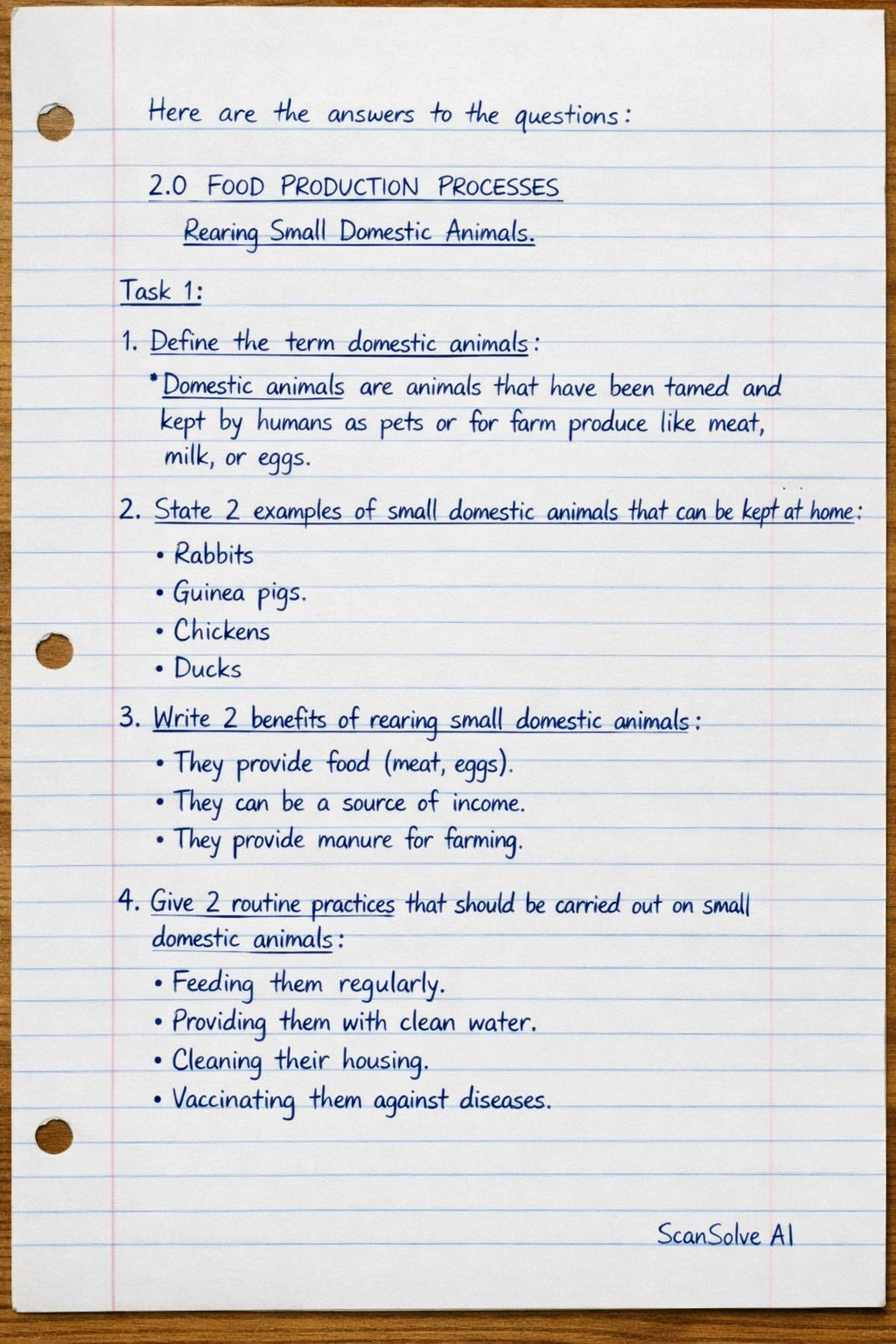
Here are the answers to the questions:
2.0 FOOD PRODUCTION PROCESSES
Rearing Small Domestic Animals
Task 1:
1. Define the term domestic animals:
- Domestic animals are animals that have been tamed and kept by humans as pets or for farm produce like meat, milk, or eggs.
2. State 2 examples of small domestic animals that can be kept at home:
- Rabbits
- Guinea pigs
- Chickens
- Ducks
3. Write 2 benefits of rearing small domestic animals:
- They provide food (meat, eggs).
- They can be a source of income.
- They provide manure for farming.
4. Give 2 routine practices that should be carried out on small domestic animals:
- Feeding them regularly.
- Providing them with clean water.
- Cleaning their housing.
- Vaccinating them against diseases.
5. Joseph was constructing a rabbit hutch. Why would you advise him to raise the hutch from the ground?
- Raising the hutch from the ground helps to prevent predators from reaching the rabbits, improves ventilation, and keeps the hutch dry from ground moisture.
6. Rabbits and guinea pigs feed on:
- Green leafy vegetables, hay, and pellets.
7. What is a routine?
- A routine is a sequence of actions regularly followed; a fixed program of activities.
8. Jackline wanted to construct a hutch for his rabbits. Name 2 materials and tools he required:
- Materials: Wood, wire mesh.
- Tools: Hammer, saw, nails.
9. Madam Susan is a farmer who keeps small domestic animals used as sources of meat. She wanted to control parasites. Name 2 ways she can use:
- Regular cleaning and disinfection of the animal housing.
- Deworming the animals.
- Spraying the animals or their housing with appropriate pesticides.
10. When constructing the roof of a hutch, Grade 6 learners made sure that it was slightly sloping. Why do you think they did so?
- They made the roof sloping to allow rainwater to run off easily, preventing water from collecting and damaging the hutch or making it damp.
11. Grade 6 learners wanted to make a deflector to use in their school to keep off birds. Name 2 materials they required:
- Old CDs/DVDs
- Shiny foil/plastic strips
- String/wire
12. Peter had stored maize grains in his store. He noticed that rodents were destroying his maize grains. Which method can be used to keep the rodents off?
- Using traps (e.g., snap traps, live traps).
- Using rodenticides (poison baits).
- Ensuring proper sealing of storage containers and entry points.
- Keeping cats as natural predators.
Preserving crop production; fruits and vegetables
Task 3:
1. Define Fruits:
- Fruits are the sweet, fleshy product of a tree or other plant that contains seed and can be eaten as food.
2. Define Vegetable:
- Vegetables are parts of plants that are consumed by humans or other animals as food, typically savory and not sweet.
3. Define Preserving:
- Preserving is the process of treating and storing food to prevent spoilage and maintain its quality for a longer period.
4. List 2 fruits found in your locality:
- Mangoes
- Bananas
- Oranges
- Avocados
5. List 2 vegetables found in your locality:
- Cabbages
- Tomatoes
- Spinach
- Kales
6. Which method do you use to preserve and store fruits at home?
- Refrigeration
- Drying
- Making jams/jellies
7. Mary wanted to preserve fruits using sun drying method. Name 2 materials she needed:
- Drying trays or mats
- Netting or cloth to cover the fruits
- Knives for slicing
8. State 2 importance of preserving fruits:
- It reduces food waste.
- It ensures food availability during off-seasons.
- It adds variety to the diet.
9. Anita wanted to preserve fruits using sun drying method. State 2 hygiene practices that she should observe:
- Wash hands thoroughly before handling fruits.
- Ensure all equipment and drying surfaces are clean.
- Wash fruits thoroughly before slicing.
10. Most fruits and vegetables are perishable. Explain the meaning of term perishable:
- Perishable means that food items are likely to decay or spoil quickly if not stored properly, due to factors like moisture, temperature, and microbial activity.
11. Fruits and vegetables should be arranged in a single layer during drying. Explain why this is done:
- Arranging them in a single layer ensures even exposure to sunlight and air, which promotes faster and more uniform drying, preventing mold growth.
12. Grade 6 learners were told to discuss items used to store fruits and vegetables at home. Name 2 items they stated:
- Baskets
- Refrigerators
- Airtight containers
13. Why is it important to cover fruits and vegetables with a net when sun drying?
- It is important to cover them with a net to protect them from insects, birds, and dust while allowing air circulation for drying.
14. What is blanching?
- Blanching is a cooking process where food, usually a vegetable or fruit, is scalded in boiling water or steam for a short period, then plunged into iced water to stop the cooking process.
15. What is sun drying?
- Sun drying is a method of food preservation that involves spreading food items, typically fruits or vegetables, in direct sunlight to remove moisture, thereby inhibiting microbial growth and extending shelf life.
Still stuck on this one?
Ask a follow-up, and the answer starts from this question.
More Economics Questions
Handwritten Step-by-Step Solution
Get this as a handwritten image on WhatsApp — like a tutor wrote it for you.
Try on WhatsApp