
We read your photo as:
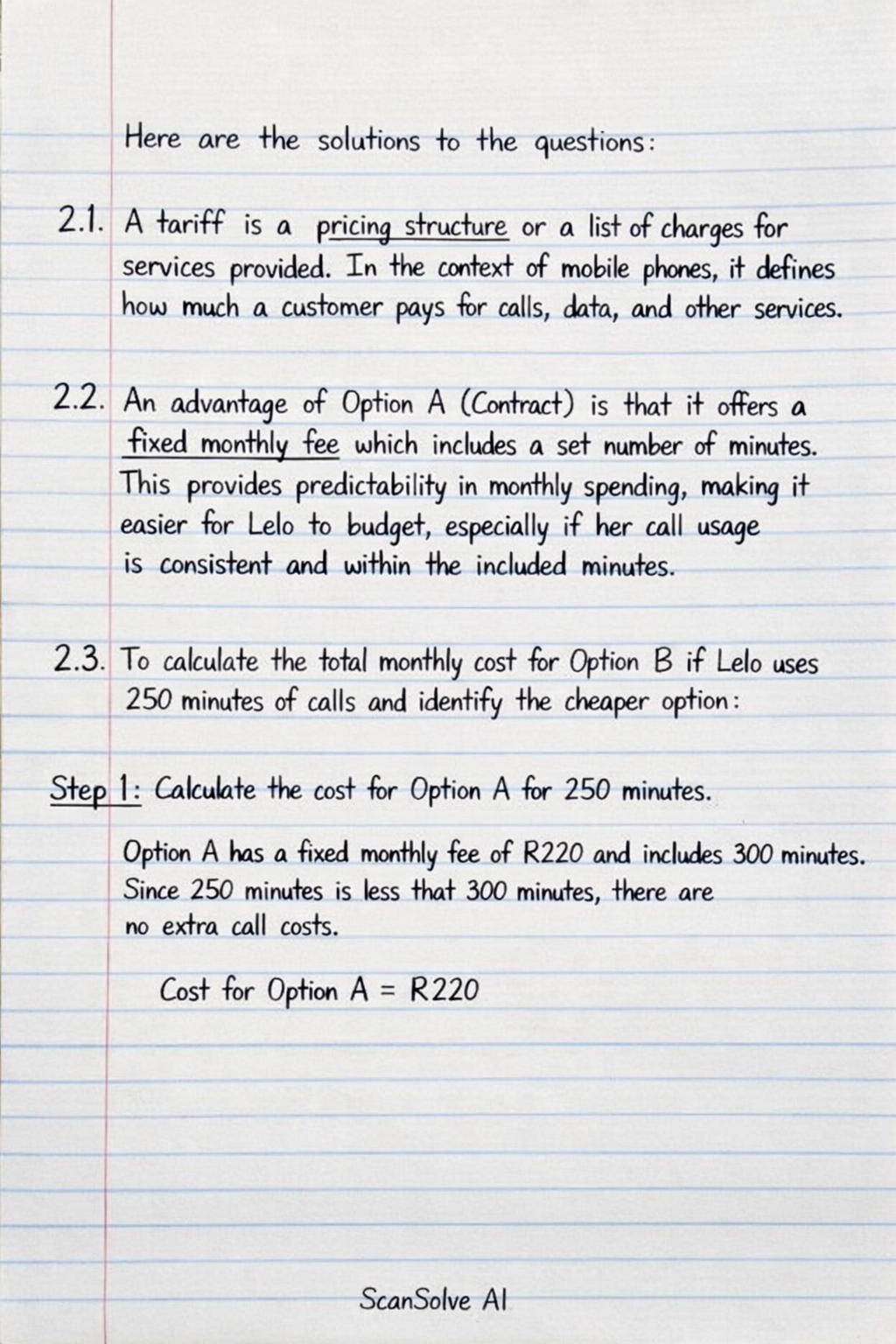
A tariff is a pricing structure or a list of charges for services provided. In the context of mobile phones, it defines how much a customer pays for calls, data, and other services.
ScanSolve AI Answer
Answer
Step-by-step solution
3 stepsHere are the solutions to the questions:
Part 2.1
A tariff is a pricing structure or a list of charges for services provided. In the context of mobile phones, it defines how much a customer pays for calls, data, and other services.
Part 2.2
An advantage of Option A (Contract) is that it offers a fixed monthly fee which includes a set number of minutes. This provides predictability in monthly spending, making it easier for Lelo to budget, especially if her call usage is consistent and within the included minutes.
Part 2.3
To calculate the total monthly cost for Option B if Lelo uses 250 minutes of calls and identify the cheaper option:
Calculate the cost for Option A for 250 minutes.
Option A has a fixed monthly fee of R220 and includes 300 minutes. Since 250 minutes is less than 300 minutes, there are no extra call costs.
Calculate the cost for Option B for 250 minutes.
Option B has no monthly fee, and the call cost is R2.30 per minute.
Compare the costs to identify the cheaper option.
Since , Option A is cheaper.
The total monthly cost for Option B is , and the cheaper option for using 250 minutes is Option A.
Part 2.4
Choosing the wrong tariff can significantly affect Lelo's monthly budget by leading to unnecessary expenditure. If Lelo chooses a contract (Option A) but uses very few minutes, she would be paying a fixed fee for minutes she doesn't utilize. Conversely, if she chooses a pay-as-you-go tariff (Option B) but makes many calls, the per-minute costs can quickly accumulate to a much higher total than a contract, causing her to overspend and potentially exceed her budget for communication, leaving less money for other essential expenses or savings.
Try one yourself
A new problem that tests the same skill.
Still stuck on this one?
Ask a follow-up, and the answer starts from this question.
More Economics Questions
Handwritten Step-by-Step Solution
Get this as a handwritten image on WhatsApp — like a tutor wrote it for you.
Try on WhatsApp