
We read your photo as:
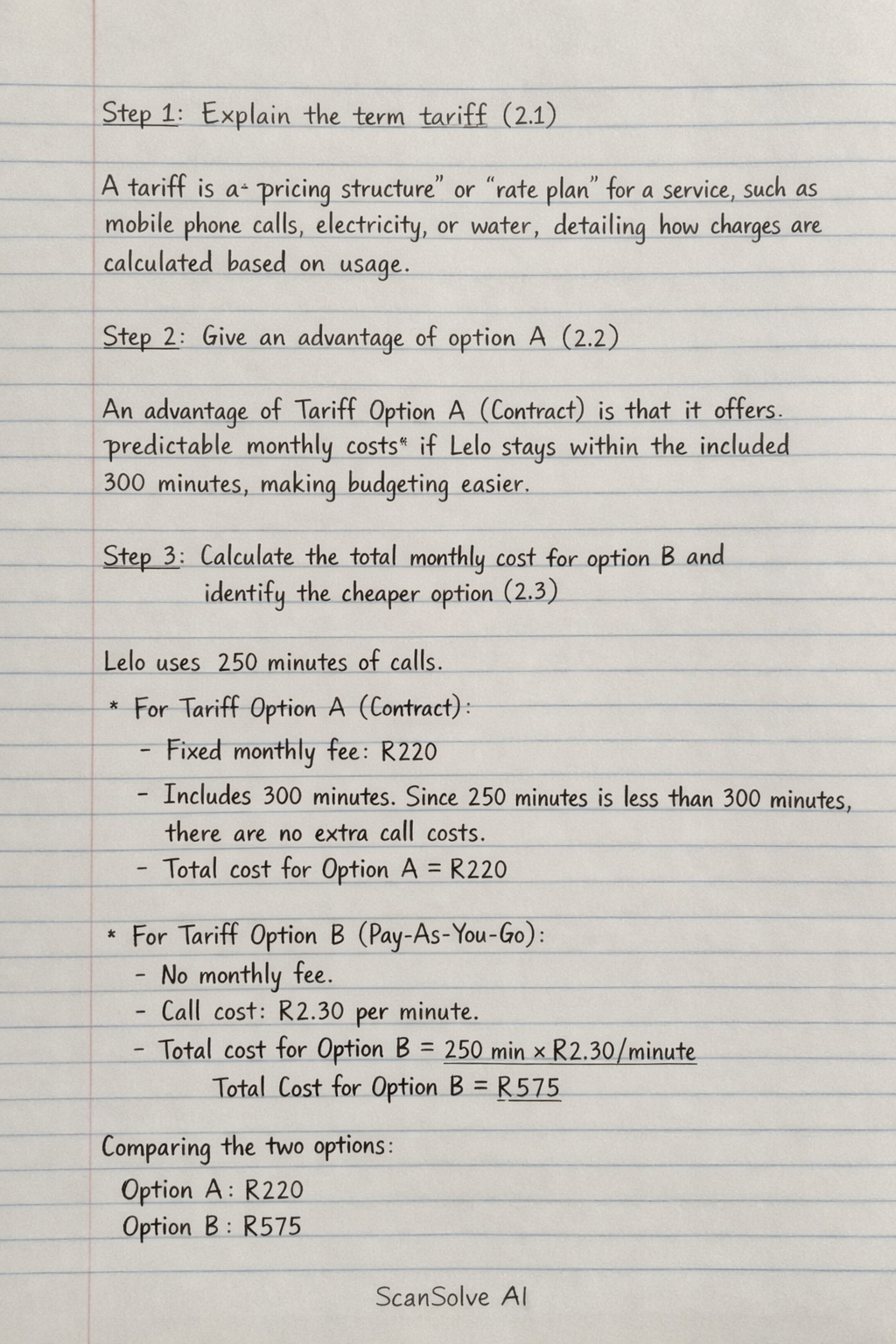
Explain the term tariff (2.1)
ScanSolve AI Answer
Step-by-step solution
8 stepsExplain the term tariff (2.1)
A tariff is a pricing structure or rate plan for a service, such as mobile phone calls, electricity, or water, detailing how charges are calculated based on usage.
Give an advantage of option A (2.2)
An advantage of Tariff Option A (Contract) is that it offers predictable monthly costs if Lelo stays within the included 300 minutes, making budgeting easier.
Calculate the total monthly cost for option B and identify the cheaper option (2.3)
Lelo uses 250 minutes of calls.
-
For Tariff Option A (Contract):
- Fixed monthly fee: R220
- Includes 300 minutes. Since 250 minutes is less than 300 minutes, there are no extra call costs.
- Total cost for Option A = R220
-
For Tariff Option B (Pay-As-You-Go):
- No monthly fee.
- Call cost: R2.30 per minute.
- Total cost for Option B =
Comparing the two options: Option A: R220 Option B: R575
The total monthly cost for option B is R575.
The cheaper option for using 250 minutes is Option A.-
Explain how choosing the wrong tariff can affect Lelo's monthly budget (2.4)
Choosing the wrong tariff can negatively impact Lelo's budget by leading to unnecessary expenses. For example, if Lelo chooses a contract with a high fixed fee but uses very few minutes, they pay for services they don't use. Conversely, if Lelo chooses a pay-as-you-go option but makes many calls, the high per-minute rates could result in a much larger bill than a contract with included minutes.
Write down the difference between bar scale and number scale (3.1.1)
A bar scale is a visual representation of the scale, typically a line marked with distances, which remains accurate even if the map or plan is enlarged or reduced. A number scale (or ratio scale) is expressed as a ratio (e.g., 1:50), indicating that one unit on the plan represents a certain number of units in reality, but it becomes inaccurate if the map or plan is resized.
Explain the meaning of the scale 1:50 (3.1.2)
The scale 1:50 means that 1 unit of measurement on the plan represents 50 of the same units in actual size. For example, 1 cm on the plan corresponds to 50 cm in the real classroom.
Calculate the actual length of the desk in metres (3.1.3)
The teacher's desk measures 6 cm on the plan.
The scale is 1:50.
Actual length in cm = Plan length Scale factorTo convert centimetres to metres, divide by 100.
The actual length of the desk is:
Calculate the actual distance between the desks in metres (3.1.4)
The distance between two learners' desks is 4 cm on the plan.
The scale is 1:50.
Actual distance in cm = Plan distance Scale factorTo convert centimetres to metres, divide by 100.
The actual distance between the desks is:
Still stuck on this one?
Ask a follow-up, and the answer starts from this question.
More Economics Questions
Handwritten Step-by-Step Solution
Get this as a handwritten image on WhatsApp — like a tutor wrote it for you.
Try on WhatsApp