

This economics question tests your understanding of economic models and analysis. The step-by-step answer below applies the relevant framework and explains the reasoning.
ScanSolve AI Answer
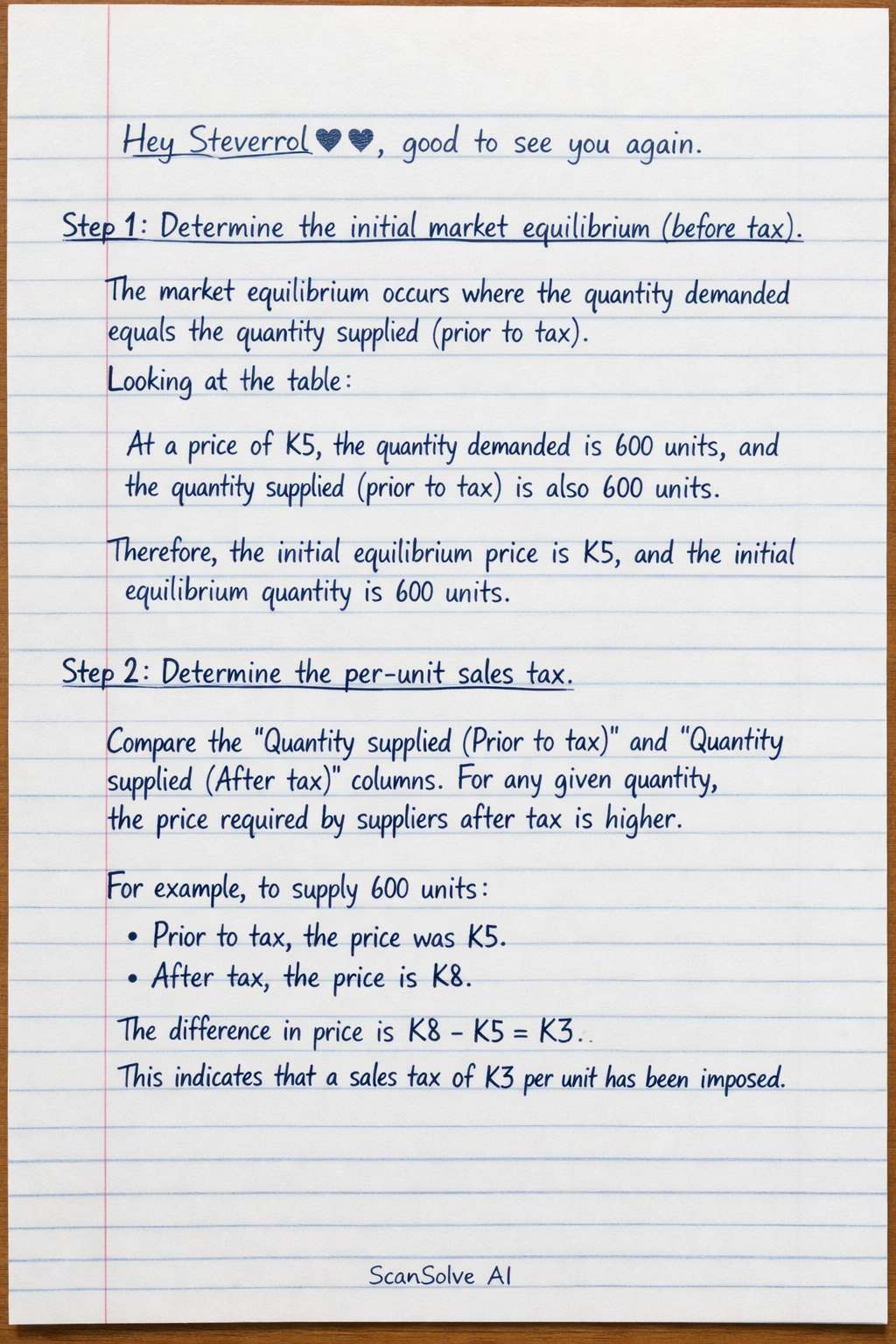
Step 1: Determine the initial market equilibrium (before tax). The market equilibrium occurs where the quantity demanded equals the quantity supplied (prior to tax). Looking at the table: At a price of K5, the quantity demanded is 600 units, and the quantity supplied (prior to tax) is also 600 units. Therefore, the initial equilibrium price is K5, and the initial equilibrium quantity is 600 units. Step 2: Determine the per-unit sales tax. Compare the "Quantity supplied (Prior to tax)" and "Quantity supplied (After tax)" columns. For any given quantity, the price required by suppliers after tax is higher. For example, to supply 600 units: • Prior to tax, the price was K5. • After tax, the price is K8. The difference in price is K8 - K5 = K3. This indicates that a sales tax of K3 per unit has been imposed. Step 3: Determine the new market equilibrium (after tax). The new equilibrium occurs where the quantity demanded equals the quantity supplied (after tax). Looking at the table: • At Price K7: Quantity demanded = 400 units, Quantity supplied (after tax) = 500 units. • At Price K6: Quantity demanded = 500 units, Quantity supplied (after tax) = 400 units. Since there is no exact match in the table, the equilibrium lies between these two price points. By interpolating linearly between these points: The new equilibrium price is K6.5, and the new equilibrium quantity is 450 units. Step 4: Analyze the impact of the tax. • The price paid by consumers increases from K5 to K6.5. • The price received by producers (after paying the K3 tax) decreases from K5 to K3.5 (K6.5 - K3). • The equilibrium quantity traded decreases from 600 units to 450 units. • The government's tax revenue is K3 per unit × 450 units = K1350. • The tax burden is shared: consumers pay K1.5 of the tax (K6.5 - K5), and producers bear K1.5 of the tax (K5 - K3.5). The key equilibrium points are: Initial Equilibrium: Price = K5, Quantity = 600 units* Sales Tax: K3 per unit* New Equilibrium: Price = K6.5, Quantity = 450 units* Send me the next one 📸