
We read your photo as:
Explain what a tariff is in this context and calculate the total units of electricity purchased given an initial meter reading and a purchase amount.
ScanSolve AI Answer
Step-by-step solution
10 steps2.1.1
A tariff in this context refers to the rate or price charged per unit of electricity (kWh) by the municipality. It is the cost structure for the electricity service.
2.1.2
a)
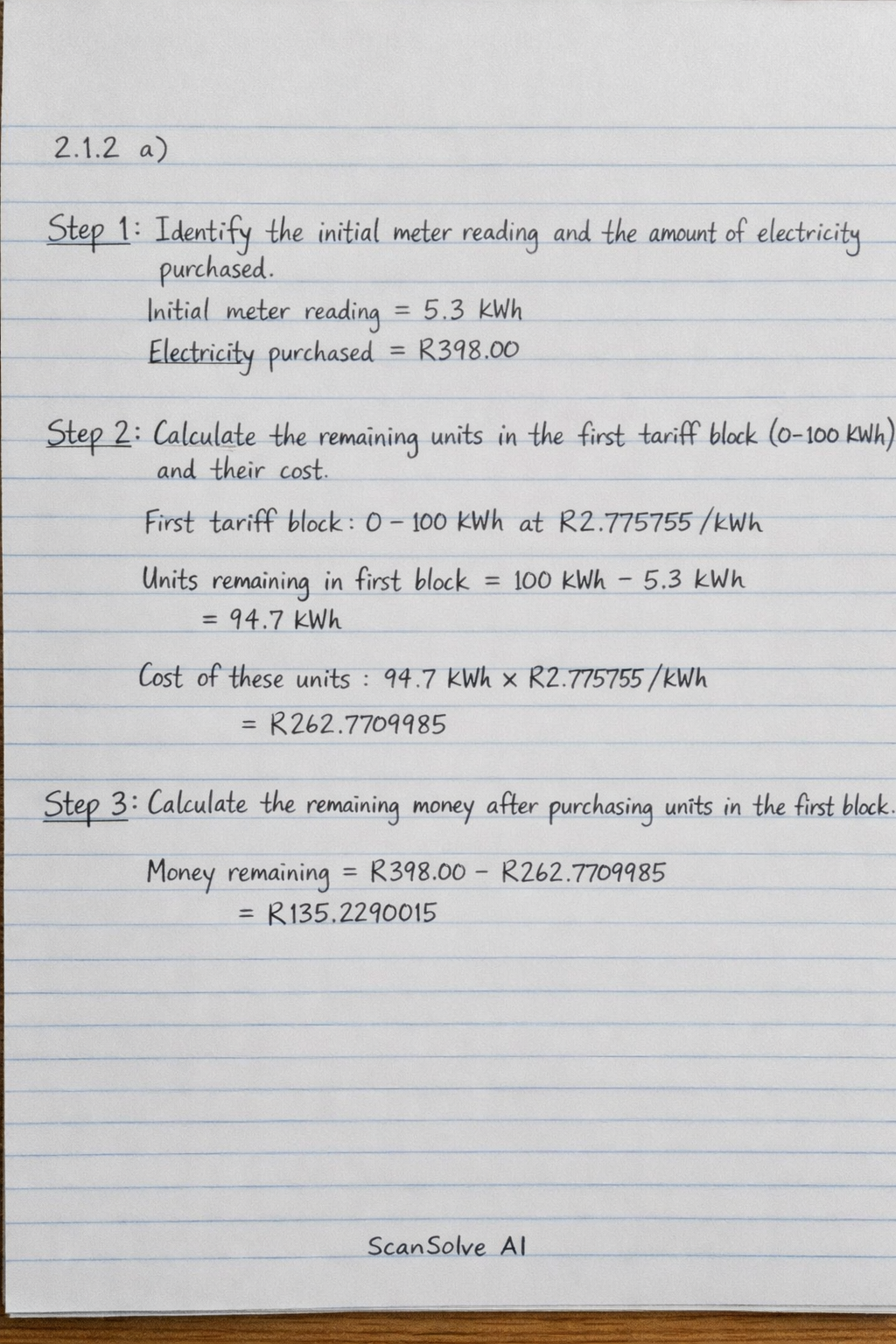
Identify the initial meter reading and the amount of electricity purchased.
The initial meter reading before purchase was .
Lebogang purchased electricity worth .Calculate the remaining units in the first tariff block (0-100 kWh) and their cost.
The first tariff block is for at per unit.
Units remaining in the first block = .
Cost of these units = .Calculate the remaining money after purchasing units in the first block.
Money remaining = .
Calculate the units purchased in the second tariff block (101-400 kWh).
The second tariff block is for at per unit.
Units purchased in the second block = .Calculate the total units of electricity purchased.
Total units purchased = .
Calculate the new meter reading after the purchase.
New meter reading = Initial meter reading + Total units purchased
New meter reading = .Round the new meter reading to the nearest whole number and compare.
Rounded new meter reading = .
The meter reading after purchase shown in Table 3 is . When rounded to the nearest whole number, becomes .
Therefore, the meter reading after purchase is correct when rounded to the nearest whole number.b)
Identify the VAT rate.
The tariffs are VAT inclusive. Assuming the standard South African VAT rate of .
Calculate the VAT amount on the electricity purchase.
The total purchase amount of includes VAT.
VAT amount =
VAT amount =
VAT amount =
VAT amount =Round the VAT amount to two decimal places.
The VAT amount on her electricity purchase is .
Still stuck on this one?
Ask a follow-up, and the answer starts from this question.
More Economics Questions
Handwritten Step-by-Step Solution
Get this as a handwritten image on WhatsApp — like a tutor wrote it for you.
Try on WhatsApp