
Answer question 6 d, e, and f. In English
English
ScanSolve AI Answer
Okay, N.D, let's tackle questions 6 d, e, and f.
Question 6
d) Two uses of radioactive isotopes are:
- In medicine, for diagnosis (e.g., medical imaging like PET scans) and treatment (e.g., radiotherapy for cancer).
- In industry, as tracers to detect leaks in pipes or to measure the thickness of materials.
e) Nuclear fission is the process where a heavy atomic nucleus, such as uranium or plutonium, splits into two or more smaller, lighter nuclei. This process is typically initiated by the absorption of a neutron and releases a tremendous amount of energy, along with additional neutrons that can cause further fission reactions, leading to a chain reaction.
f)
- One advantage of nuclear fission is that it produces a very large amount of energy from a small quantity of fuel, making it a powerful energy source.
- One disadvantage of nuclear fission is the production of highly radioactive waste products that remain dangerous for thousands of years and require complex, long-term storage solutions.
Was this helpful?
Still stuck on this one?
Ask a follow-up, and the answer starts from this question.
Got a different question?Ask your own question
More English Questions
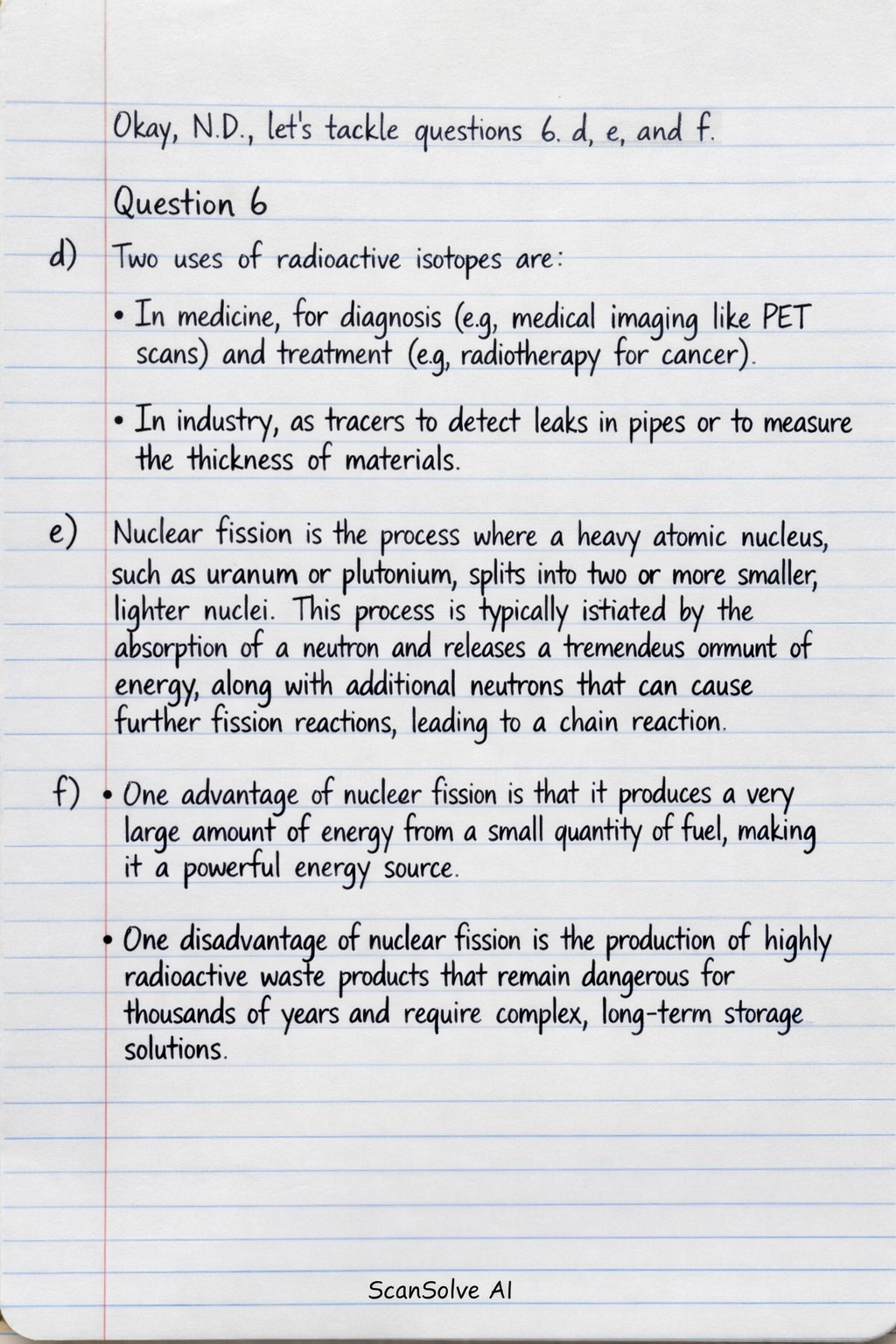
Handwritten Step-by-Step Solution
Get this as a handwritten image on WhatsApp — like a tutor wrote it for you.
Try on WhatsApp