
![To determine the type of inhibition, we will use the Lineweaver-Burk plot, which plots 1/V against 1/[S]. The Lineweaver-Burk equation is:](/_next/image?url=https%3A%2F%2Fohijasnjvprzodcmxltt.supabase.co%2Fstorage%2Fv1%2Fobject%2Fpublic%2Fwhatsapp-images%2F1776773770225-f8222189689cf2db.png&w=3840&q=75)
This English question involves literary analysis, grammar, or writing skills. The detailed response below provides a well-structured answer with supporting evidence and clear explanations.
ScanSolve AI Answer
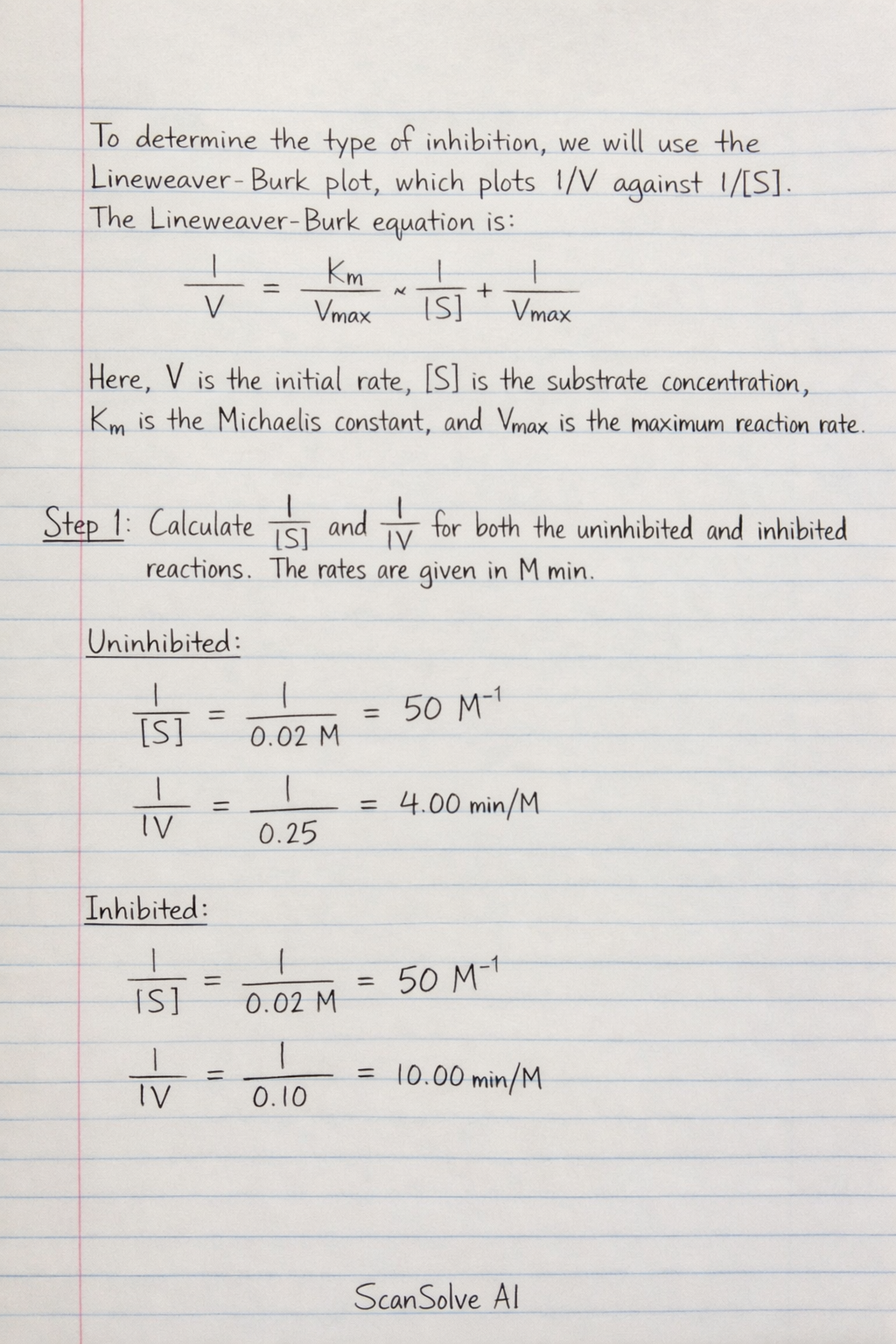
To determine the type of inhibition, we will use the Lineweaver-Burk plot, which plots 1/V against 1/[S]. The Lineweaver-Burk equation is: (1)/(V) = (K_m)/(V_max) (1)/([S]) + (1)/(V_max) Here, V is the initial rate, [S] is the substrate concentration, K_m is the Michaelis constant, and V_max is the maximum reaction rate. Step 1: Calculate 1/[S] and 1/V for both the uninhibited and inhibited reactions. The rates are given in M min