
We read your photo as:
Using relevant examples, discuss the conditions necessary for spatial interaction to occur and their relevance in understanding the flow of goods and services in Kenya.
ScanSolve AI Answer
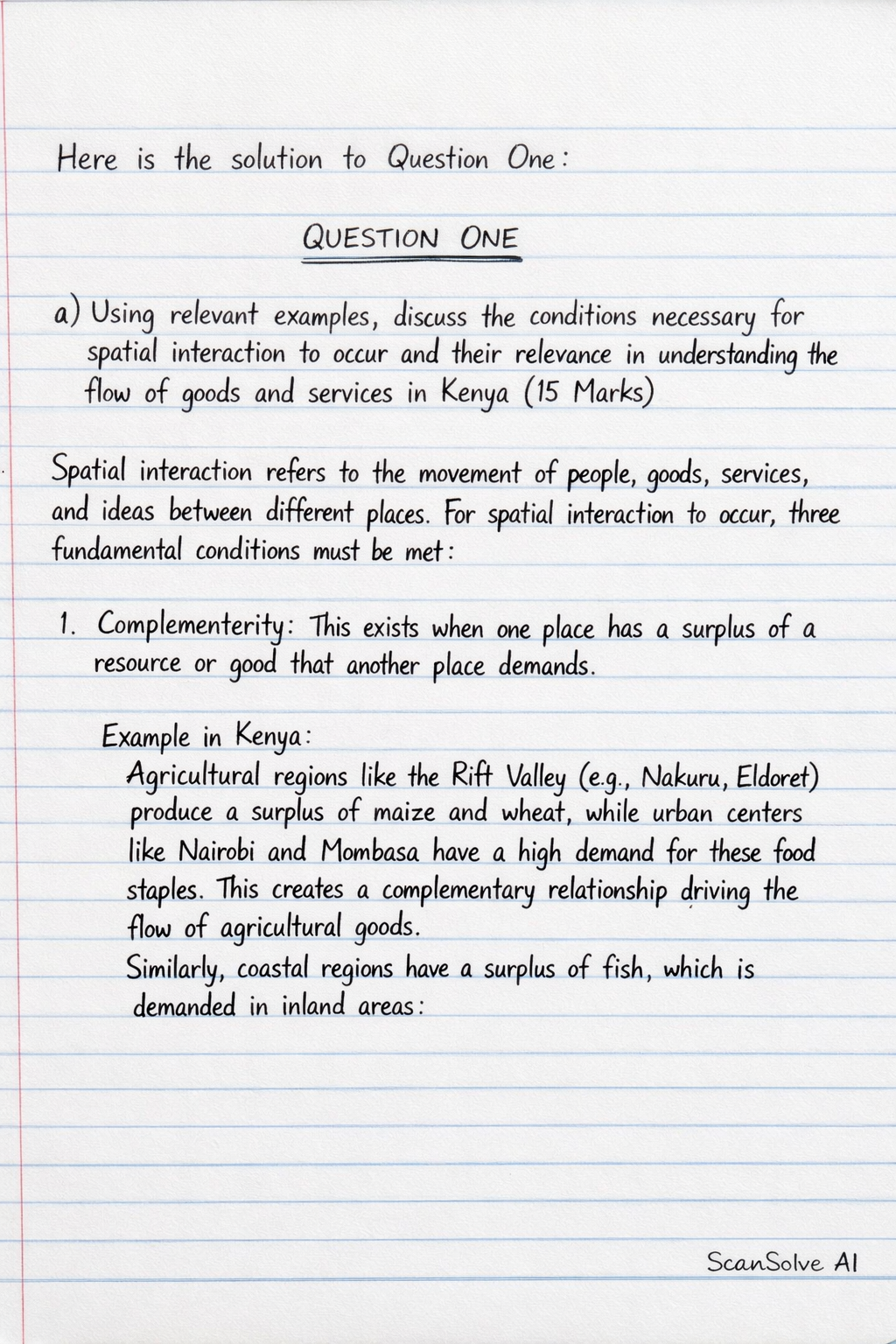
Here is the solution to Question One:
QUESTION ONE
a) Using relevant examples, discuss the conditions necessary for spatial interaction to occur and their relevance in understanding the flow of goods and services in Kenya (15 Marks)
Spatial interaction refers to the movement of people, goods, services, and ideas between different places. For spatial interaction to occur, three fundamental conditions must be met:
-
Complementarity: This exists when one place has a surplus of a resource or good that another place demands.
- Example in Kenya: Agricultural regions like the Rift Valley (e.g., Nakuru, Eldoret) produce a surplus of maize and wheat, while urban centers like Nairobi and Mombasa have a high demand for these food staples. This creates a complementary relationship driving the flow of agricultural goods. Similarly, coastal regions have a surplus of fish, which is demanded in inland areas.
-
Transferability: This refers to the ease and cost of moving goods, people, or information between places. It depends on factors like distance, transportation infrastructure, and the value of the item being moved.
- Example in Kenya: The development of infrastructure like the Standard Gauge Railway (SGR) and improved road networks (e.g., Nairobi-Mombasa highway) has significantly increased the transferability of goods between major cities and ports. This reduces transport costs and time, facilitating trade and the movement of services. For instance, fresh produce from agricultural areas can now reach urban markets faster and more affordably.
-
Intervening Opportunity: This occurs when a closer or more accessible alternative source or destination reduces the attractiveness of a more distant interaction.
- Example in Kenya: If Nairobi needs fresh vegetables, it might source them from nearby Kiambu or Limuru counties rather than more distant agricultural areas like Western Kenya, even if the latter has a surplus. The closer proximity of Kiambu presents an intervening opportunity, reducing the flow from further regions. Similarly, a consumer in Kisumu might choose to buy goods from a local retailer rather than traveling to Nairobi, due to the intervening opportunity of a closer market.
Relevance in understanding the flow of goods and services in Kenya:
These conditions are crucial for understanding Kenya's economic geography. They explain why certain regions specialize in particular productions and how they connect to markets. For instance, the high demand for manufactured goods in rural areas (complementarity) combined with improved roads (transferability) drives the flow of goods from industrial hubs like Nairobi. Conversely, the presence of local markets (intervening opportunities) can limit the reach of distant suppliers. Analyzing these factors helps in planning infrastructure development, market access, and regional economic integration to optimize the flow of goods and services across the country.
b) Citing relevant examples, discuss the types of spatial diffusion process. (15 Marks)
Spatial diffusion is the process by which an idea, innovation, or characteristic spreads from one place to another over time. There are two main types:
-
Relocation Diffusion: This occurs when the innovation or idea spreads through the physical movement of people from one place to another. The individuals carrying the idea move, and the idea is established in a new location.
- Example: The spread of chapati (flatbread) making from South Asia to East Africa, including Kenya, is an example of relocation diffusion. It was introduced by Indian migrants who settled in Kenya during the colonial era and brought their culinary traditions with them. As these communities grew and interacted, the practice diffused into the broader Kenyan culture.
-
Expansion Diffusion: This occurs when an idea or innovation spreads outward from its hearth (origin) to other places while remaining strong in the original location. It does not involve the physical movement of the carriers of the idea. Expansion diffusion can be further categorized into:
- Contagious Diffusion: This is the rapid, widespread diffusion of a characteristic throughout the population, similar to the spread of a disease. It spreads from person to person through direct contact, like a ripple effect.
- Example: The spread of a new fashion trend or a popular dance style (e.g., Odi Dance or Gengetone music) in Kenya. It typically starts in urban centers like Nairobi and quickly spreads to surrounding areas and then to other towns through social media, word-of-mouth, and direct interaction among youth.
- Hierarchical Diffusion: This is the spread of an idea from persons or nodes of authority or power to other persons or places. It often follows a hierarchy, such as from large cities to smaller cities, or from influential individuals to less influential ones.
- Example: The adoption of mobile banking services like M-Pesa in Kenya. It was initially adopted by urban, tech-savvy populations and businesses in major cities (Nairobi, Mombasa) and then gradually diffused downwards to smaller towns and rural areas as its benefits became apparent and infrastructure expanded. Similarly, government policies or new technologies often diffuse from national capitals to regional centers and then to local communities.
- Contagious Diffusion: This is the rapid, widespread diffusion of a characteristic throughout the population, similar to the spread of a disease. It spreads from person to person through direct contact, like a ripple effect.
Still stuck on this one?
Ask a follow-up, and the answer starts from this question.
More Geography Questions
Handwritten Step-by-Step Solution
Get this as a handwritten image on WhatsApp — like a tutor wrote it for you.
Try on WhatsApp