
We read your photo as:
Describe the socio-economic practices of early humans in Africa during the Early, Middle, and Late Stone Age periods.
ScanSolve AI Answer
Here are the socio-economic practices of early humans in Africa during the specified periods:
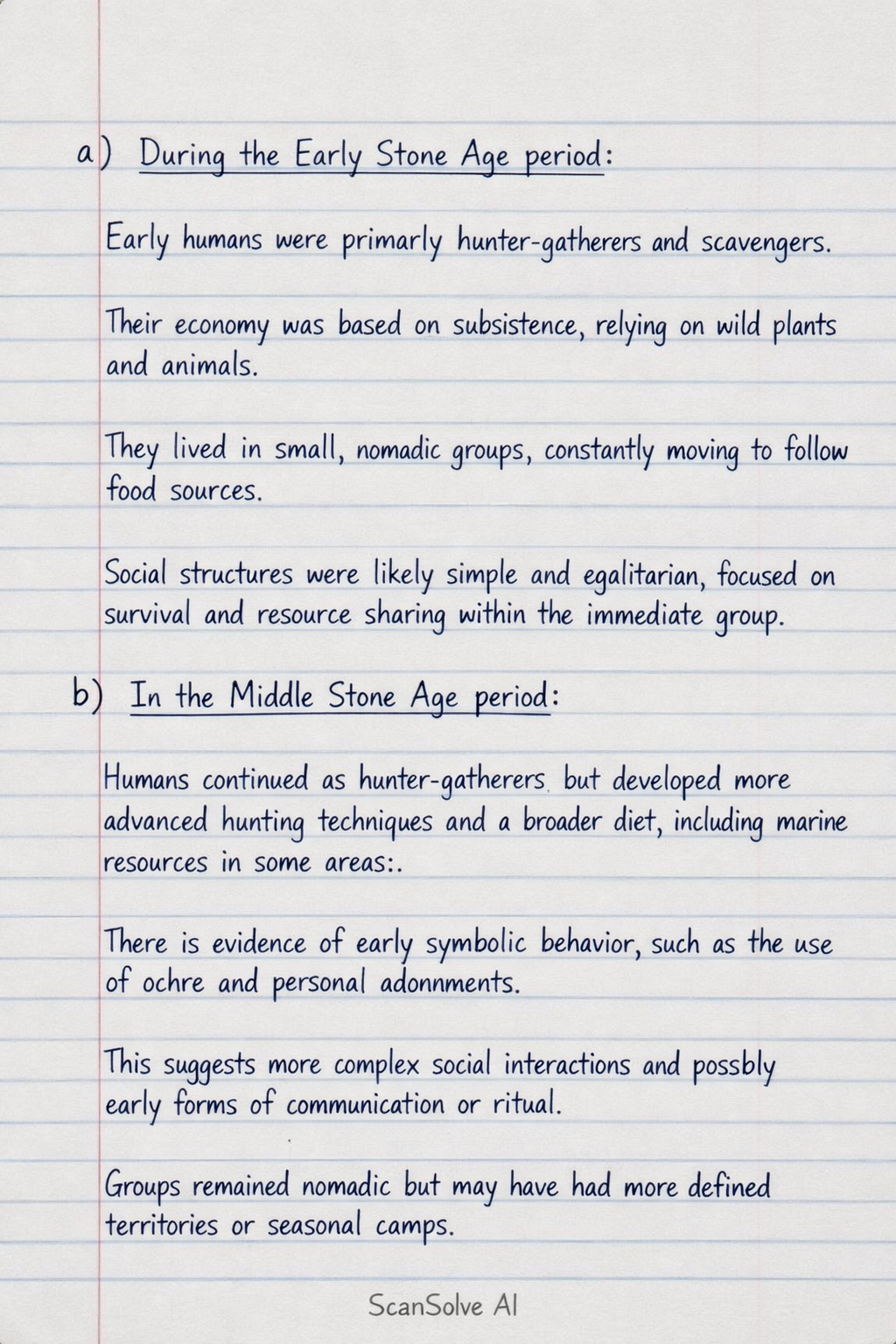
a) During the Early Stone Age period, early humans were primarily hunter-gatherers and scavengers. Their economy was based on subsistence, relying on wild plants and animals. They lived in small, nomadic groups, constantly moving to follow food sources. Social structures were likely simple and egalitarian, focused on survival and resource sharing within the immediate group.
b) In the Middle Stone Age period, humans continued as hunter-gatherers but developed more sophisticated hunting techniques and a broader diet, including marine resources in some areas. There is evidence of early symbolic behavior, such as the use of ochre and personal adornments, suggesting more complex social interactions and possibly early forms of communication or ritual. Groups remained nomadic but might have had more defined territories or seasonal camps.
c) The Late Stone Age period saw highly specialized hunter-gatherer societies. Humans developed diverse and refined tools, including microliths and bone tools, allowing for more efficient exploitation of resources. There is strong evidence of art, long-distance trade networks, and more complex social organization, including larger group sizes and potentially more structured leadership. While still mobile, some groups may have established more semi-permanent settlements, adapting to specific regional environments.
Still stuck on this one?
Ask a follow-up, and the answer starts from this question.
More History Questions
Handwritten Step-by-Step Solution
Get this as a handwritten image on WhatsApp — like a tutor wrote it for you.
Try on WhatsApp