
We read your photo as:
What were the main characteristics, advantages, and disadvantages of early civilizations in Africa and their trade and political systems?
ScanSolve AI Answer
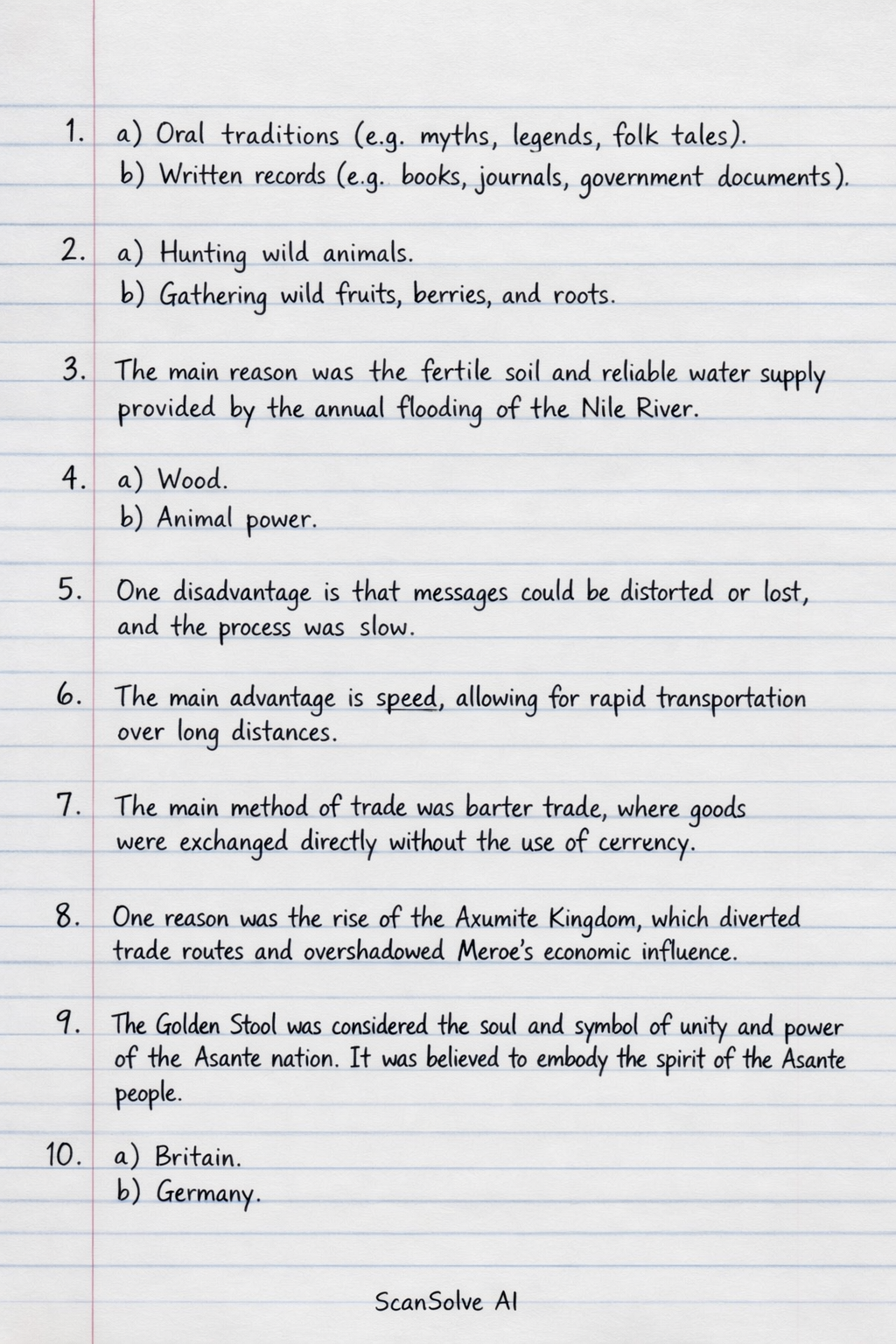
- a) Oral traditions (e.g., myths, legends, folk tales).
b) Written records (e.g., books, journals, government documents).
- a) Hunting wild animals.
b) Gathering wild fruits, berries, and roots.
-
The main reason was the fertile soil and reliable water supply provided by the annual flooding of the Nile River.
-
a) Wood.
b) Animal power.
-
One disadvantage is that messages could be distorted or lost, and the process was slow.
-
The main advantage is speed, allowing for rapid transportation over long distances.
-
The main method of trade was barter trade, where goods were exchanged directly without the use of currency.
-
One reason was the rise of the Axumite Kingdom, which diverted trade routes and overshadowed Meroe's economic influence.
-
The Golden Stool was considered the soul and symbol of unity and power of the Asante nation. It was believed to embody the spirit of the Asante people.
-
a) Britain.
b) Germany.
-
The Lozi collaborated with the British primarily for protection against their traditional enemies, particularly the Ndebele.
-
a) It led to the creation of an assimilated elite class of Africans who adopted French culture and language.
b) It resulted in the loss of traditional African cultures and institutions among the assimilated population.
-
The main cause was the assassination of Archduke Franz Ferdinand of Austria-Hungary by a Serbian nationalist.
-
Nationalism developed due to economic exploitation and racial discrimination by the colonial administration, which fostered a desire for self-rule among Ghanaians.
-
a) To administer peacekeeping operations and mediate international disputes.
b) To prepare reports and studies for other UN organs and manage the UN's budget.
- a) It has promoted democracy and good governance among member states.
b) It has fostered economic cooperation and trade among its members.
- a) Direct democracy.
b) Representative democracy.
Still stuck on this one?
Ask a follow-up, and the answer starts from this question.
More History Questions
Handwritten Step-by-Step Solution
Get this as a handwritten image on WhatsApp — like a tutor wrote it for you.
Try on WhatsApp