1; 3; 9; 27;... Which statement best describes the pattern?

Mathematics
1; 3; 9; 27;... Which statement best describes the pattern?

ScanSolve AI Answer

Answer

3$.

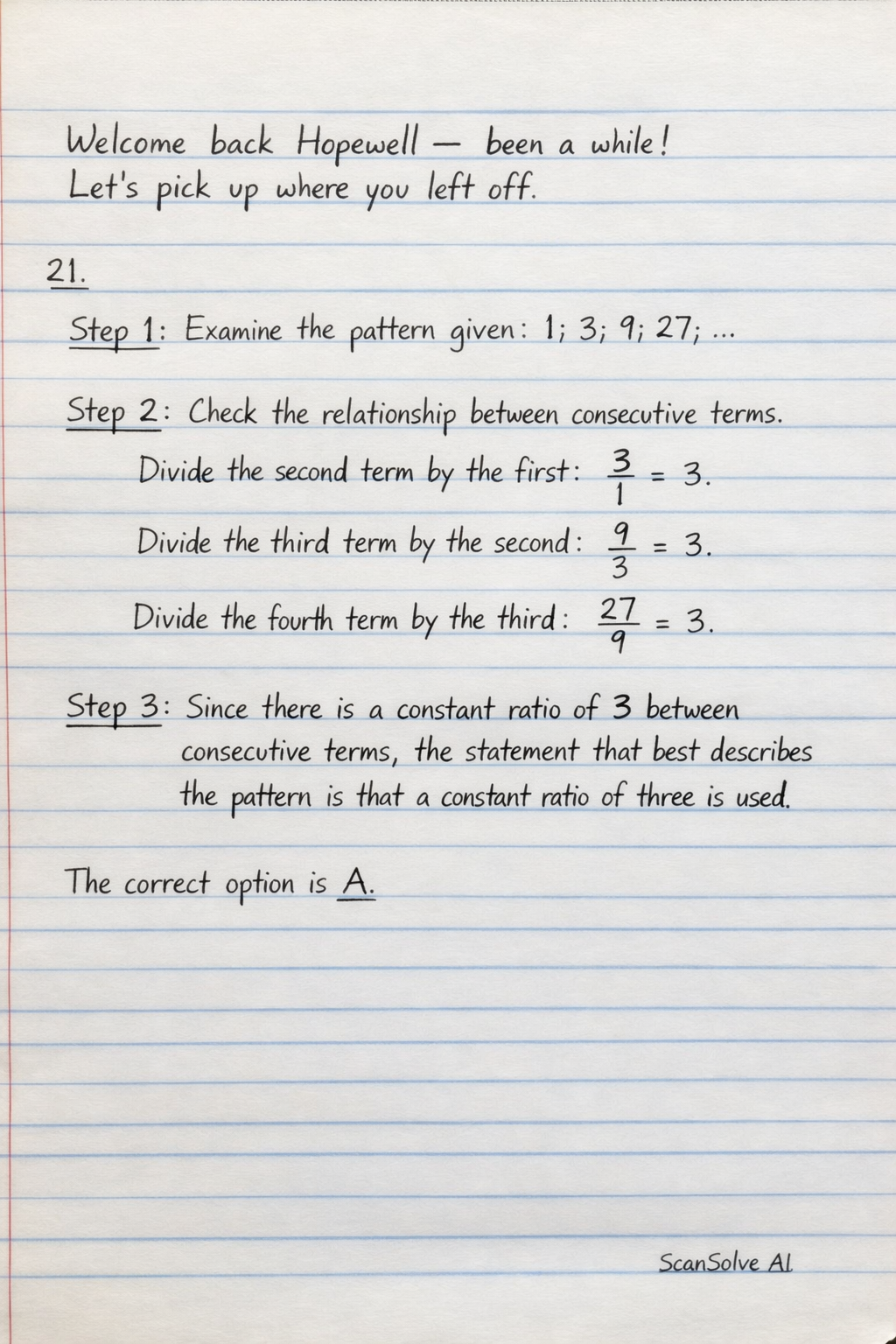
21. Step 1: Examine the pattern given: 1;3;9;27;...1; 3; 9; 27; ... Step 2: Check the relationship between consecutive terms. Divide the second term by the first: 31=3\frac{3}{1} = 3. Divide the third term by the second: 93=3\frac{9}{3} = 3. Divide the fourth term by the third: 279=3\frac{27}{9} = 3. Step 3: Since there is a constant ratio of 33 between consecutive terms, the statement that best describes the pattern is that a constant ratio of three is used.

The correct option is A.

22. Step 1: Analyze the given table to find the relationship between nn and TnT_n. n | 1 | 3 | 5 | 7 Tn | 5 | 1 | -3 | -7 Step 2: Calculate the change in TnT_n for a given change in nn. When nn changes from 11 to 33 (change of +2+2), TnT_n changes from 55 to 11 (change of 4-4). When nn changes from 33 to 55 (change of +2+2), TnT_n changes from 11 to 3-3 (change of 4-4). This indicates a linear relationship of the form Tn=mn+cT_n = mn + c. The slope m=changeinTnchangeinn=42=2m = \frac{change in T_n}{change in n} = \frac{-4}{2} = -2. Step 3: Substitute the slope m=2m = -2 into the equation Tn=2n+cT_n = -2n + c. Use one of the points from the table, for example, (n=1,Tn=5)(n=1, T_n=5). 5=2(1)+c5 = -2(1) + c 5=2+c5 = -2 + c c=5+2c = 5 + 2 c=7c = 7 Step 4: Write the general term using the calculated mm and cc. Tn=2n+7T_n = -2n + 7.

The correct option is C.

23. Step 1: Identify the given expression: 3x3+3x(x2)+3x2+3x3x^3 + 3x(x^2) + 3x^2 + 3x. Step 2: Simplify any terms in the expression. The term 3x(x2)3x(x^2) can be simplified to 3x1+2=3x33x^{1+2} = 3x^3. So the expression becomes 3x3+3x3+3x2+3x3x^3 + 3x^3 + 3x^2 + 3x. Step 3: Recall that like terms have the same variable(s) raised to the same power(s). From the simplified expression, the terms are 3x33x^3, 3x33x^3, 3x23x^2, and 3x3x. Step 4: Check the given options for pairs of like terms. A 3x33x^3 and 3x(x2)3x(x^2): Since 3x(x2)=3x33x(x^2) = 3x^3, this pair consists of 3x33x^3 and 3x33x^3, which are like terms.

The correct option is A.

24. Step 1: Identify the given term: (2x2)3(-2x^2)^3. Step 2: Apply the exponent to both the coefficient and the variable part. (2x2)3=(2)3(x2)3(-2x^2)^3 = (-2)^3 \cdot (x^2)^3 Step 3: Calculate the numerical part and the variable part separately. (2)3=2×2×2=8(-2)^3 = -2 \times -2 \times -2 = -8. (x2)3=x2×3=x6(x^2)^3 = x^{2 \times 3} = x^6. Step 4: Combine the results to get the simplified term. The simplified term is 8x6-8x^6. Step 5: Identify the coefficient and the degree of the term. The coefficient is the numerical factor, which is 8-8. The degree of the term is the exponent of the variable, which is 66.

The correct option is D.

Send me the next one 📸

Was this helpful?

Need help with your own homework?

Get instant step-by-step solutions to any question. Free to start.

Ask Your Question
Handwritten step-by-step solution preview

Handwritten Step-by-Step Solution

Get this as a handwritten image on WhatsApp — like a tutor wrote it for you.

Try on WhatsApp

Still have questions?

Quick Answer

21. Step 1: Examine the pattern given: 1; 3; 9; 27; ...

1; 3; 9; 27;... Which statement best describes the pattern?
Mathematics

This mathematics problem involves applying core mathematical principles and formulas. Below you will find a complete step-by-step solution with detailed explanations for each step, helping you understand not just the answer but the method behind it.

ScanSolve AI Answer
21. Step 1: Examine the pattern given: 1; 3; 9; 27; ... Step 2: Check the relationship between consecutive terms. Divide the second term by the first: (3)/(1) = 3. Divide the third term by the second: (9)/(3) = 3. Divide the fourth term by the third: (27)/(9) = 3. Step 3: Since there is a constant ratio of 3 between consecutive terms, the statement that best describes the pattern is that a constant ratio of three is used. The correct option is A. 22. Step 1: Analyze the given table to find the relationship between n and T_n. n | 1 | 3 | 5 | 7 Tn | 5 | 1 | -3 | -7 Step 2: Calculate the change in T_n for a given change in n. When n changes from 1 to 3 (change of +2), T_n changes from 5 to 1 (change of -4). When n changes from 3 to 5 (change of +2), T_n changes from 1 to -3 (change of -4). This indicates a linear relationship of the form T_n = mn + c. The slope m = change in T_nchange in n = (-4)/(2) = -2. Step 3: Substitute the slope m = -2 into the equation T_n = -2n + c. Use one of the points from the table, for example, (n=1, T_n=5). 5 = -2(1) + c 5 = -2 + c c = 5 + 2 c = 7 Step 4: Write the general term using the calculated m and c. T_n = -2n + 7. The correct option is C. 23. Step 1: Identify the given expression: 3x^3 + 3x(x^2) + 3x^2 + 3x. Step 2: Simplify any terms in the expression. The term 3x(x^2) can be simplified to 3x^1+2 = 3x^3. So the expression becomes 3x^3 + 3x^3 + 3x^2 + 3x. Step 3: Recall that like terms have the same variable(s) raised to the same power(s). From the simplified expression, the terms are 3x^3, 3x^3, 3x^2, and 3x. Step 4: Check the given options for pairs of like terms. A 3x^3 and 3x(x^2): Since 3x(x^2) = 3x^3, this pair consists of 3x^3 and 3x^3, which are like terms. The correct option is A. 24. Step 1: Identify the given term: (-2x^2)^3. Step 2: Apply the exponent to both the coefficient and the variable part. (-2x^2)^3 = (-2)^3 · (x^2)^3 Step 3: Calculate the numerical part and the variable part separately. (-2)^3 = -2 × -2 × -2 = -8. (x^2)^3 = x^2 × 3 = x^6. Step 4: Combine the results to get the simplified term. The simplified term is -8x^6. Step 5: Identify the coefficient and the degree of the term. The coefficient is the numerical factor, which is -8. The degree of the term is the exponent of the variable, which is 6. The correct option is D. Send me the next one 📸