

This mathematics problem involves applying core mathematical principles and formulas. Below you will find a complete step-by-step solution with detailed explanations for each step, helping you understand not just the answer but the method behind it.
ScanSolve AI Answer
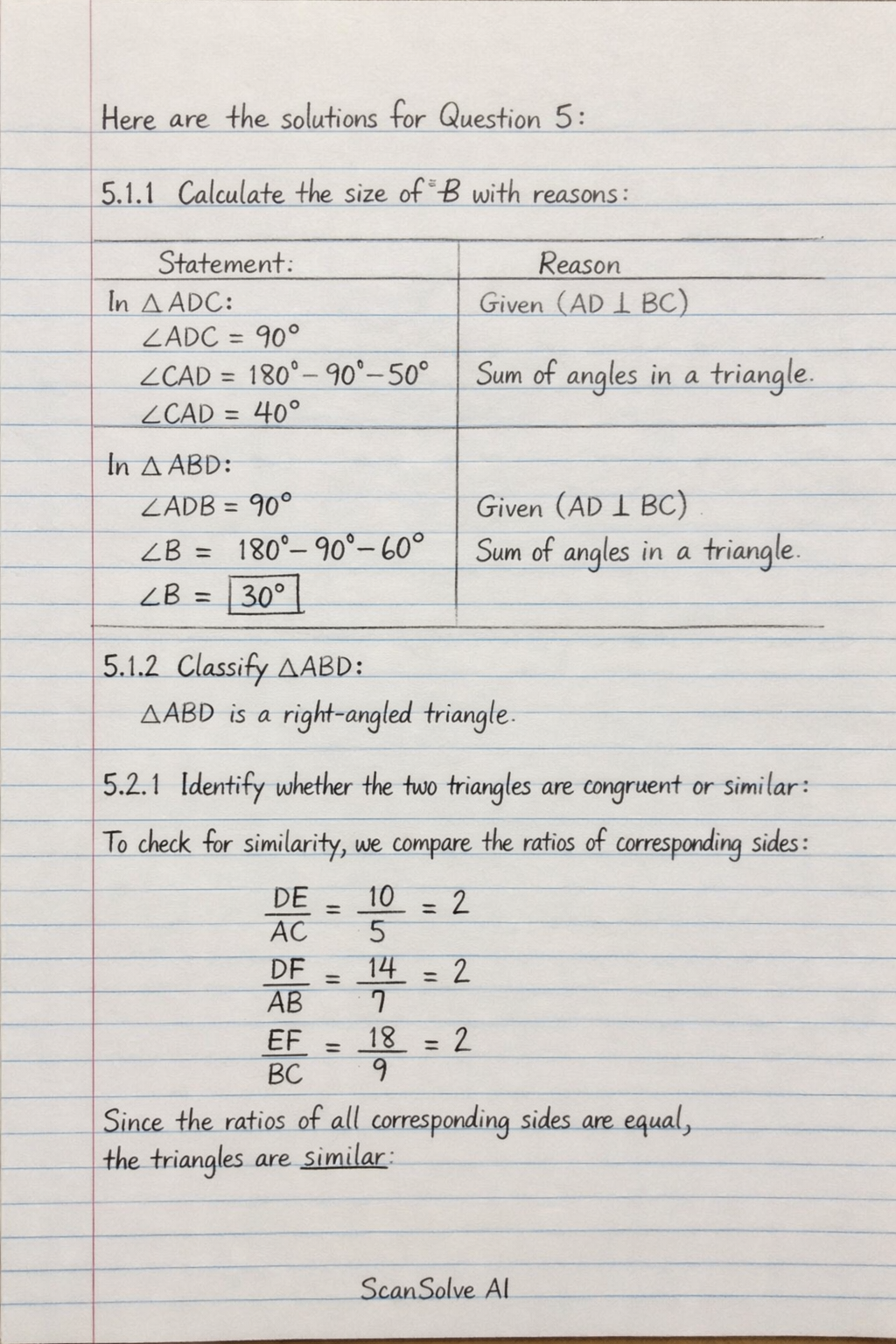
5.1.1 Calculate the size of B with reasons. Statement — ReasonIn ADC: ADC = 90^ — Given (AD BC) CAD = 180^ - 90^ - 50^ — Sum of angles in a triangle CAD = 40^ In ABD: ADB = 90^ — Given (AD BC) B = 180^ - 90^ - 60^ — Sum of angles in a triangle B = 30^ 5.1.2 Classify ABD. ABD is a right-angled triangle. 5.2.1 Identify whether the two triangles are congruent or similar. To check for similarity, we compare the ratios of corresponding sides: (DE)/(AC) = (10)/(5) = 2 (DF)/(AB) = (14)/(7) = 2 (EF)/(BC) = (18)/(9) = 2 Since the ratios of all corresponding sides are equal, the triangles are similar. 5.2.2 Describe the properties that make them congruent or similar. The properties that make them similar are: Their corresponding angles are equal. Their corresponding sides are in proportion. 5.3 ABCD is a rhombus. Determine, with reasons, the size of: Angle 1 ( AOB) Step 1: Identify the property of diagonals in a rhombus. The diagonals of a rhombus bisect each other at right angles. Step 2: State the angle. AOB = 90^ Reason: Diagonals of a rhombus intersect at right angles. Angle 2 ( ADO) Step 1: Use the properties of a rhombus and sum of angles in a triangle. In AOD: DAO = 22^ (Given) AOD = 90^ (Diagonals of a rhombus intersect at right angles) Step 2: Calculate ADO. ADO = 180^ - DAO - AOD (Sum of angles in a triangle) ADO = 180^ - 22^ - 90^ ADO = 68^ Reason: Sum of angles in a triangle.