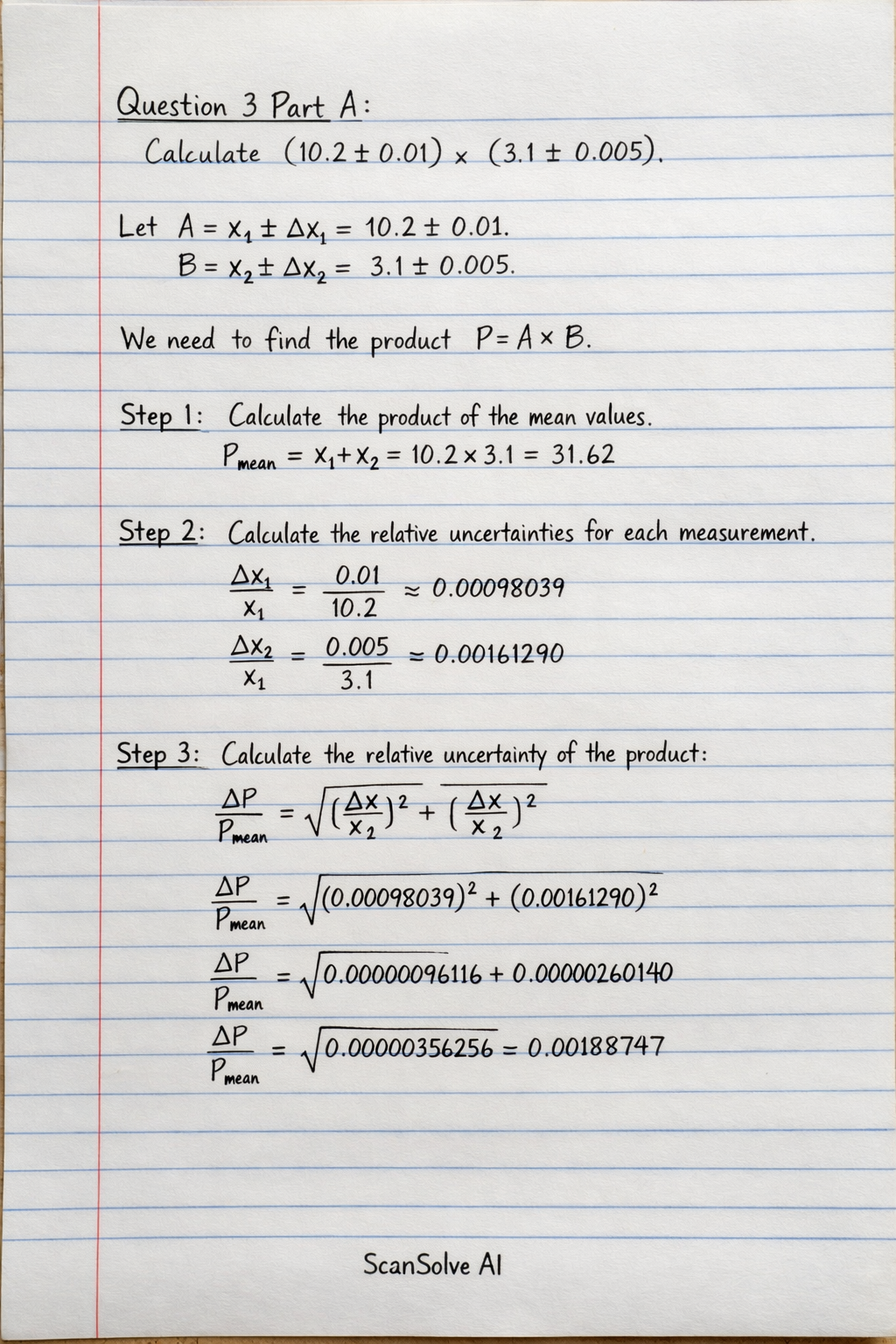
We read your photo as:

Calculate (10.2 01) imes (3.1 005).

Mathematics

ScanSolve AI Answer

Answers

2 parts
3

31.62±0.0631.62 \pm 0.06

4

0.0±0.30.0 \pm 0.3

Step-by-step solution

8 steps

Here are the calculations for the given measurements:

Part 3· 5 steps

Part A

Calculate (10.2±0.01)×(3.1±0.005)(10.2 \pm 0.01) \times (3.1 \pm 0.005).

Let the two measurements be A=x1±Δx1=10.2±0.01A = x_1 \pm \Delta x_1 = 10.2 \pm 0.01 and B=x2±Δx2=3.1±0.005B = x_2 \pm \Delta x_2 = 3.1 \pm 0.005.
We need to find the product P=A×BP = A \times B.

  1. Calculate the product of the mean values.

    Pmean=x1×x2=10.2×3.1=31.62P_{mean} = x_1 \times x_2 = 10.2 \times 3.1 = 31.62
  2. Calculate the relative uncertainties for each measurement.

    Δx1x1=0.0110.2≈0.00098039\frac{\Delta x_1}{x_1} = \frac{0.01}{10.2} \approx 0.00098039 Δx2x2=0.0053.1≈0.00161290\frac{\Delta x_2}{x_2} = \frac{0.005}{3.1} \approx 0.00161290
  3. Calculate the relative uncertainty of the product using the formula for multiplication

    ΔPPmean=(Δx1x1)2+(Δx2x2)2\frac{\Delta P}{P_{mean}} = \sqrt{\left(\frac{\Delta x_1}{x_1}\right)^2 + \left(\frac{\Delta x_2}{x_2}\right)^2} ΔPPmean=(0.00098039)2+(0.00161290)2\frac{\Delta P}{P_{mean}} = \sqrt{(0.00098039)^2 + (0.00161290)^2} ΔPPmean=0.00000096116+0.00000260140\frac{\Delta P}{P_{mean}} = \sqrt{0.00000096116 + 0.00000260140} ΔPPmean=0.00000356256≈0.00188747\frac{\Delta P}{P_{mean}} = \sqrt{0.00000356256} \approx 0.00188747
  4. Calculate the absolute uncertainty of the product.

    ΔP=Pmean×(ΔPPmean)=31.62×0.00188747≈0.05969\Delta P = P_{mean} \times \left(\frac{\Delta P}{P_{mean}}\right) = 31.62 \times 0.00188747 \approx 0.05969
  5. Round the uncertainty to one significant figure and the mean value to the same decimal place.

    Rounding ΔP=0.05969\Delta P = 0.05969 to one significant figure gives 0.06.
    The uncertainty is in the hundredths place. Therefore, Pmean=31.62P_{mean} = 31.62 should be rounded to the hundredths place.
    The final result is 31.62±0.0631.62 \pm 0.06.

    31.62±0.06\boxed{31.62 \pm 0.06}

Part 4

0.0±0.30.0 \pm 0.3

Calculate (19.02±0.03)−(19.01±0.3)(19.02 \pm 0.03) - (19.01 \pm 0.3).

Let the two measurements be A=x1±Δx1=19.02±0.03A = x_1 \pm \Delta x_1 = 19.02 \pm 0.03 and B=x2±Δx2=19.01±0.3B = x_2 \pm \Delta x_2 = 19.01 \pm 0.3.
We need to find the difference D=A−BD = A - B.

  1. Calculate the difference of the mean values.

    Dmean=x1−x2=19.02−19.01=0.01D_{mean} = x_1 - x_2 = 19.02 - 19.01 = 0.01
  2. Calculate the absolute uncertainty of the difference using the formula for addition/subtraction

    ΔD=(Δx1)2+(Δx2)2\Delta D = \sqrt{(\Delta x_1)^2 + (\Delta x_2)^2} ΔD=(0.03)2+(0.3)2\Delta D = \sqrt{(0.03)^2 + (0.3)^2} ΔD=0.0009+0.09\Delta D = \sqrt{0.0009 + 0.09} ΔD=0.0909≈0.301496\Delta D = \sqrt{0.0909} \approx 0.301496
  3. Round the uncertainty to one significant figure and the mean value to the same decimal place.

    Rounding ΔD=0.301496\Delta D = 0.301496 to one significant figure gives 0.3.
    The uncertainty is in the tenths place. Therefore, Dmean=0.01D_{mean} = 0.01 should be rounded to the tenths place, which is 0.0.
    The final result is 0.0±0.30.0 \pm 0.3.

    0.0±0.3\boxed{0.0 \pm 0.3}
Was this helpful?

Try one yourself

A new problem that tests the same skill.

Still stuck on this one?

Ask a follow-up, and the answer starts from this question.

Got a different question?Ask your own question
Handwritten step-by-step solution preview

Handwritten Step-by-Step Solution

Get this as a handwritten image on WhatsApp — like a tutor wrote it for you.

Try on WhatsApp