

This mathematics problem involves applying core mathematical principles and formulas. Below you will find a complete step-by-step solution with detailed explanations for each step, helping you understand not just the answer but the method behind it.
ScanSolve AI Answer
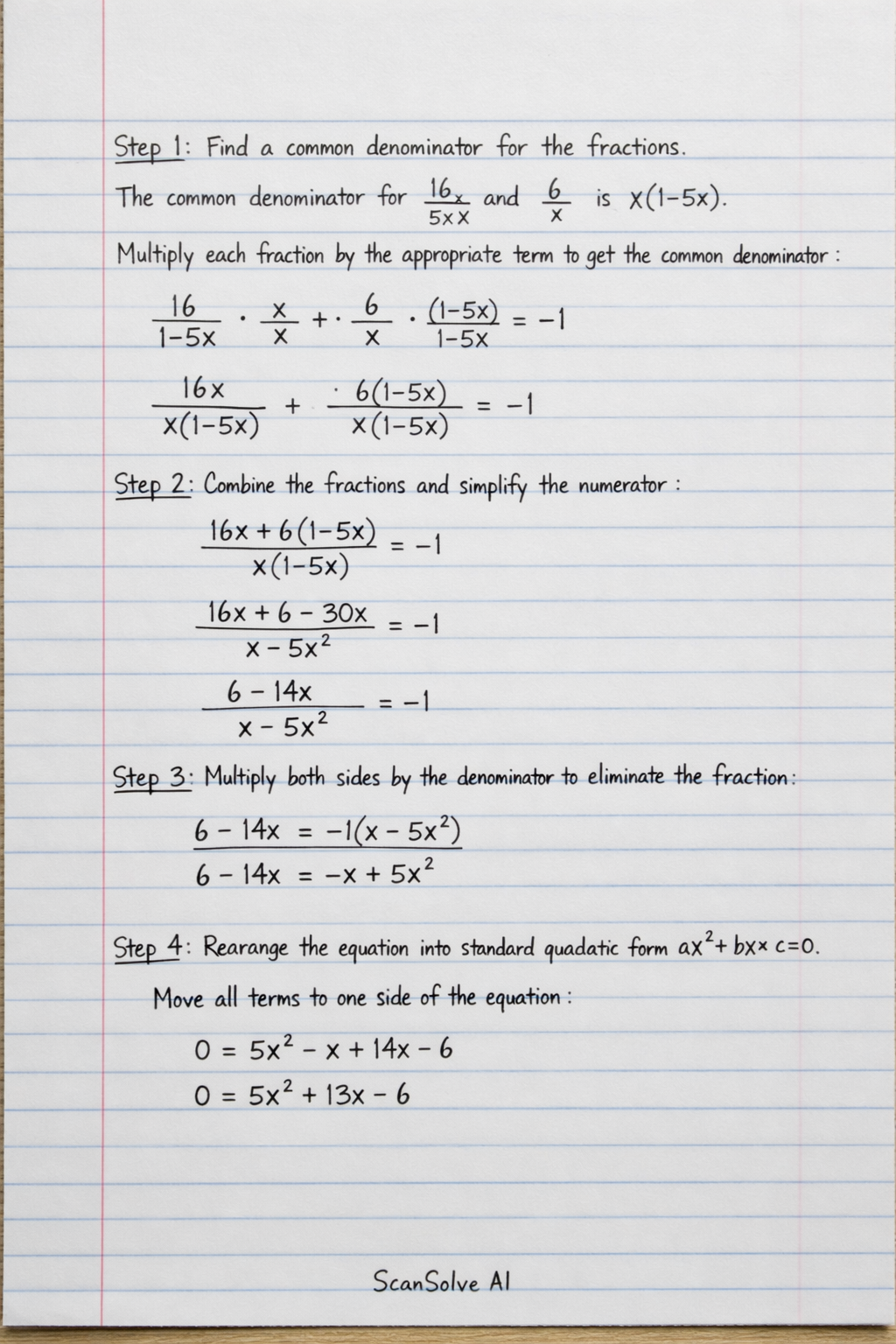
Step 1: Find a common denominator for the fractions. The common denominator for (16)/(1-5x) and (6)/(x) is x(1-5x). Multiply each fraction by the appropriate term to get the common denominator: (16)/(1-5x) · (x)/(x) + (6)/(x) · (1-5x)/(1-5x) = -1 (16x)/(x(1-5x)) + (6(1-5x))/(x(1-5x)) = -1 Step 2: Combine the fractions and simplify the numerator. (16x + 6(1-5x))/(x(1-5x)) = -1 (16x + 6 - 30x)/(x - 5x^2) = -1 (6 - 14x)/(x - 5x^2) = -1 Step 3: Multiply both sides by the denominator to eliminate the fraction. 6 - 14x = -1(x - 5x^2) 6 - 14x = -x + 5x^2 Step 4: Rearrange the equation into standard quadratic form ax^2 + bx + c = 0. Move all terms to one side of the equation: 0 = 5x^2 - x + 14x - 6 0 = 5x^2 + 13x - 6 Step 5: Solve the quadratic equation using the quadratic formula x = -b ± sqrt(b^2 - 4ac)2a. For 5x^2 + 13x - 6 = 0, we have a=5, b=13, c=-6. First, calculate the discriminant = b^2 - 4ac: = (13)^2 - 4(5)(-6) = 169 - (-120) = 169 + 120 = 289 Now, substitute the values into the quadratic formula: x = -13 ± sqrt(289)2(5) x = (-13 ± 17)/(10) Step 6: Calculate the two possible values for x. x_1 = (-13 + 17)/(10) = (4)/(10) = (2)/(5) x_2 = (-13 - 17)/(10) = (-30)/(10) = -3 Both solutions are valid as they do not make the original denominators zero (x ≠ 0 and 1-5x ≠ 0 x ≠ (1)/(5)). The solutions are x = (2)/(5), -3. Send me the next one 📸