We read your photo as:

The diagram below shows a spotlight at point B, which is mounted 12 m directly above point C, at the front of the field. The spotlight swings 44,3 degrees from the vertical to illuminate another point, D, the midpoint of AC.

Mathematics

ScanSolve AI Answer

Step-by-step solution

10 steps

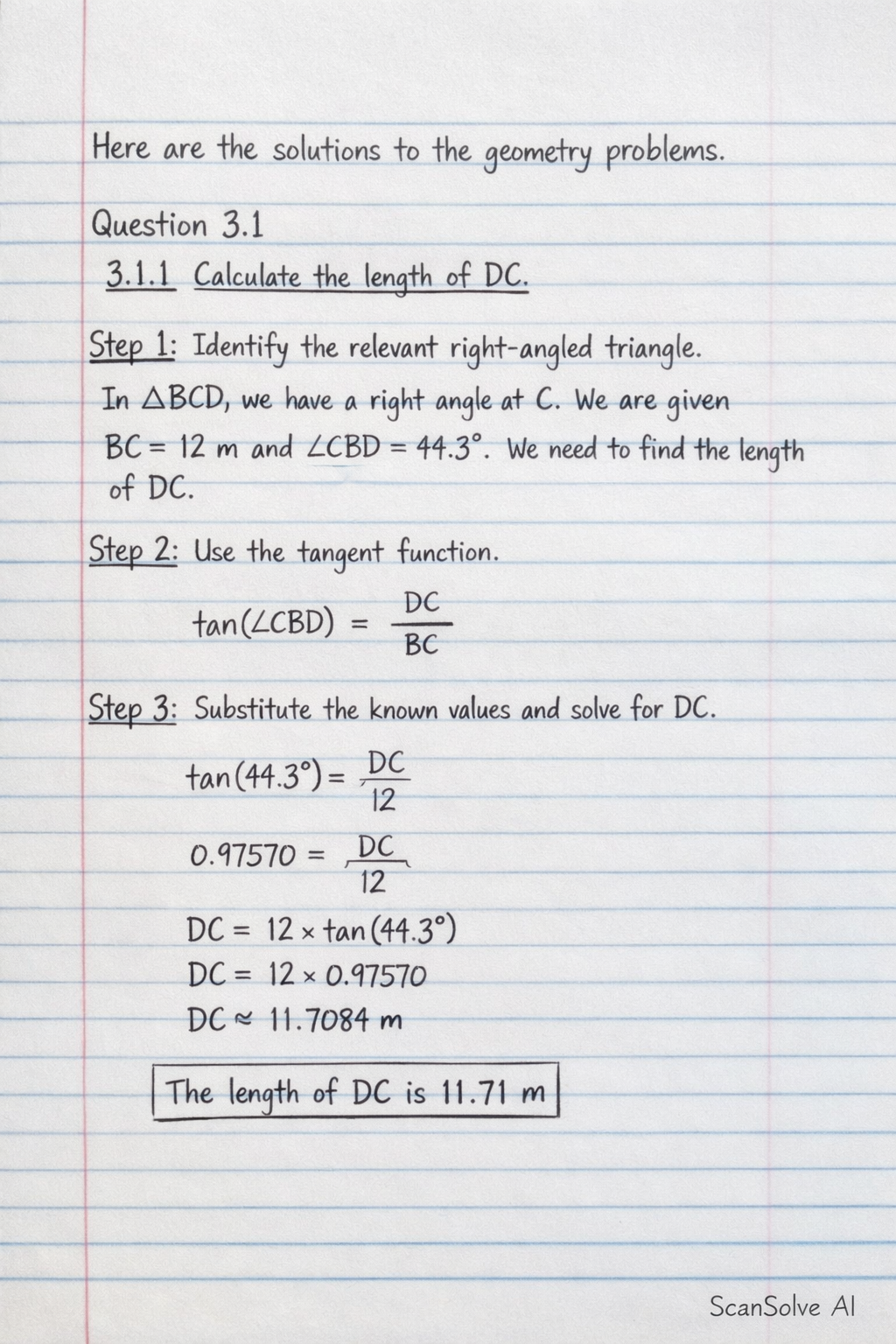
Here are the solutions to the geometry problems.

Question 3.1

3.1.1 Calculate the length of DC.

  1. Identify the relevant right-angled triangle.

    In △BCD\triangle BCD, we have a right angle at C. We are given BC=12BC = 12 m and ∠CBD=44.3∘\angle CBD = 44.3^\circ. We need to find the length of DCDC.

  2. Use the tangent function.

    The tangent of an angle in a right-angled triangle is the ratio of the opposite side to the adjacent side.

    tan⁡(∠CBD)=DCBC\tan(\angle CBD) = \frac{DC}{BC}
  3. Substitute the known values and solve for DCDC.

    tan⁡(44.3∘)=DC12\tan(44.3^\circ) = \frac{DC}{12} DC=12×tan⁡(44.3∘)DC = 12 \times \tan(44.3^\circ) DC≈12×0.97570DC \approx 12 \times 0.97570 DC≈11.7084 mDC \approx 11.7084 \text{ m}

    The length of DC is 11.71 m\boxed{11.71 \text{ m}}.

    3.1.2 Calculate through how many degrees the spotlight must swing in order to illuminate point A (i.e. calculate θ\theta).

  4. Find the length of AC.

    Since D is the midpoint of AC, AC=2×DCAC = 2 \times DC.

    AC=2×11.7084 m=23.4168 mAC = 2 \times 11.7084 \text{ m} = 23.4168 \text{ m}
  5. Find the angle ∠CBA\angle CBA in △ABC\triangle ABC.

    In △ABC\triangle ABC, we have a right angle at C. We know BC=12BC = 12 m and AC=23.4168AC = 23.4168 m.

    tan⁡(∠CBA)=ACBC\tan(\angle CBA) = \frac{AC}{BC} tan⁡(∠CBA)=23.416812\tan(\angle CBA) = \frac{23.4168}{12} tan⁡(∠CBA)≈1.9514\tan(\angle CBA) \approx 1.9514 ∠CBA=arctan⁡(1.9514)≈62.87∘\angle CBA = \arctan(1.9514) \approx 62.87^\circ
  6. Calculate θ\theta.

    The angle θ\theta is the difference between ∠CBA\angle CBA and ∠CBD\angle CBD.

    θ=∠CBA−∠CBD\theta = \angle CBA - \angle CBD θ=62.87∘−44.3∘\theta = 62.87^\circ - 44.3^\circ θ=18.57∘\theta = 18.57^\circ

    The spotlight must swing through 18.57∘\boxed{18.57^\circ}.

    Question 3.2

    Assume that ABCD is a rectangle in a horizontal plane and EB is a vertical line segment. The angle of elevation from D to E is ∠EDA=22∘\angle EDA = 22^\circ.

    Calculate the length of BE.

  7. Identify the relevant right-angled triangle and find AE.

    In right-angled △EAD\triangle EAD (right-angled at A), we are given DE=800DE = 800 cm and ∠EDA=22∘\angle EDA = 22^\circ.
    We can find AEAE using the sine function:

    sin⁡(∠EDA)=AEDE\sin(\angle EDA) = \frac{AE}{DE} sin⁡(22∘)=AE800\sin(22^\circ) = \frac{AE}{800} AE=800×sin⁡(22∘)AE = 800 \times \sin(22^\circ) AE≈800×0.374606AE \approx 800 \times 0.374606 AE≈299.68 cmAE \approx 299.68 \text{ cm}
  8. Calculate BE.

    Since ABCD is a rectangle, AB=DC=155AB = DC = 155 cm.
    The length BEBE is the sum of ABAB and AEAE.

    BE=AB+AEBE = AB + AE BE=155 cm+299.68 cmBE = 155 \text{ cm} + 299.68 \text{ cm} BE=454.68 cmBE = 454.68 \text{ cm}

    The length of BE is 454.68 cm\boxed{454.68 \text{ cm}}.

    Determine the distance of BC.

  9. Find the length of AD.

    In right-angled △EAD\triangle EAD, we can find ADAD using the cosine function:

    cos⁡(∠EDA)=ADDE\cos(\angle EDA) = \frac{AD}{DE} cos⁡(22∘)=AD800\cos(22^\circ) = \frac{AD}{800} AD=800×cos⁡(22∘)AD = 800 \times \cos(22^\circ) AD≈800×0.927184AD \approx 800 \times 0.927184 AD≈741.75 cmAD \approx 741.75 \text{ cm}
  10. Determine BC.

    Since ABCD is a rectangle, BC=ADBC = AD.

    BC=741.75 cmBC = 741.75 \text{ cm}

    The distance of BC is 741.75 cm\boxed{741.75 \text{ cm}}.

Was this helpful?

Still stuck on this one?

Ask a follow-up, and the answer starts from this question.

Got a different question?Ask your own question
Handwritten step-by-step solution preview

Handwritten Step-by-Step Solution

Get this as a handwritten image on WhatsApp — like a tutor wrote it for you.

Try on WhatsApp