
We read your photo as:
A population of 10,000 in 1960 grew to 12,000 in 1970. Estimate the population in 1980 and find the doubling time.
ScanSolve AI Answer
Answers
3 partsStep-by-step solution
6 stepsPart a· 2 steps
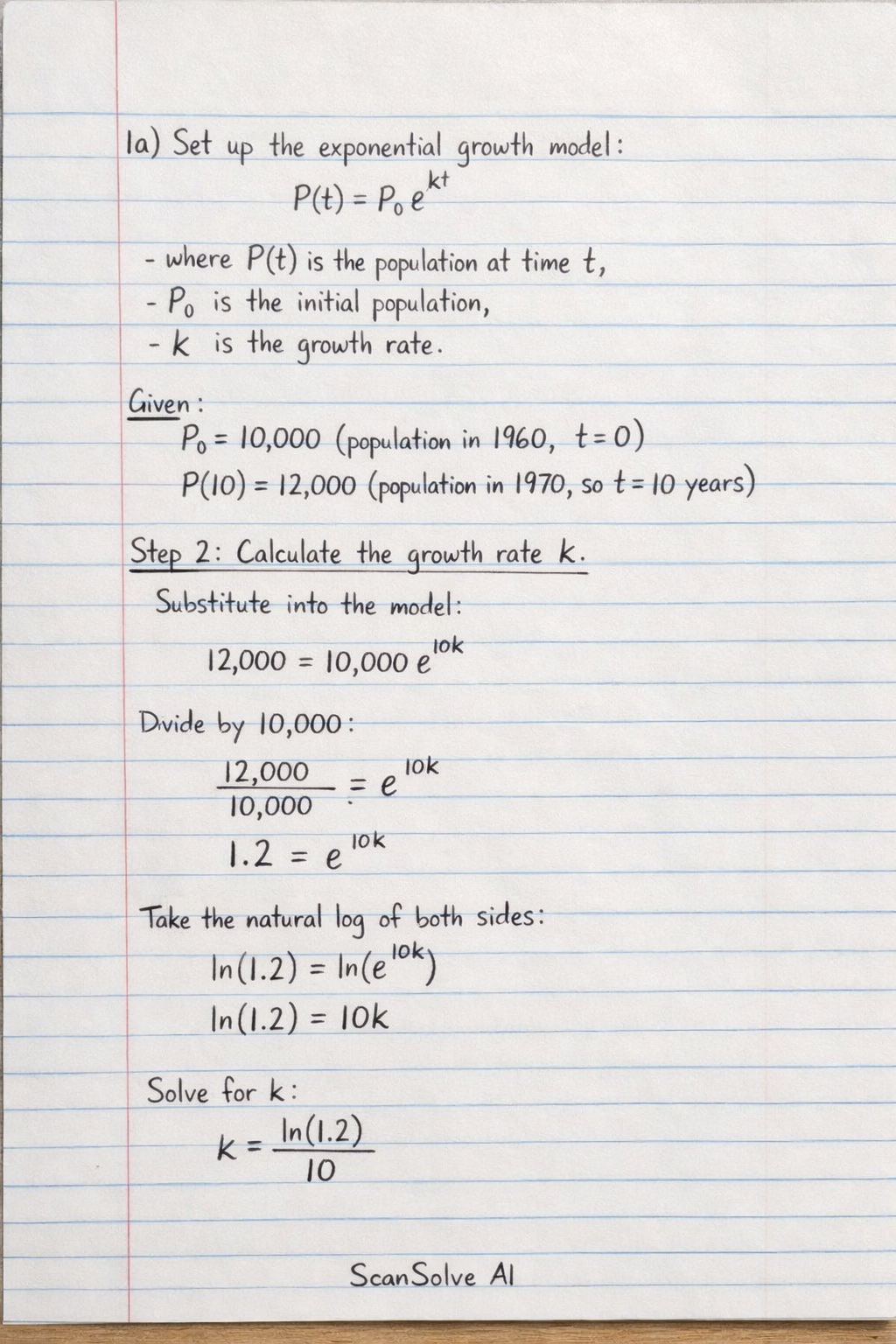
Step 1: Set up the exponential growth model.
The exponential growth model is given by , where is the population at time , is the initial population, and is the growth rate.
Given:
(population in 1960, which we take as )
(population in 1970, so years)
Calculate the growth rate .
Substitute the values into the model:
Divide by 10000:
Take the natural logarithm of both sides:
Estimate the population in 1980.
The time from 1960 to 1980 is years.
Substitute and into the model:Using the logarithm property :
Using the property :
The estimated population in 1980 is .
Part b
Step 1: Define doubling time.
The doubling time is the time it takes for the population to double. If the initial population is , the population after years will be .
Using the exponential growth model :
Solve for .
Take the natural logarithm of both sides:
From part (a), we found . Substitute this value:
Calculate the numerical value for .
Using a calculator:
The doubling time for the town's population is approximately .
Part c2
Step 1: Set up the identity.
We want to express in the form .
Using the angle addition formula for sine, .
Comparing this to :
Find .
Square both equations and add them:
Since :
Since represents an amplitude, it must be positive:
Find .
Divide Equation 2 by Equation 1:
Since and , is in the first quadrant.
So, .
The values are and .
Try one yourself
A new problem that tests the same skill.
Still stuck on this one?
Ask a follow-up, and the answer starts from this question.
More Mathematics Questions
Handwritten Step-by-Step Solution
Get this as a handwritten image on WhatsApp — like a tutor wrote it for you.
Try on WhatsApp