
We read your photo as:
A solid metal sphere of radius 7 cm is melted and recast into smaller spheres of radius 1.4 cm. a) Find the number of smaller spheres obtained. b) If the metal used costs Ksh 450 per cubic centimetre, find the total cost of the metal in the original sphere. (Take pi = 22/7)
ScanSolve AI Answer
Step-by-step solution
7 stepshere are the solutions to the questions from the image, explained in English:
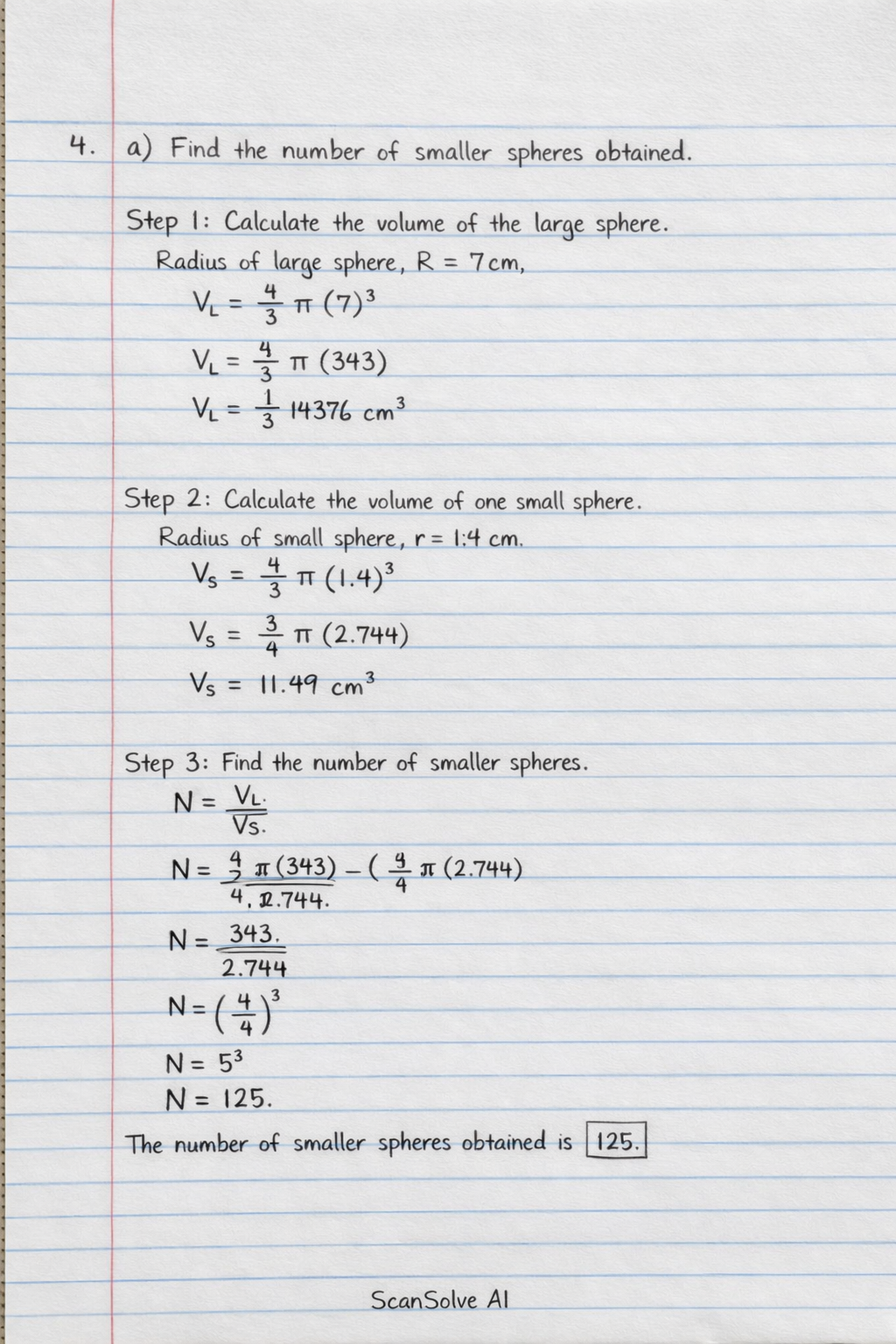
4. a) Find the number of smaller spheres obtained.
Calculate the volume of the large sphere.
The radius of the large sphere, cm.
The volume of a sphere is given by the formula .Calculate the volume of one small sphere.
The radius of a small sphere, cm.
Find the number of smaller spheres.
The number of smaller spheres () is the total volume of the large sphere divided by the volume of one small sphere.
Cancel out :
The number of smaller spheres obtained is .
b) If the metal used costs Ksh 450 per cubic centimetre, find the total cost of the metal in the original sphere.
Calculate the volume of the original sphere using .
The radius of the original sphere, cm.
Calculate the total cost.
The cost per cubic centimetre is Ksh 450.
Total cost = Volume of original sphere Cost per cubic centimetre.The total cost of the metal in the original sphere is .
5. a) Form an equation in and solve it.
Formulate the equation.
The exterior angle of a regular polygon is .
The interior angle of the regular polygon is .
The sum of an interior angle and its corresponding exterior angle is always .Solve the equation for .
Combine like terms:
Divide by 6:
The equation is and the value of is .
Still stuck on this one?
Ask a follow-up, and the answer starts from this question.
More Mathematics Questions
Handwritten Step-by-Step Solution
Get this as a handwritten image on WhatsApp — like a tutor wrote it for you.
Try on WhatsApp