
We read your photo as:
A survey of 120 households revealed that 70 do homestay business, 50 do agriculture business, and 30 do other work. Find N((H U A)') and draw a Venn diagram.
ScanSolve AI Answer
Answers
3 partsStep-by-step solution
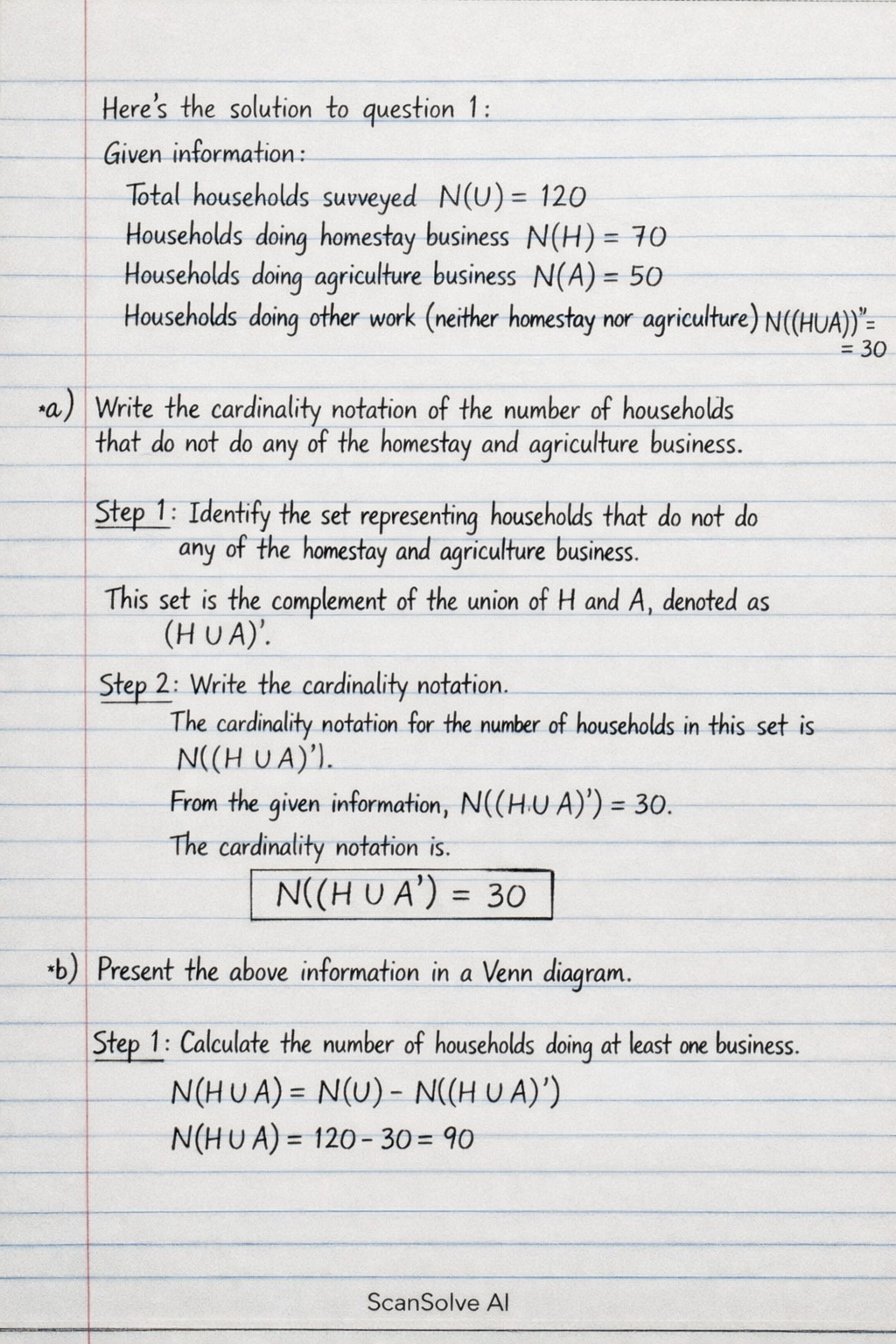
12 stepsHere's the solution to question 1:
Given information:
Total households surveyed
Households doing homestay business
Households doing agriculture business
Households doing other work (neither homestay nor agriculture)
Part a· 2 steps
Write the cardinality notation of the number of households that do not do any of the homestay and agriculture business.
Identify the set representing households that do not do any of the homestay and agriculture business.
This set is the complement of the union of H and A, denoted as .
Write the cardinality notation.
The cardinality notation for the number of households in this set is .
From the given information, .The cardinality notation is .
Part b· 4 steps
Present the above information in a Venn diagram.
Calculate the number of households doing at least one business.
Calculate the number of households doing both businesses.
Calculate the number of households doing only homestay business.
Calculate the number of households doing only agriculture business.
The Venn diagram would consist of a universal set (rectangle) containing two overlapping circles, and .
- The region representing households doing only homestay business ( only) has a value of 40.
- The region representing households doing only agriculture business ( only) has a value of 20.
- The region representing households doing both homestay and agriculture business () has a value of 30.
- The region representing households doing neither homestay nor agriculture business () is outside the circles but inside the universal set, and has a value of 30.
Part c60
Find the number of households doing only one business.
Identify the households doing only one business.
These are the households doing only homestay business or only agriculture business.
Sum the number of households doing only one business.
The number of households doing only one business is .
Part d8:5
If 10 households that do other work start homestay business, find the ratio of homestay and agriculture business households.
Determine the new number of households doing other work.
Initially, . If 10 of these start homestay business, then:
Determine the new number of households doing homestay business.
The 10 households that previously did other work now do homestay business.
Initially, .Determine the new number of households doing agriculture business.
The number of households doing agriculture business remains unchanged.
Find the ratio of homestay and agriculture business households.
The ratio is .
Simplify the ratio by dividing both sides by 10.
The ratio of homestay and agriculture business households is .
Try one yourself
A new problem that tests the same skill.
Still stuck on this one?
Ask a follow-up, and the answer starts from this question.
More Mathematics Questions
Handwritten Step-by-Step Solution
Get this as a handwritten image on WhatsApp — like a tutor wrote it for you.
Try on WhatsApp