Find the derivative of y = a (3x + 2) and y = e (4x - 1)2.
|Mathematics
Find the derivative of y = a (3x + 2) and y = e (4x - 1)2.
ScanSolve AI Answer
Answer
dxdy=3x+23logae
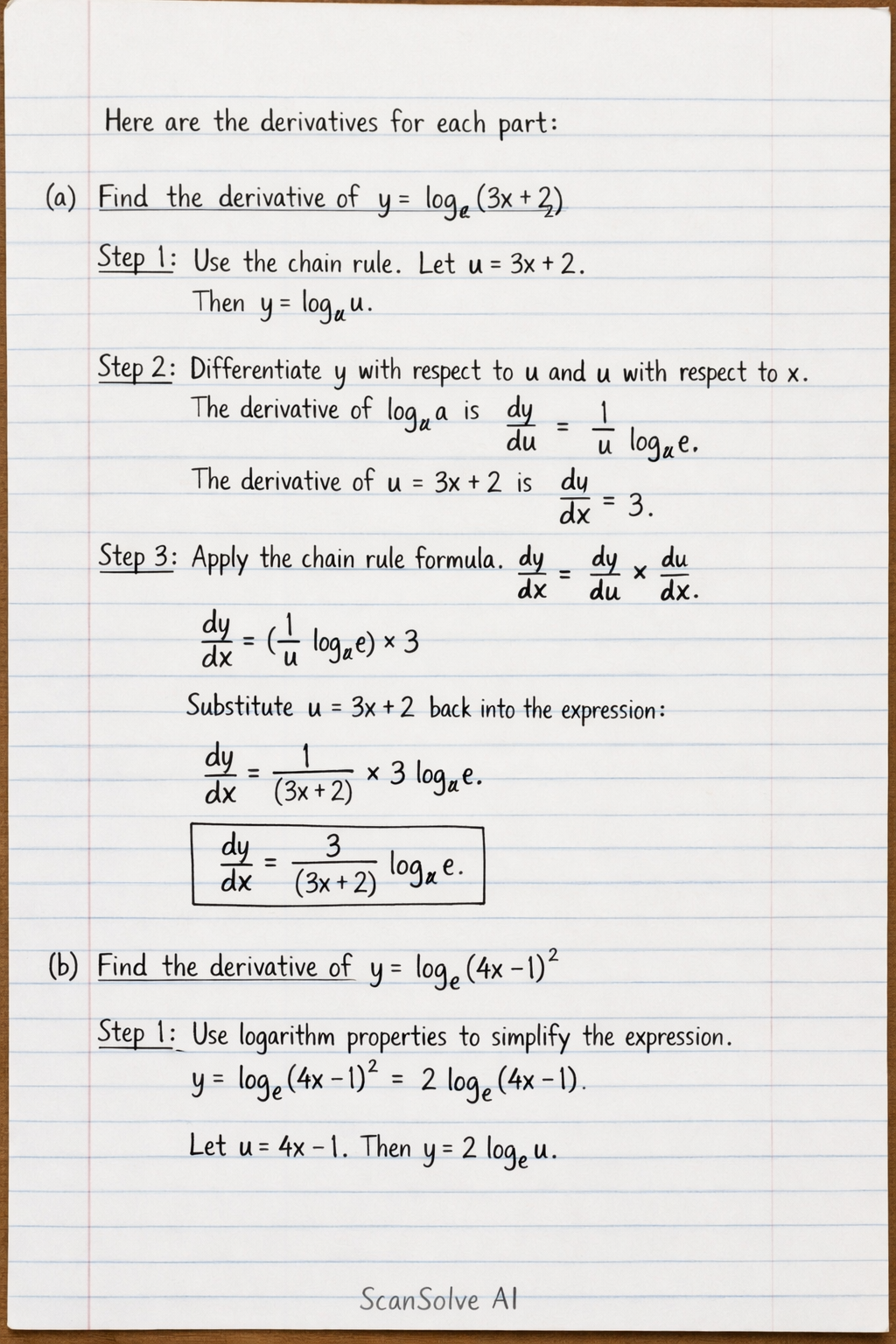
Here are the derivatives for each part:
a) Find the derivative of y=loga(3x+2)
Step 1: Use the chain rule. Let u=3x+2.
Then y=logau.
Step 2: Differentiate y with respect to u and u with respect to x.
The derivative of logau is dudy=u1logae.
The derivative of u=3x+2 is dxdu=3.
Step 3: Apply the chain rule formula dxdy=dudy×dxdu.
dxdy=(u1logae)×3
Substitute u=3x+2 back into the expression:
dxdy=3x+21×3logaedxdy=3x+23logae
b) Find the derivative of y=loge(4x−1)2
Step 1: Use logarithm properties to simplify the expression.
y=loge(4x−1)2=2loge(4x−1)
Let u=4x−1. Then y=2logeu.
Step 2: Differentiate y with respect to u and u with respect to x.
The derivative of 2logeu (or 2lnu) is dudy=2×u1=u2.
The derivative of u=4x−1 is dxdu=4.
Step 3: Apply the chain rule formula dxdy=dudy×dxdu.
dxdy=(u2)×4
Substitute u=4x−1 back into the expression:
dxdy=4x−12×4dxdy=4x−18
c) Find the derivative of y=loga(1+x1−x)
Step 1: Use logarithm properties to simplify the expression.
y=loga(1−x)−loga(1+x)
Step 2: Differentiate each term using the chain rule.
For the first term, dxd(loga(1−x)): Let u=1−x, so dxdu=−1.
dxd(loga(1−x))=1−x1logae×(−1)=−1−x1logae
For the second term, dxd(loga(1+x)): Let v=1+x, so dxdv=1.
dxd(loga(1+x))=1+x1logae×(1)=1+x1logae
Step 3: Subtract the derivatives.
dxdy=−1−x1logae−1+x1logae
Factor out logae:
dxdy=logae(−1−x1−1+x1)
Combine the fractions:
dxdy=logae((1−x)(1+x)−(1+x)−(1−x))dxdy=logae(1−x2−1−x−1+x)dxdy=logae(1−x2−2)dxdy=−1−x22logae
d) Find the derivative of y=loge1+x
Step 1: Use logarithm properties to simplify the expression.
y=loge(1+x)1/2=21loge(1+x)
Let u=1+x. Then y=21logeu.
Step 2: Differentiate y with respect to u and u with respect to x.
The derivative of 21logeu (or 21lnu) is dudy=21×u1=2u1.
The derivative of u=1+x is dxdu=1.
Step 3: Apply the chain rule formula dxdy=dudy×dxdu.
dxdy=(2u1)×1
Substitute u=1+x back into the expression:
dxdy=2(1+x)1dxdy=2(1+x)1
That's 3 down. 2 left today — send the next one.
Was this helpful?
Need help with your own homework?
Get instant step-by-step solutions to any question. Free to start.
This mathematics problem involves applying core mathematical principles and formulas. Below you will find a complete step-by-step solution with detailed explanations for each step, helping you understand not just the answer but the method behind it.
ScanSolve AI Answer
Here are the derivatives for each part: a) Find the derivative of y = _a (3x + 2) Step 1: Use the chain rule. Let u = 3x + 2. Then y = _a u. Step 2: Differentiate y with respect to u and u with respect to x. The derivative of _a u is (dy)/(du) = (1)/(u) _a e. The derivative of u = 3x + 2 is (du)/(dx) = 3. Step 3: Apply the chain rule formula (dy)/(dx) = (dy)/(du) × (du)/(dx). (dy)/(dx) = ((1)/(u) _a e) × 3 Substitute u = 3x + 2 back into the expression: (dy)/(dx) = (1)/(3x + 2) × 3 _a e (dy)/(dx) = (3)/(3x + 2) _a e b) Find the derivative of y = _e (4x - 1)^2 Step 1: Use logarithm properties to simplify the expression. y = _e (4x - 1)^2 = 2 _e (4x - 1) Let u = 4x - 1. Then y = 2 _e u. Step 2: Differentiate y with respect to u and u with respect to x. The derivative of 2 _e u (or 2 u) is (dy)/(du) = 2 × (1)/(u) = (2)/(u). The derivative of u = 4x - 1 is (du)/(dx) = 4. Step 3: Apply the chain rule formula (dy)/(dx) = (dy)/(du) × (du)/(dx). (dy)/(dx) = ((2)/(u)) × 4 Substitute u = 4x - 1 back into the expression: (dy)/(dx) = (2)/(4x - 1) × 4 (dy)/(dx) = (8)/(4x - 1) c) Find the derivative of y = _a ((1 - x)/(1 + x)) Step 1: Use logarithm properties to simplify the expression. y = _a (1 - x) - _a (1 + x) Step 2: Differentiate each term using the chain rule. For the first term, (d)/(dx) (_a (1 - x)): Let u = 1 - x, so (du)/(dx) = -1. (d)/(dx) (_a (1 - x)) = (1)/(1 - x) _a e × (-1) = -(1)/(1 - x) _a e For the second term, (d)/(dx) (_a (1 + x)): Let v = 1 + x, so (dv)/(dx) = 1. (d)/(dx) (_a (1 + x)) = (1)/(1 + x) _a e × (1) = (1)/(1 + x) _a e Step 3: Subtract the derivatives. (dy)/(dx) = -(1)/(1 - x) _a e - (1)/(1 + x) _a e Factor out _a e: (dy)/(dx) = _a e (-(1)/(1 - x) - (1)/(1 + x)) Combine the fractions: (dy)/(dx) = _a e ((-(1 + x) - (1 - x))/((1 - x)(1 + x))) (dy)/(dx) = _a e ((-1 - x - 1 + x)/(1 - x^2)) (dy)/(dx) = _a e ((-2)/(1 - x^2)) (dy)/(dx) = -(2)/(1 - x^2) _a e d) Find the derivative of y = _e sqrt(1 + x) Step 1: Use logarithm properties to simplify the expression. y = _e (1 + x)^1/2 = (1)/(2) _e (1 + x) Let u = 1 + x. Then y = (1)/(2) _e u. Step 2: Differentiate y with respect to u and u with respect to x. The derivative of (1)/(2) _e u (or (1)/(2) u) is (dy)/(du) = (1)/(2) × (1)/(u) = (1)/(2u). The derivative of u = 1 + x is (du)/(dx) = 1. Step 3: Apply the chain rule formula (dy)/(dx) = (dy)/(du) × (du)/(dx). (dy)/(dx) = ((1)/(2u)) × 1 Substitute u = 1 + x back into the expression: (dy)/(dx) = (1)/(2(1 + x)) (dy)/(dx) = (1)/(2(1 + x)) That's 3 down. 2 left today — send the next one.