
We read your photo as:
Differentiate y = 3x6. Find racdydx of y = 2x3 − 3x2 + 12x. Integrate integral (10x3 + 5x + 3x)\,dx. Construct the following angles.
Mathematics
ScanSolve AI Answer
Step-by-step solution
4 stepsDifferentiate .
Using the power rule for differentiation, :
The derivative is .
Find of .
Differentiate each term using the power rule:
The derivative is .
Integrate .
First, simplify the integrand:
Using the power rule for integration, :
The integral is .
Construct the following angles.
These steps describe how to construct the angles using a compass and straightedge.
i)
- Draw a line segment and mark a point P on it.
- With P as the center, draw an arc intersecting the line at two points, A and B.
- With A and B as centers, and a radius greater than AP, draw two arcs intersecting each other at point C.
- Join P and C. The angle (or ) is .
ii)
- Construct a angle, say , as described above.
- Bisect the angle. With B and C as centers, and a radius greater than half of BC, draw two arcs intersecting each other at point D.
- Join P and D. The angle is .
iii)
- Draw a line segment and mark a point P on it.
- With P as the center, draw an arc intersecting the line at point A.
- With A as the center and the same radius, draw another arc intersecting the first arc at point B.
- Join P and B. The angle is .
iv)
- Draw a line segment and mark a point P on it.
- With P as the center, draw an arc intersecting the line at point A.
- With A as the center and the same radius, draw an arc intersecting the first arc at point B (this forms ).
- With B as the center and the same radius, draw another arc intersecting the first arc at point C.
- Join P and C. The angle is .
v)
- Draw a line segment AB and mark a point P on it.
- With P as the center, draw an arc intersecting AB at points X and Y.
- With X as the center and the same radius, draw an arc intersecting the first arc at Z. This forms .
- Bisect . With X and Z as centers, draw arcs intersecting at M. Join P and M. This forms .
- The angle is .
Was this helpful?
Still stuck on this one?
Ask a follow-up, and the answer starts from this question.
Got a different question?Ask your own question
More Mathematics Questions
QIf y = (x2+3x−1)(2x−5), find racdydx.QFind the derivative of y = 3x6 and y = 2x3 - 3x2 + 12x.QDifferentiate the equation (x2 y3) + 3x3 y2 = 6 with respect to x and solve for (dy)/(dx).QDifferentiate y = (x2+3x)(x−2) and find the gradient at x=1. Integrate (3x2+4x) dx and find the area…QDifferentiate between Differentiation and Integration. Determine the slope of A(−2, −4) and B(−3…
Browse by topic:Calculus
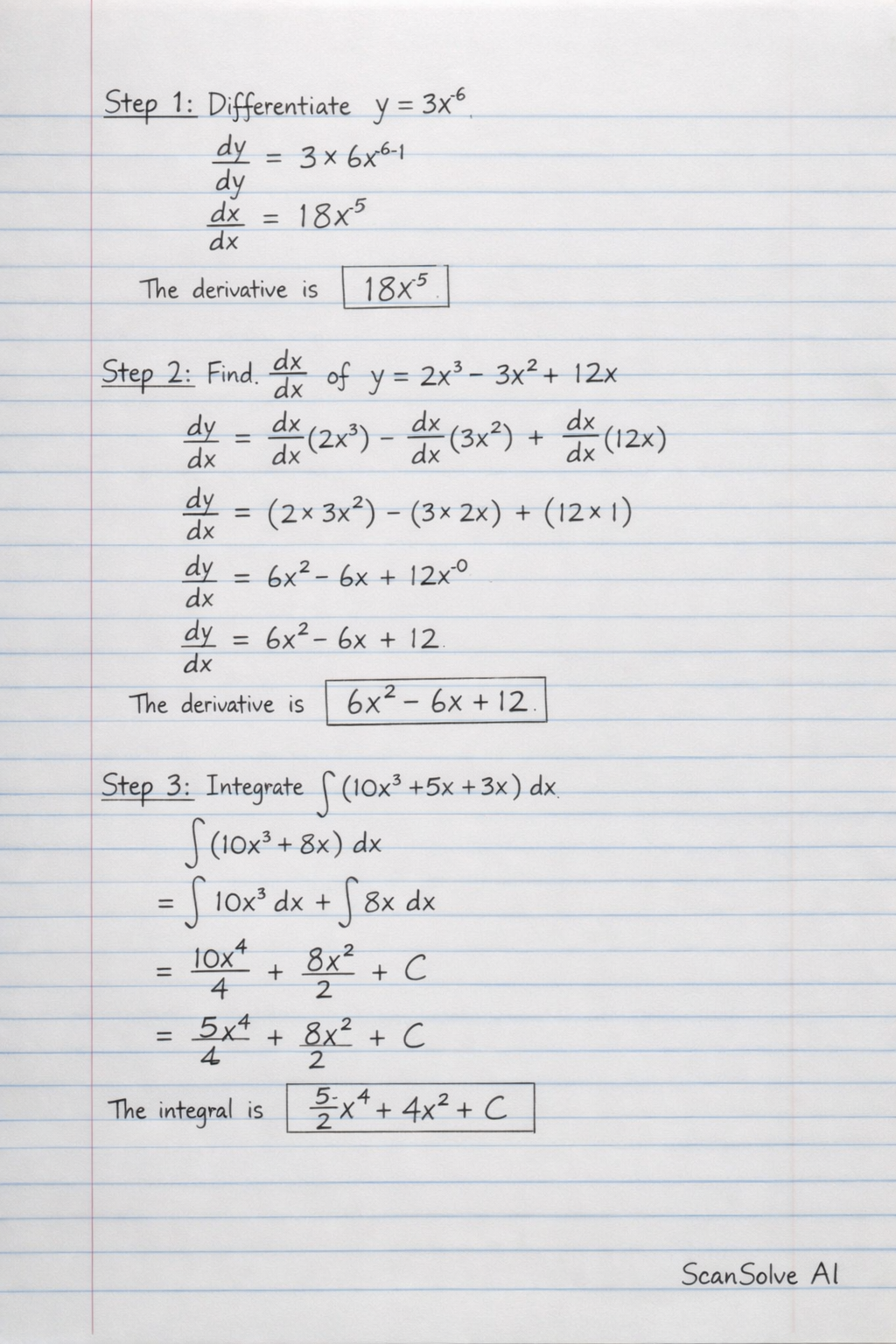
Handwritten Step-by-Step Solution
Get this as a handwritten image on WhatsApp — like a tutor wrote it for you.
Try on WhatsApp