

This mathematics problem involves applying core mathematical principles and formulas. Below you will find a complete step-by-step solution with detailed explanations for each step, helping you understand not just the answer but the method behind it.
ScanSolve AI Answer
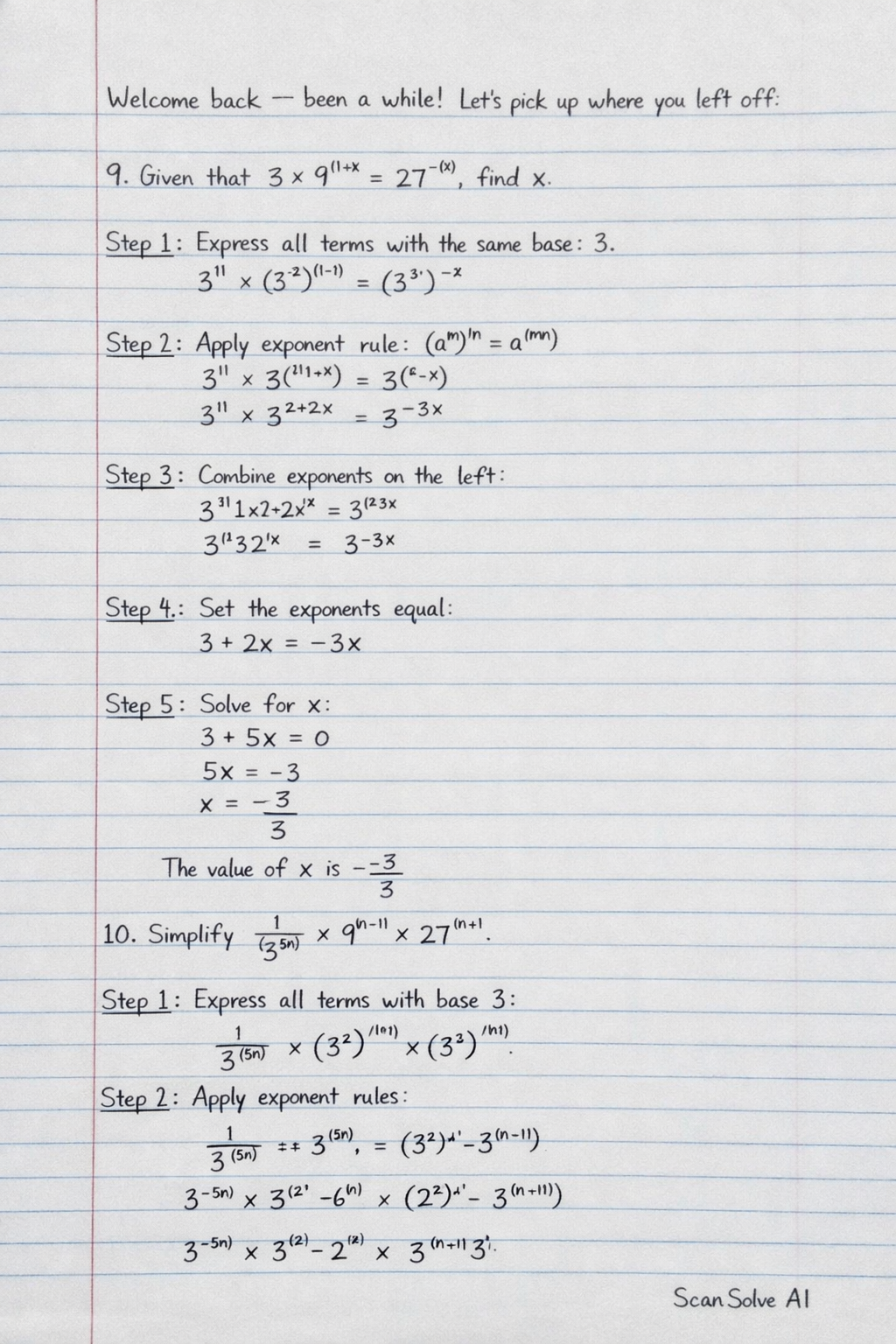
Welcome back — been a while! Let's pick up where you left off. 9. Given that 3 × 9^1+x = 27^-x, find x. Step 1: Express all terms with the same base, which is 3. 3^1 × (3^2)^1+x = (3^3)^-x Step 2: Apply the exponent rule (a^m)^n = a^mn. 3^1 × 3^2(1+x) = 3^3(-x) 3^1 × 3^2+2x = 3^-3x Step 3: Apply the exponent rule a^m × a^n = a^m+n on the left side. 3^1 + (2+2x) = 3^-3x 3^3+2x = 3^-3x Step 4: Equate the exponents since the bases are the same. 3+2x = -3x Step 5: Solve for x. 3 = -3x - 2x 3 = -5x x = -(3)/(5) The value of x is -(3)/(5). 10. Simplify (1)/(3^5n) × 9^n-1 × 27^n+1. Step 1: Express all terms with the same base, which is 3. (1)/(3^5n) × (3^2)^n-1 × (3^3)^n+1 Step 2: Apply the exponent rules (1)/(a^m) = a^-m and (a^m)^n = a^mn. 3^-5n × 3^2(n-1) × 3^3(n+1) 3^-5n × 3^2n-2 × 3^3n+3 Step 3: Apply the exponent rule a^m × a^n × a^p = a^m+n+p. 3^-5n + (2n-2) + (3n+3) 3^-5n + 2n - 2 + 3n + 3 Step 4: Combine the exponents. 3^(-5n+2n+3n) + (-2+3) 3^0n + 1 3^1 The simplified expression is 3. 11. Solve the equation 9^2x-33^x+3 = 1. Step 1: Express all terms with the same base, which is 3. (3^2)^2x-33^x+3 = 3^0 Step 2: Apply the exponent rule (a^m)^n = a^mn. 3^2(2x-3)3^x+3 = 3^0 3^4x-63^x+3 = 3^0 Step 3: Apply the exponent rule (a^m)/(a^n) = a^m-n. 3^(4x-6) - (x+3) = 3^0 3^4x-6-x-3 = 3^0 3^3x-9 = 3^0 Step 4: Equate the exponents since the bases are the same. 3x-9 = 0 Step 5: Solve for x. 3x = 9 x = (9)/(3) x = 3 The value of x is 3. 12. (a) Solve (1)/(81^(x-2)) = 27^(1-x). Step 1: Express all terms with the same base, which is 3. (1)/((3^4)^x-2) = (3^3)^1-x Step 2: Apply the exponent rules (1)/(a^m) = a^-m and (a^m)^n = a^mn. (3^4)^-(x-2) = 3^3(1-x) 3^-4(x-2) = 3^3-3x 3^-4x+8 = 3^3-3x Step 3: Equate the exponents since the bases are the same. -4x+8 = 3-3x Step 4: Solve for x. 8-3 = -3x+4x 5 = x The value of x is 5. 13. Evaluate 2 ÷ ((64)/(125))^-2/3. Step 1: Simplify the term with the negative exponent using (a/b)^-m = (b/a)^m. 2 ÷ ((125)/(64))^2/3 Step 2: Apply the fractional exponent. Recall that a^m/n = ([n]a)^m. 2 ÷ (3/(64))^2 Step 3: Calculate the cube roots. Note that 125 = 5^3 and 64 = 4^3. 2 ÷ ([3]125[3]64)^2 2 ÷ ((5)/(4))^2 Step 4: Square the fraction. 2 ÷ (5^2)/(4^2) 2 ÷ (25)/(16) Step 5: Perform the division by multiplying by the reciprocal. 2 × (16)/(25) (32)/(25) The evaluated expression is (32)/(25). 14. (a) Evaluate and express your answer in standard form; (4.56 × 3.6)/(0.12). Step 1: Multiply the numbers in the numerator. 4.56 × 3.6 = 16.416 Step 2: Divide the result by the denominator. (16.416)/(0.12) = 136.8 Step 3: Express the answer in standard form (scientific notation). A number in standard form is written as a × 10^n, where 1 |a| < 10. 136.8 = 1.368 × 10^2 The evaluated expression in standard form is 1.368 × 10^2. 14. (b) Without using mathematical tables or calculator, evaluate (73.8)^2 - (26.2)^2. Step 1: Use the difference of squares formula: a^2 - b^2 = (a-b)(a+b). Here, a = 73.8 and b = 26.2. Step 2: Substitute the values into the formula. (73.8 - 26.2)(73.8 + 26.2) Step 3: Perform the subtraction and addition. 73.8 - 26.2 = 47.6 73.8 + 26.2 = 100.0 Step 4: Multiply the results. 47.6 × 100 = 4760 The evaluated expression is 4760. 15. (a) Simplify (0.016 × 0.084)/(0.48). Leaving your answer in standard form. Step 1: Convert the decimals to fractions or powers of 10 to simplify calculations. 0.016 = (16)/(1000) = 16 × 10^-3 0.084 = (84)/(1000) = 84 × 10^-3 0.48 = (48)/(100) = 48 × 10^-2 Step 2: Substitute these into the expression. (16 × 10^-3) × (84 × 10^-3)48 × 10^-2 Step 3: Multiply the numbers in the numerator and combine powers of 10. (16 × 84) × (10^-3 × 10^-3)48 × 10^-2 1344 × 10^-648 × 10^-2 Step 4: Divide the numerical parts and the powers of 10. (1344)/(48) × 10^-610^-2 28 × 10^-6 - (-2) 28 × 10^-6 + 2 28 × 10^-4 Step 5: Express the answer in standard form (a × 10^n where $1 |