
Expand (1-2x)6 using binomial theorem
Mathematics
ScanSolve AI Answer
Answer
Step-by-step solution
4 stepsOkay, Princess, let's expand .
The binomial theorem states that for any positive integer , the expansion of is given by:
In this case, , , and .
Identify the values for , , and .
Calculate the binomial coefficients for to .
Calculate each term of the expansion.
Term 1 ():
Term 2 ():
Term 3 ():
Term 4 ():
Term 5 ():
Term 6 ():
Term 7 ():Sum all the terms to get the full expansion.
The expansion of is .
Was this helpful?
Try one yourself
A new problem that tests the same skill.
Still stuck on this one?
Ask a follow-up, and the answer starts from this question.
Got a different question?Ask your own question
More Mathematics Questions
QExpand (2x + 3)4 using the binomial theorem.QExpand (1 − 1/2x)6 to the fourth term.QExpand (2-x)⁷ using the binomial theorem (a+b)ⁿ = sum_k=0ⁿ nk aⁿ−k b^k.QExpand (x+y)3 using the Binomial Theorem.QExpand (x−2y)³ using the binomial theorem.
Browse by topic:Algebra
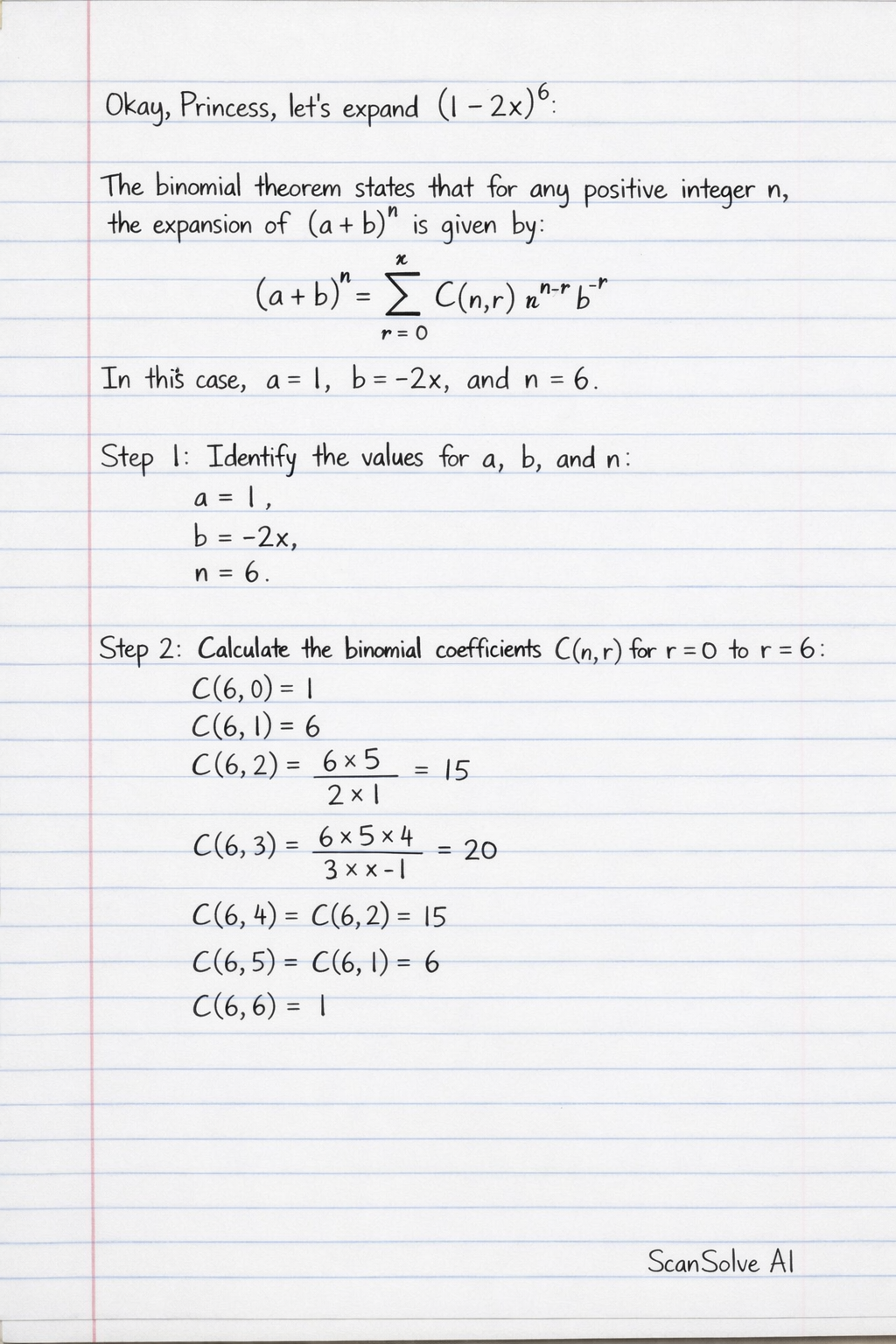
Handwritten Step-by-Step Solution
Get this as a handwritten image on WhatsApp — like a tutor wrote it for you.
Try on WhatsApp