

This mathematics problem involves applying core mathematical principles and formulas. Below you will find a complete step-by-step solution with detailed explanations for each step, helping you understand not just the answer but the method behind it.
ScanSolve AI Answer
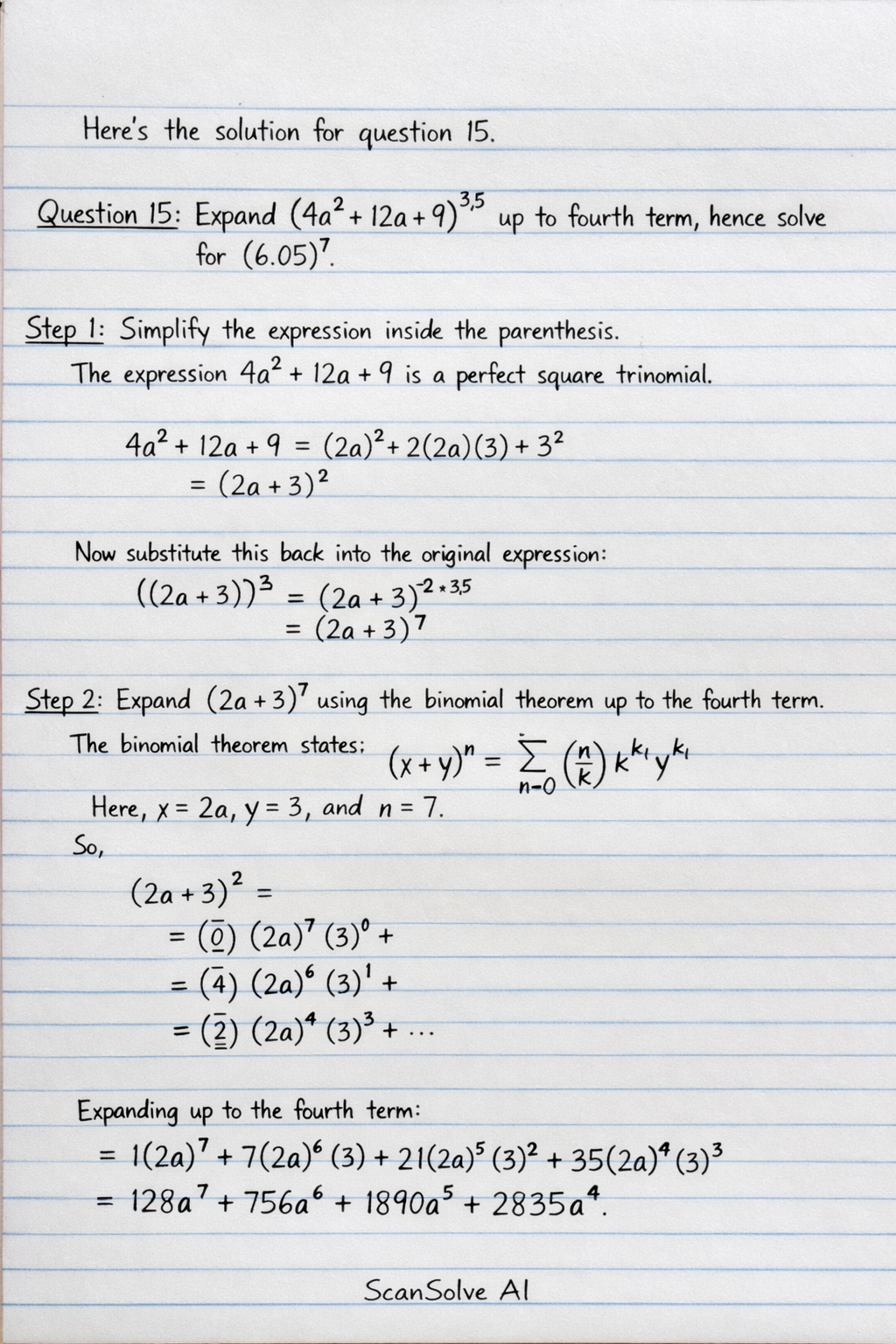
Here's the solution for question 15. Question 15: Expand (4a^2 + 12a + 9)^3.5 up to fourth term, hence solve for (6.05)^7. Step 1: Simplify the expression inside the parenthesis. The expression 4a^2 + 12a + 9 is a perfect square trinomial. 4a^2 + 12a + 9 = (2a)^2 + 2(2a)(3) + 3^2 = (2a + 3)^2 Now substitute this back into the original expression: ( (2a + 3)^2 )^3.5 = (2a + 3)^2 × 3.5 = (2a + 3)^7 Step 2: Expand (2a + 3)^7 using the binomial theorem up to the fourth term. The binomial theorem states that (x + y)^n = _k=0^n nk x^n-k y^k. Here, x = 2a, y = 3, and n = 7. The first term (k=0): T_1 = 70 (2a)^7-0 (3)^0 = 1 · (2a)^7 · 1 = 128a^7 The second term (k=1): T_2 = 71 (2a)^7-1 (3)^1 = 7 · (2a)^6 · 3 = 7 · 64a^6 · 3 = 1344a^6 The third term (k=2): T_3 = 72 (2a)^7-2 (3)^2 = (7 × 6)/(2 × 1) · (2a)^5 · 9 = 21 · 32a^5 · 9 = 6048a^5 The fourth term (k=3): T_4 = 73 (2a)^7-3 (3)^3 = (7 × 6 × 5)/(3 × 2 × 1) · (2a)^4 · 27 = 35 · 16a^4 · 27 = 15120a^4 The expansion up to the fourth term is: 128a^7 + 1344a^6 + 6048a^5 + 15120a^4 + Step 3: Solve for (6.05)^7 using the binomial expansion method. To solve for (6.05)^7, we can write it as (6 + 0.05)^7. This is in the form (x+y)^n where x=6, y=0.05, and n=7. Since y is a small value, the first few terms of the expansion will give a good approximation. First term: T_1 = 70 (6)^7 (0.05)^0 = 1 · 279936 · 1 = 279936 Second term: T_2 = 71 (6)^6 (0.05)^1 = 7 · 46656 · 0.05 = 7 · 2332.8 = 16329.6 Third term: T_3 = 72 (6)^5 (0.05)^2 = 21 · 7776 · 0.0025 = 21 · 19.44 = 408.24 Fourth term: T_4 = 73 (6)^4 (0.05)^3 = 35 · 1296 · 0.000125 = 35 · 0.162 = 5.67 Step 4: Sum the first four terms to approximate (6.05)^7. (6.05)^7 ≈ 279936 + 16329.6 + 408.24 + 5.67 = 296679.51 The expansion up to the fourth term is 128a^7 + 1344a^6 + 6048a^5 + 15120a^4. The value of (6.05)^7 is approximately 296679.51. Expansion: 128a^7 + 1344a^6 + 6048a^5 + 15120a^4; Value of (6.05)^7 ≈ 296679.51