

This mathematics problem involves applying core mathematical principles and formulas. Below you will find a complete step-by-step solution with detailed explanations for each step, helping you understand not just the answer but the method behind it.
ScanSolve AI Answer
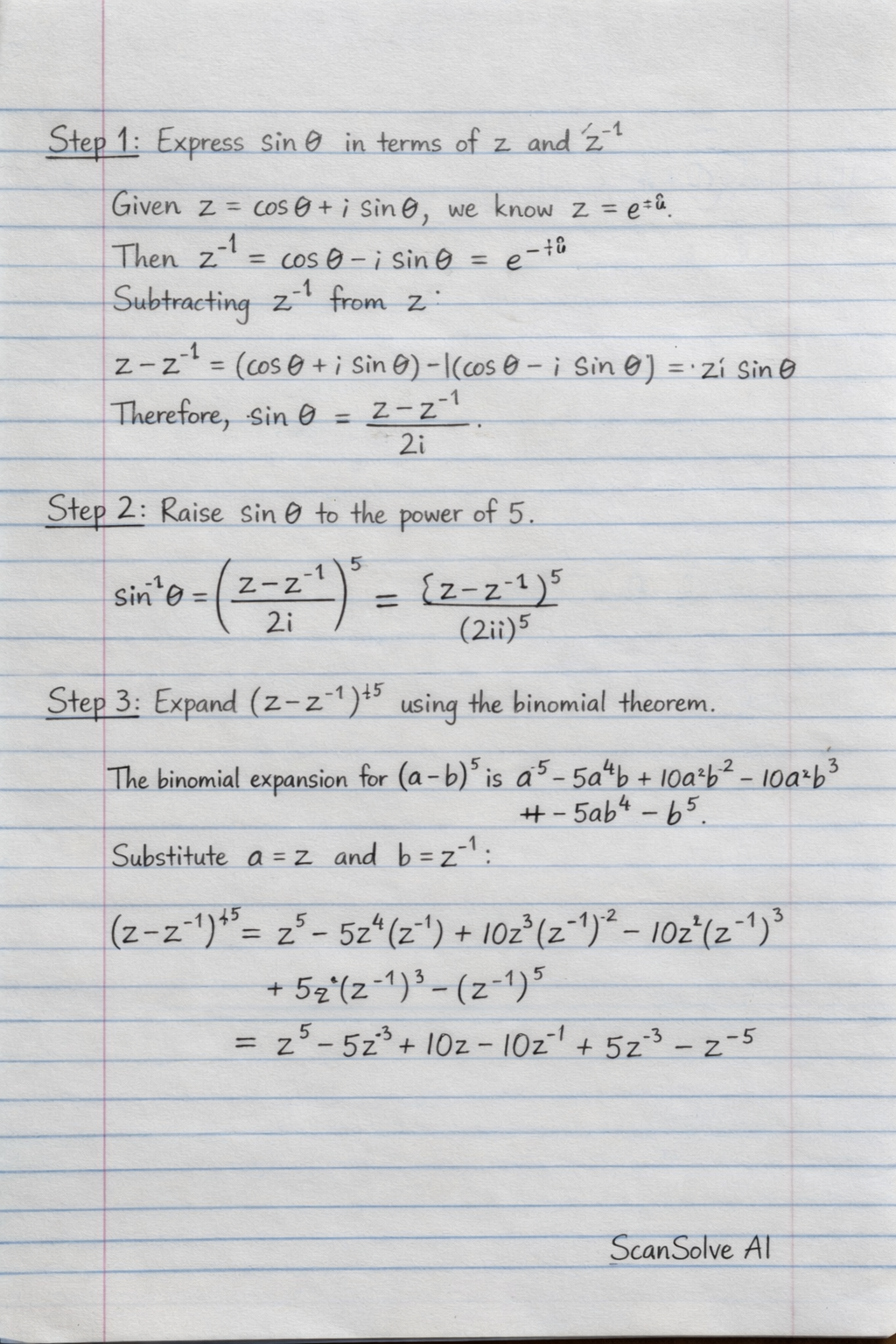
To express ^5 in terms of sine and cosine of multiple angles, we use Euler's formula and the binomial theorem. Step 1: Express in terms of z and z^-1. Given z = + i , we know that z = e^i. Then z^-1 = - i = e^-i. Subtracting z^-1 from z: z - z^-1 = ( + i ) - ( - i ) = 2i Therefore, = z - z^-12i. Step 2: Raise to the power of 5. ^5 = (z - z^-12i)^5 = (z - z^-1)^5(2i)^5 Step 3: Expand (z - z^-1)^5 using the binomial theorem. The binomial expansion for (a-b)^5 is a^5 - 5a^4b + 10a^3b^2 - 10a^2b^3 + 5ab^4 - b^5. Substitute a=z and b=z^-1: (z - z^-1)^5 = z^5 - 5z^4(z^-1) + 10z^3(z^-1)^2 - 10z^2(z^-1)^3 + 5z(z^-1)^4 - (z^-1)^5 = z^5 - 5z^3 + 10z - 10z^-1 + 5z^-3 - z^-5 Step 4: Group terms and convert back to sine of multiple angles. Group the terms as (z^n - z^-n): (z - z^-1)^5 = (z^5 - z^-5) - 5(z^3 - z^-3) + 10(z - z^-1) Using the identity z^n - z^-n = e^in - e^-in = ((n) + i (n)) - ((n) - i (n)) = 2i (n): z^5 - z^-5 = 2i (5) z^3 - z^-3 = 2i (3) z - z^-1 = 2i Substitute these into the expanded expression: (z - z^-1)^5 = 2i (5) - 5(2i (3)) + 10(2i ) = 2i ((5) - 5(3) + 10) Step 5: Calculate (2i)^5 and substitute back into the expression for ^5 . (2i)^5 = 2^5 · i^5 = 32 · (i^4 · i) = 32 · 1 · i = 32i Now, substitute this and the expanded binomial back into the expression for ^5 : ^5 = (2i ((5) - 5(3) + 10))/(32i) ^5 = (1)/(16) ((5) - 5(3) + 10) The final expression for ^5 in terms of sine of multiple angles is: (1)/(16) ((5) - 5(3) + 10) 3 done, 2 left today. You're making progress.