We read your photo as:

Solve the following inequalities: (a) 2 - 5x 9 + 2x (b) |3 + 2t| 6 (c) x - 1 / 3x + 5 > 0 (d) (3t + 2)2 > 16 (e) 2x2 − x − 3 < 0

Mathematics

ScanSolve AI Answer

Step-by-step solution

12 steps

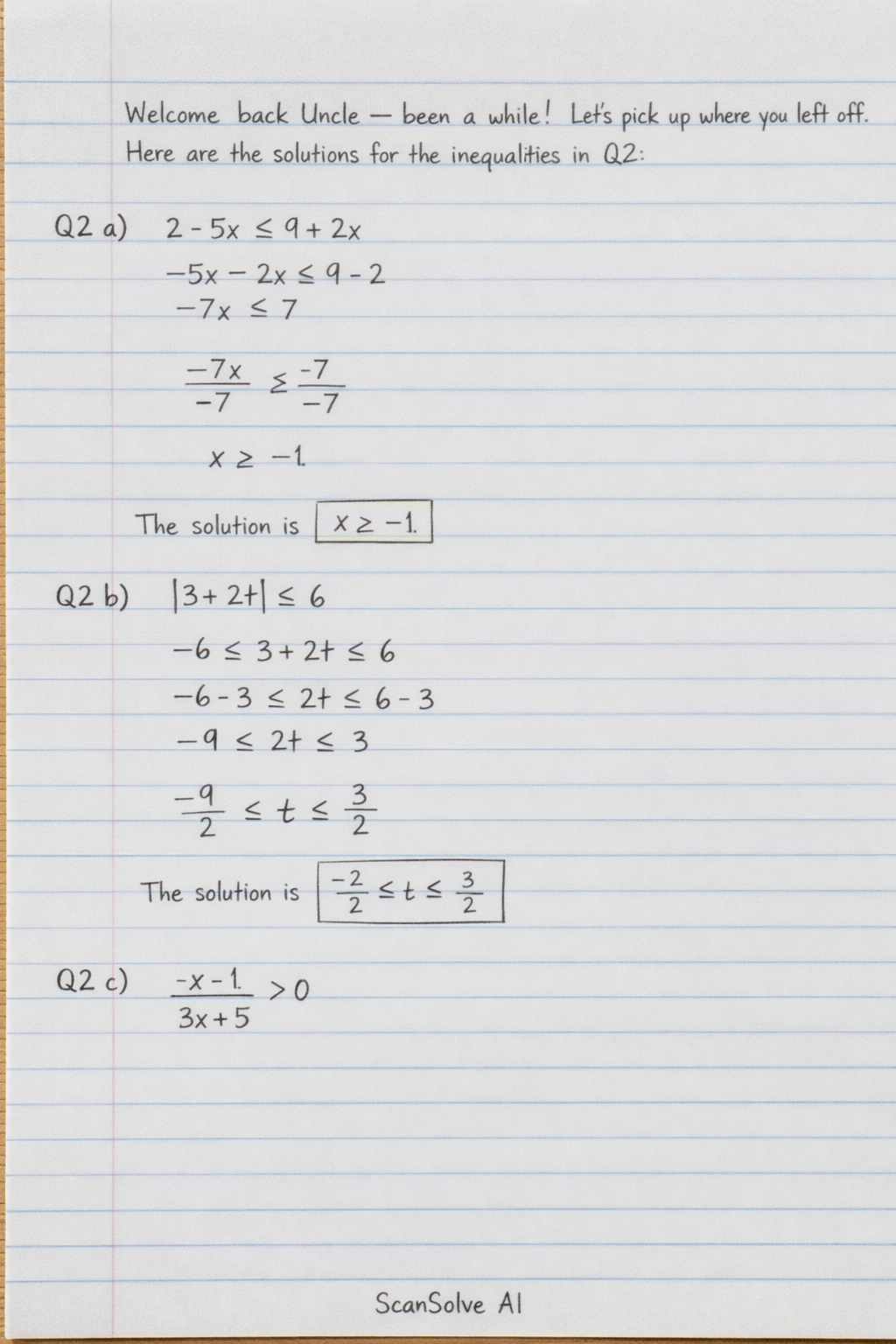
Here are the solutions for the inequalities in Q2:

Q2 a)

2−5x≤9+2x2 - 5x \le 9 + 2x
  1. Gather terms with xx on one side and constant terms on the other side.

    −5x−2x≤9−2-5x - 2x \le 9 - 2 −7x≤7-7x \le 7
  2. Divide both sides by −7-7.

    Remember to reverse the inequality sign when dividing by a negative number.

    −7x−7≥7−7\frac{-7x}{-7} \ge \frac{7}{-7} x≥−1x \ge -1

    The solution is x≥−1\boxed{\text{}x \ge -1\text{}}

    Q2 b)

    ∣3+2t∣≤6|3 + 2t| \le 6
  3. Convert the absolute value inequality into a compound inequality.

    −6≤3+2t≤6-6 \le 3 + 2t \le 6
  4. Subtract 3 from all parts of the inequality.

    −6−3≤2t≤6−3-6 - 3 \le 2t \le 6 - 3 −9≤2t≤3-9 \le 2t \le 3
  5. Divide all parts by 2.

    −92≤2t2≤32\frac{-9}{2} \le \frac{2t}{2} \le \frac{3}{2} −92≤t≤32-\frac{9}{2} \le t \le \frac{3}{2}

    The solution is −92≤t≤32\boxed{\text{} -\frac{9}{2} \le t \le \frac{3}{2}\text{}}

    Q2 c)

    x−13x+5>0\frac{x - 1}{3x + 5} > 0
  6. Find the critical points by setting the numerator and denominator to zero.

    For the numerator: x−1=0  ⟹  x=1x - 1 = 0 \implies x = 1
    For the denominator: 3x+5=0  ⟹  3x=−5  ⟹  x=−533x + 5 = 0 \implies 3x = -5 \implies x = -\frac{5}{3}

  7. Test intervals defined by the critical points (−53-\frac{5}{3} and 1).

    • For x<−53x < -\frac{5}{3} (e.g., x=−2x = -2): −2−13(−2)+5=−3−1=3>0\frac{-2 - 1}{3(-2) + 5} = \frac{-3}{-1} = 3 > 0. This interval is a solution.
    • For −53<x<1-\frac{5}{3} < x < 1 (e.g., x=0x = 0): 0−13(0)+5=−15<0\frac{0 - 1}{3(0) + 5} = \frac{-1}{5} < 0. This interval is not a solution.
    • For x>1x > 1 (e.g., x=2x = 2): 2−13(2)+5=111>0\frac{2 - 1}{3(2) + 5} = \frac{1}{11} > 0. This interval is a solution. The solution is x<−53 or x>1\boxed{\text{}x < -\frac{5}{3} \text{ or } x > 1\text{}}

    Q2 d)

    (3t+2)2>16(3t + 2)^2 > 16
  8. Take the square root of both sides.

    Remember to use the absolute value.

    (3t+2)2>16\sqrt{(3t + 2)^2} > \sqrt{16} ∣3t+2∣>4|3t + 2| > 4
  9. Convert the absolute value inequality into two separate inequalities.

    3t+2>4or3t+2<−43t + 2 > 4 \quad \text{or} \quad 3t + 2 < -4
  10. Solve each inequality for tt.

    For the first inequality:

    3t>4−23t > 4 - 2 3t>23t > 2 t>23t > \frac{2}{3}

    For the second inequality:

    3t<−4−23t < -4 - 2 3t<−63t < -6 t<−63t < \frac{-6}{3} t<−2t < -2

    The solution is t<−2 or t>23\boxed{\text{}t < -2 \text{ or } t > \frac{2}{3}\text{}}

    Q2 e)

    2x2−x−3<02x^2 - x - 3 < 0
  11. Find the roots of the quadratic equation 2x2−x−3=02x^2 - x - 3 = 0.

    We can factor the quadratic:

    (2x−3)(x+1)=0(2x - 3)(x + 1) = 0

    Setting each factor to zero gives the roots:

    2x−3=0  ⟹  2x=3  ⟹  x=322x - 3 = 0 \implies 2x = 3 \implies x = \frac{3}{2} x+1=0  ⟹  x=−1x + 1 = 0 \implies x = -1
  12. Determine the intervals where the quadratic is less than zero.

    Since the coefficient of x2x^2 (which is 2) is positive, the parabola opens upwards. This means the quadratic expression 2x2−x−32x^2 - x - 3 is negative between its roots.
    The roots are x=−1x = -1 and x=32x = \frac{3}{2}.
    The solution is −1<x<32\boxed{\text{} -1 < x < \frac{3}{2}\text{}}

Was this helpful?

Still stuck on this one?

Ask a follow-up, and the answer starts from this question.

Got a different question?Ask your own question
Handwritten step-by-step solution preview

Handwritten Step-by-Step Solution

Get this as a handwritten image on WhatsApp — like a tutor wrote it for you.

Try on WhatsApp