
We read your photo as:
Resolve the following into partial fractions (a) (x-11)/(x2-x-2) (b) (3-x)/((x2+3)(x+3)) (c) (x3-6x+9)/(x2+x-2)
ScanSolve AI Answer
Step-by-step solution
19 stepsHere's the solution for Question Q1:
Q1 a)
We need to resolve into partial fractions.
Factor the denominator.
Set up the partial fraction decomposition.
Since the denominator has distinct linear factors, we write:
Combine the fractions on the right side.
Equate the numerators.
Solve for A and B by substituting values for .
Let :
Let :
Write the partial fraction decomposition.
The partial fraction decomposition is
Q1 b)
We need to resolve into partial fractions.
Identify the types of factors in the denominator.
The denominator has an irreducible quadratic factor () and a linear factor ().
Set up the partial fraction decomposition.
Combine the fractions on the right side.
Equate the numerators.
Solve for A, B, and C.
Let :
Expand the equation and group terms by powers of :
Compare coefficients:
Coefficient of :
Since , then .
Coefficient of :
Substitute :(Check constant term: . This is consistent.)
Write the partial fraction decomposition.
The partial fraction decomposition is
Q1 c)
We need to resolve into partial fractions.
Perform polynomial long division because the degree of the numerator (3) is greater than the degree of the denominator (2).
So, .
Factor the denominator of the remainder term.
Set up the partial fraction decomposition for the remainder term.
Combine the fractions on the right side.
Equate the numerators.
Solve for A and B by substituting values for .
Let :
Let :
Write the complete partial fraction decomposition.
The partial fraction decomposition is
Still stuck on this one?
Ask a follow-up, and the answer starts from this question.
More Mathematics Questions
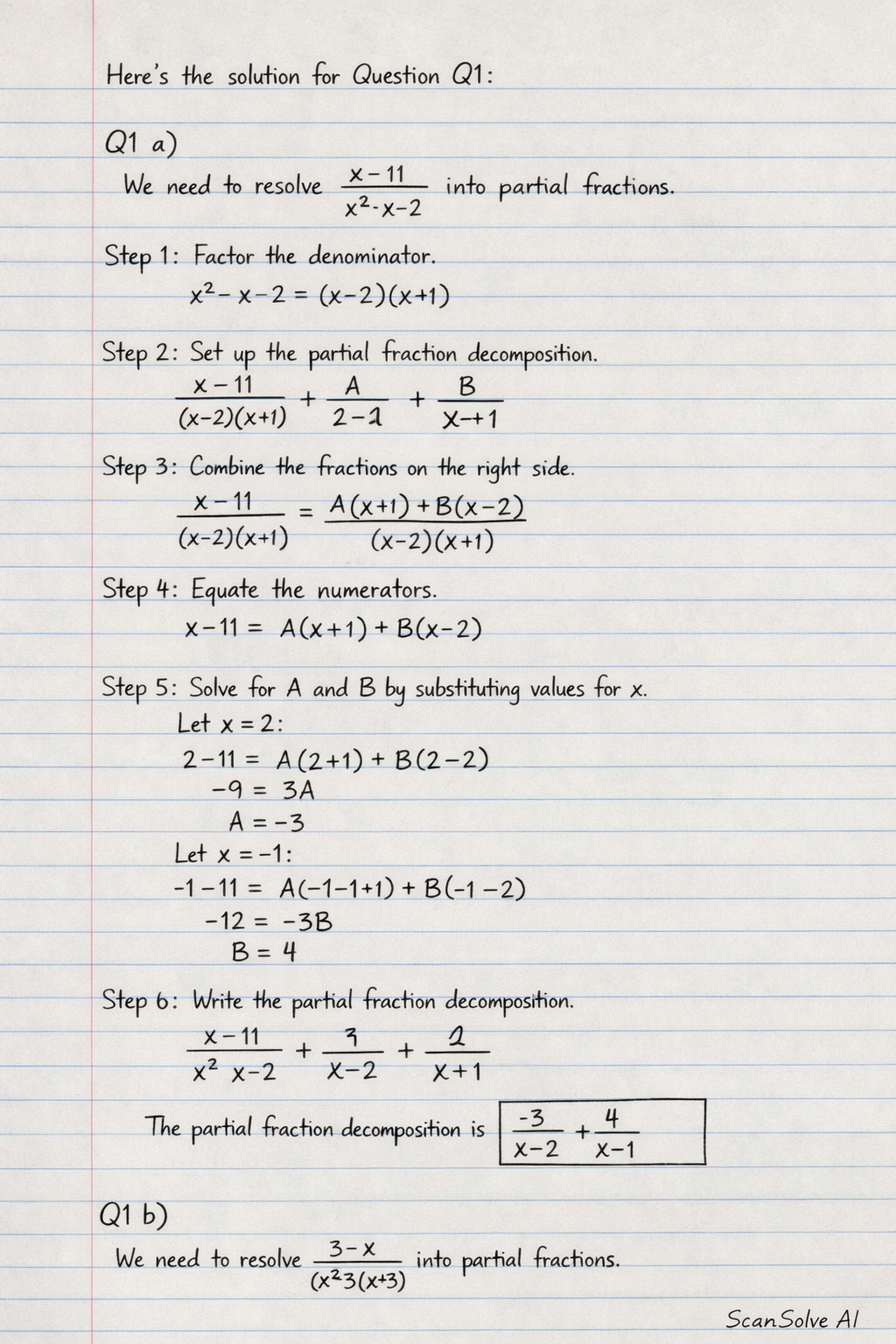
Handwritten Step-by-Step Solution
Get this as a handwritten image on WhatsApp — like a tutor wrote it for you.
Try on WhatsApp