Solve the following integration problems: i) integral (x+1)sqrt(2x+x2)\,dx ii) integral01 t t\,dt
|Mathematics
Solve the following integration problems: i) integral (x+1)sqrt(2x+x2)\,dx ii) integral01 t t\,dt
ScanSolve AI Answer
Answer
31(2x+x2)3/2+C
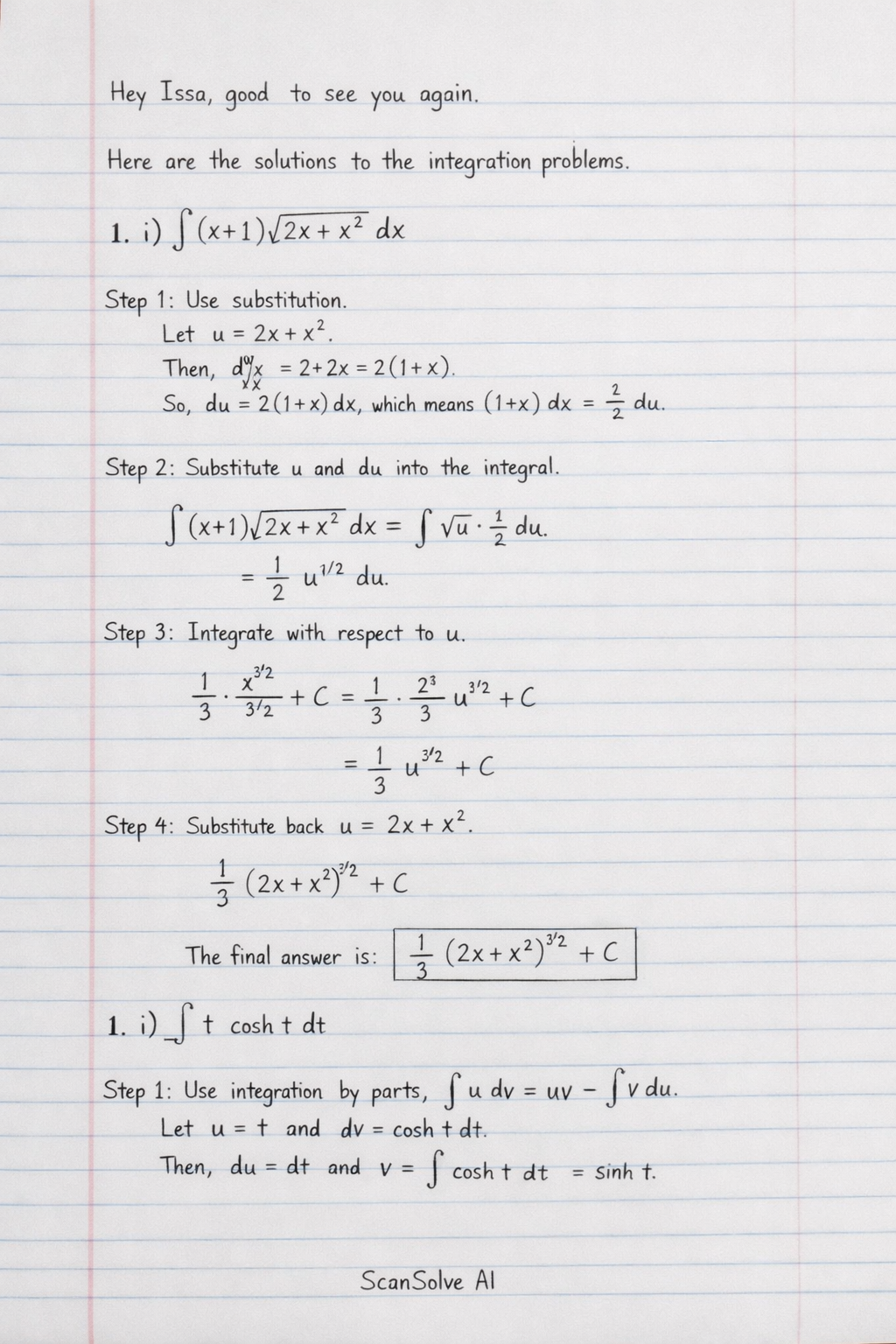
Hey Issa, good to see you again.
Here are the solutions to the integration problems.
1. i) ∫(x+1)2x+x2dx
Step 1: Use substitution.
Let u=2x+x2.
Then, differentiate u with respect to x:
dxdu=2+2x=2(1+x)
So, du=2(1+x)dx, which means (1+x)dx=21du.
Step 2: Substitute u and du into the integral.
∫(x+1)2x+x2dx=∫u⋅21du=21∫u1/2du
Step 3: Integrate with respect to u.
21⋅1/2+1u1/2+1+C=21⋅3/2u3/2+C=21⋅32u3/2+C=31u3/2+C
Step 4: Substitute back u=2x+x2.
31(2x+x2)3/2+C
The final answer is 31(2x+x2)3/2+C.
1. ii) ∫01tcoshtdt
Step 1: Use integration by parts, ∫udv=uv−∫vdu.
Let u=t and dv=coshtdt.
Then, du=dt and v=∫coshtdt=sinht.
Step 2: Apply the integration by parts formula.
∫tcoshtdt=tsinht−∫sinhtdt=tsinht−cosht+C
Step 3: Evaluate the definite integral from 0 to 1.
[tsinht−cosht]01=(1⋅sinh1−cosh1)−(0⋅sinh0−cosh0)
We know that sinh0=0 and cosh0=1.
=(sinh1−cosh1)−(0−1)=sinh1−cosh1+1
Using the definitions sinhx=2ex−e−x and coshx=2ex+e−x:
sinh1−cosh1=2e1−e−1−2e1+e−1=2e−e−1−e−e−1=2−2e−1=−e−1
So, the expression becomes:
−e−1+1
The final answer is 1−e−1.
2. i) ∫x2sec2(1/x)dx
Step 1: Use substitution.
Let u=x1=x−1.
Then, differentiate u with respect to x:
dxdu=−1⋅x−2=−x21
So, du=−x21dx, which means x21dx=−du.
Step 2: Substitute u and du into the integral.
∫x2sec2(1/x)dx=∫sec2(u)(−du)=−∫sec2(u)du
Step 3: Integrate with respect to u.
−tanu+C
Step 4: Substitute back u=1/x.
−tan(1/x)+C
The final answer is −tan(1/x)+C.
2. ii) ∫xsin(lnx)dx
Step 1: Use substitution.
Let u=lnx.
Then, differentiate u with respect to x:
dxdu=x1
So, du=x1dx.
Step 2: Substitute u and du into the integral.
∫xsin(lnx)dx=∫sin(u)du
Step 3: Integrate with respect to u.
−cosu+C
Step 4: Substitute back u=lnx.
−cos(lnx)+C
The final answer is −cos(lnx)+C.
Send me the next one 📸
Was this helpful?
Need help with your own homework?
Get instant step-by-step solutions to any question. Free to start.
This mathematics problem involves applying core mathematical principles and formulas. Below you will find a complete step-by-step solution with detailed explanations for each step, helping you understand not just the answer but the method behind it.
ScanSolve AI Answer
Hey Issa, good to see you again. Here are the solutions to the integration problems. 1. i) (x+1)sqrt(2x+x^2)\,dx Step 1: Use substitution. Let u = 2x+x^2. Then, differentiate u with respect to x: (du)/(dx) = 2 + 2x = 2(1+x) So, du = 2(1+x)\,dx, which means (1+x)\,dx = (1)/(2)\,du. Step 2: Substitute u and du into the integral. (x+1)sqrt(2x+x^2)\,dx = sqrt(u) · (1)/(2)\,du = (1)/(2) u^1/2\,du Step 3: Integrate with respect to u. (1)/(2) · u^1/2+11/2+1 + C = (1)/(2) · u^3/23/2 + C = (1)/(2) · (2)/(3) u^3/2 + C = (1)/(3) u^3/2 + C Step 4: Substitute back u = 2x+x^2. (1)/(3) (2x+x^2)^3/2 + C The final answer is (1)/(3) (2x+x^2)^3/2 + C. 1. ii) _0^1 t t\,dt Step 1: Use integration by parts, u\,dv = uv - v\,du. Let u = t and dv = t\,dt. Then, du = dt and v = t\,dt = t. Step 2: Apply the integration by parts formula. t t\,dt = t t - t\,dt = t t - t + C Step 3: Evaluate the definite integral from 0 to 1. [t t - t]_0^1 = (1 · 1 - 1) - (0 · 0 - 0) We know that 0 = 0 and 0 = 1. = ( 1 - 1) - (0 - 1) = 1 - 1 + 1 Using the definitions x = e^x - e^-x2 and x = e^x + e^-x2: 1 - 1 = e^1 - e^-12 - e^1 + e^-12 = e - e^-1 - e - e^-12 = -2e^-12 = -e^-1 So, the expression becomes: -e^-1 + 1 The final answer is 1 - e^-1. 2. i) (^2(1/x))/(x^2)\,dx Step 1: Use substitution. Let u = (1)/(x) = x^-1. Then, differentiate u with respect to x: (du)/(dx) = -1 · x^-2 = -(1)/(x^2) So, du = -(1)/(x^2)\,dx, which means (1)/(x^2)\,dx = -du. Step 2: Substitute u and du into the integral. (^2(1/x))/(x^2)\,dx = ^2(u) (-du) = - ^2(u)\,du Step 3: Integrate with respect to u. u + C Step 4: Substitute back u = 1/x. -(1/x) + C The final answer is -(1/x) + C. 2. ii) (( x))/(x)\,dx Step 1: Use substitution. Let u = x. Then, differentiate u with respect to x: (du)/(dx) = (1)/(x) So, du = (1)/(x)\,dx. Step 2: Substitute u and du into the integral. (( x))/(x)\,dx = (u)\,du Step 3: Integrate with respect to u. u + C Step 4: Substitute back u = x. -( x) + C The final answer is -( x) + C. Send me the next one 📸