
We read your photo as:
Solve the following polynomial problem: a) Find the quotient and remainder when P(x) is divided by D(x). b) Factorize P(x) completely. c) Solve P(x) = 0. d) Solve the general cubic equation using the
Mathematics
ScanSolve AI Answer
To solve these types of polynomial problems, you apply specific algebraic techniques for each part.
a) Finding the Quotient and Remainder:
- Method: Use polynomial long division. This systematic process involves dividing the leading term of the dividend by the leading term of the divisor to find the first term of the quotient, multiplying that term by the divisor, subtracting the result from the dividend, and then bringing down the next term. You repeat these steps until the degree of the remainder is less than the degree of the divisor.
b) Factorizing Completely:
- Method: If the division in part (a) yields a zero remainder, then the divisor and the quotient are factors of the original polynomial. If the quotient is a quadratic expression (e.g., ), factor it further into linear terms. This can be done by finding two numbers that multiply to and add to , or by using the quadratic formula.
c) Solving :
- Method: Once the polynomial is completely factored into linear expressions (e.g., ), set each linear factor equal to zero and solve for . Each solution is a root of the polynomial.
d) Solving a general cubic equation:
- Method:
- Use the Rational Root Theorem to identify potential rational roots. This theorem states that any rational root must have as a factor of the constant term and as a factor of the leading coefficient.
- Test these potential roots by substituting them into the polynomial until you find one that makes the polynomial equal to zero. This value of is a root, and is a linear factor.
- Perform synthetic division (or long division) using this linear factor to divide the cubic polynomial. The result will be a quadratic expression.
- Solve the resulting quadratic equation by factoring or using the quadratic formula to find the remaining two roots.
You can refer to my previous message for the step-by-step application of these methods to your specific problem.
Was this helpful?
Still stuck on this one?
Ask a follow-up, and the answer starts from this question.
Got a different question?Ask your own question
More Mathematics Questions
QA cubic polynomial is defined by f(x) = 4x3 - 7x − 3. Find the remainder when f(x) is divided by…QA polynomial P(x) of degree 3 is divided by (2x−1)(x−3) and the remainder is 12x−8. If P(x) is…QSolve the following problems: (a) Find x in the proportion p3 + pq + q2 : x :: p3 - q3 : (p-q)2. (b)…QFind the remainder when P(x) = 3x4 - 2x3 + 5x − 7 is divided by x+1. Let P(x) = x3 + ax2 + bx + c…QGiven the polynomial P(x) = 2x3 - 5x2 - 19x + 42, find the quotient and remainder when P(x) is…
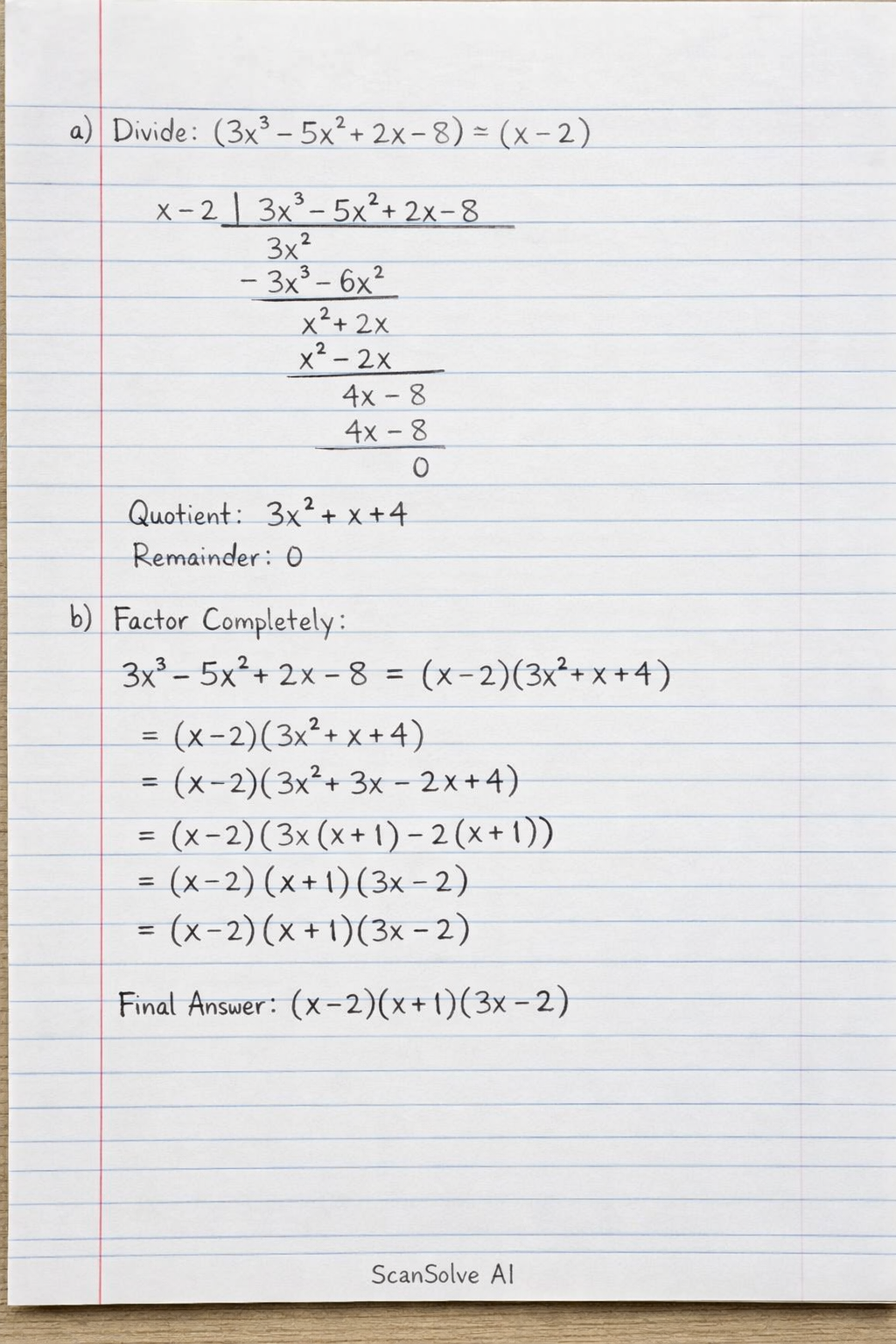
Handwritten Step-by-Step Solution
Get this as a handwritten image on WhatsApp — like a tutor wrote it for you.
Try on WhatsApp